
Authorization Artifacts as a Runtime Trust Standard
- 11/11 AI

- May 10
- 3 min read

Establishing Cryptographic Trust Before Execution
Modern infrastructure increasingly depends upon runtime trust.
AI systems, autonomous agents and distributed execution environments now operate across environments where execution itself becomes the trust boundary.
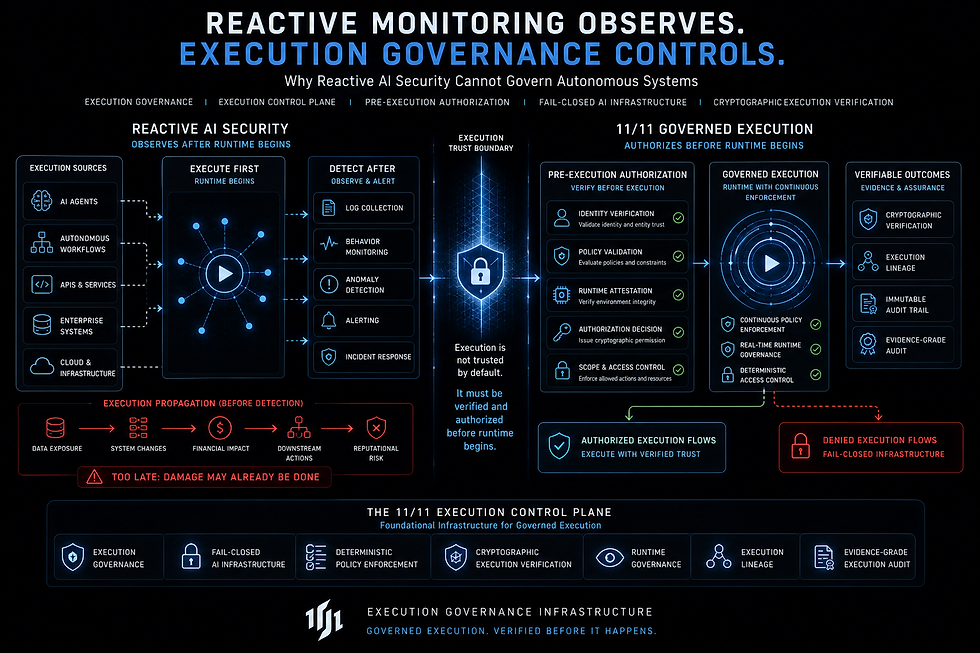
Historically, systems largely trusted execution implicitly.
If execution was requested, execution proceeded.
Verification often occurred later.
That operational model is becoming structurally insufficient.
Execution governance introduces a different trust architecture.
Execution is no longer trusted by default.
Execution must first be authorized.
This requirement establishes authorization artifacts as foundational runtime trust infrastructure.
What Authorization Artifacts Are
Authorization artifacts are cryptographically verifiable runtime trust objects.
They establish whether execution is authorized before runtime activity begins.
Authorization artifacts may include:
execution scope
initiator identity
runtime environment binding
policy validation state
authorization timestamp
expiration window
cryptographic signatures
execution constraints
operational attribution
governance metadata
Authorization artifacts therefore function as:runtime execution permits.
Execution should not occur without them.
Why Authorization Artifacts Matter
Traditional infrastructure often relies on open execution assumptions.
If a request reaches runtime infrastructure, execution is typically permitted automatically.
This creates dangerous operational assumptions for:
enterprise AI
autonomous systems
financial execution environments
healthcare infrastructure
distributed orchestration systems
machine-to-machine coordination
critical infrastructure automation
Authorization artifacts change this model.
Execution becomes conditional upon verifiable authorization.
This establishes:governed execution.
Pre-Execution Authorization
Authorization artifacts support pre-execution authorization.
Before execution occurs:
policy is evaluated
identity is verified
runtime integrity is validated
environmental trust is checked
governance rules are enforced
authorization is cryptographically issued
Only then may execution proceed.
This creates deterministic runtime trust.
Authorization Artifacts and Fail-Closed Infrastructure
Authorization artifacts are foundational to fail-closed infrastructure.
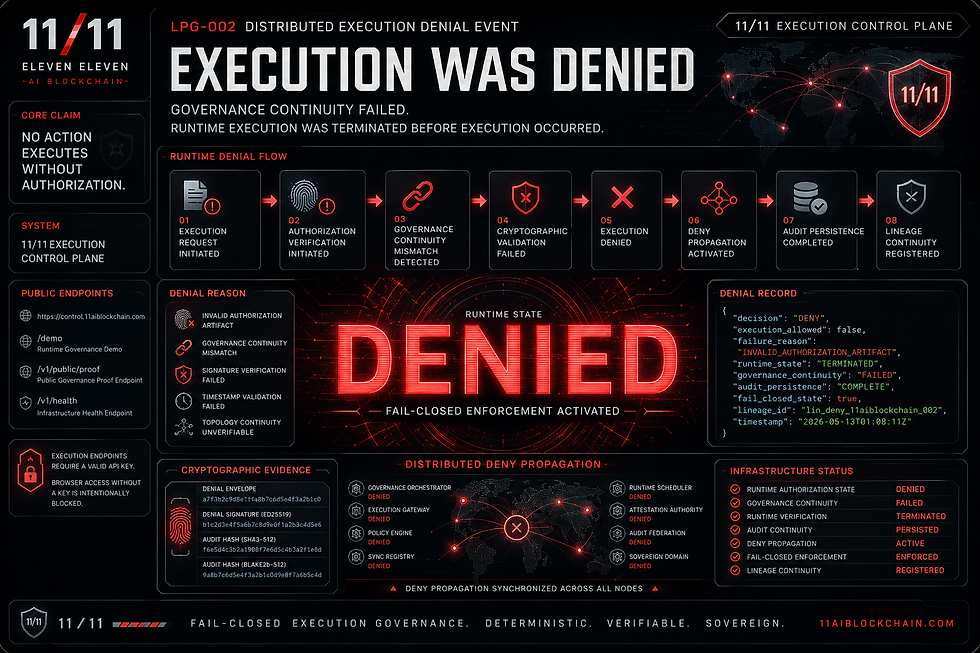
Fail-closed systems deny execution when authorization cannot be verified.
Denial conditions may include:
missing authorization artifact
invalid signature verification
expired authorization
policy mismatch
replay detection
revoked authorization
environmental integrity failure
execution scope mismatch
Failure to verify therefore results in denial.
Not warning.Not deferred audit.Not observation.
Denial.
This transforms runtime trust into an enforceable infrastructure capability.
Cryptographic Verification
Authorization artifacts establish cryptographic runtime verification.
Verification systems may validate:
digital signatures
execution scope integrity
temporal validity
runtime environment binding
policy hash consistency
authorization origin
revocation state
execution lineage relationships
This enables:
evidence-grade verification
immutable execution audit
operational attribution
forensic validation
runtime accountability
Execution therefore becomes:cryptographically governed.
Runtime Trust Architecture
Authorization artifacts establish a formal runtime trust architecture.
This architecture may include:
policy authorities
authorization services
verification engines
runtime gateways
governance meshes
lineage systems
immutable audit infrastructure
Together these systems form:the execution control plane.
Authorization artifacts function as trust anchors across this infrastructure layer.
Execution Lineage
Authorization artifacts also support execution lineage.
Execution lineage establishes traceable ancestry across runtime operations.
Lineage systems may track:
authorization source
execution origin
runtime inheritance
policy authority relationships
verification states
governance dependencies
This creates operational traceability across distributed systems.
Execution therefore becomes:
attributable
verifiable
auditable
lineage-aware
governance-capable
Autonomous Systems Require Authorization
Autonomous systems significantly increase the importance of authorization artifacts.
As AI systems begin independently coordinating:
infrastructure operations
orchestration workflows
financial execution
distributed automation
machine-level decision systems
runtime trust becomes existentially important.
Autonomous systems cannot safely rely upon open execution assumptions.
They require governed execution environments with mandatory authorization validation.
Authorization artifacts therefore become foundational infrastructure for autonomous runtime systems.
Authorization as Infrastructure
Historically, authorization was treated primarily as an application feature.
Execution governance changes that assumption.
Authorization increasingly becomes:
infrastructure-native
runtime-enforced
cryptographically verifiable
operationally attributable
policy-bound
evidence-capable
Authorization therefore evolves into:core infrastructure architecture.
Infrastructure Is Evolving
Infrastructure historically normalized:
encrypted transport
identity verification
Zero Trust networking
hardware trust boundaries
Runtime authorization now emerges as the next infrastructure requirement.
As AI infrastructure scales, execution itself must become governed.
Authorization artifacts establish the operational trust layer required for that transition.
Conclusion
Authorization artifacts establish cryptographically verifiable runtime trust for governed execution systems.
Under this model:
execution requires authorization
authorization becomes infrastructure-native
runtime trust becomes enforceable
verification becomes cryptographic
execution becomes attributable
infrastructure fails closed by default
lineage becomes operationally necessary
Execution can no longer operate under implicit trust assumptions.
Execution must first be authorized.
Authorization artifacts therefore become:foundational runtime trust infrastructure.
“Execution should not occur without verifiable authorization artifacts.”

Comments