
PILLAR PAGE 49 Autonomous Runtime Governance Coordination Fabric | 11/11 Execution Governance


Why Autonomous Runtime Coordination Requires Continuous Governance
Traditional runtime coordination systems were designed primarily for infrastructure automation and operational scalability.
Modern autonomous AI infrastructure fundamentally changes this operational reality.
AI systems increasingly:
orchestrate distributed execution autonomously
coordinate machine-speed workflows
invoke downstream runtime systems dynamically
transition across trust domains continuously
modify orchestration state in real time
operate beyond direct human oversight velocity
This creates a critical governance requirement:
runtime coordination itself must remain continuously governed across autonomous infrastructure environments.
Autonomous runtime governance coordination fabric establishes deterministic governance systems capable of synchronizing runtime trust, orchestration integrity, and execution continuity across distributed AI infrastructure.
What Is an Autonomous Runtime Governance Coordination Fabric?
Autonomous runtime governance coordination fabric is the distributed operational framework responsible for continuously governing runtime coordination across autonomous execution systems.
It coordinates:
runtime authorization continuity
orchestration synchronization
workload trust validation
cryptographic verification
execution lineage continuity
governance coordination
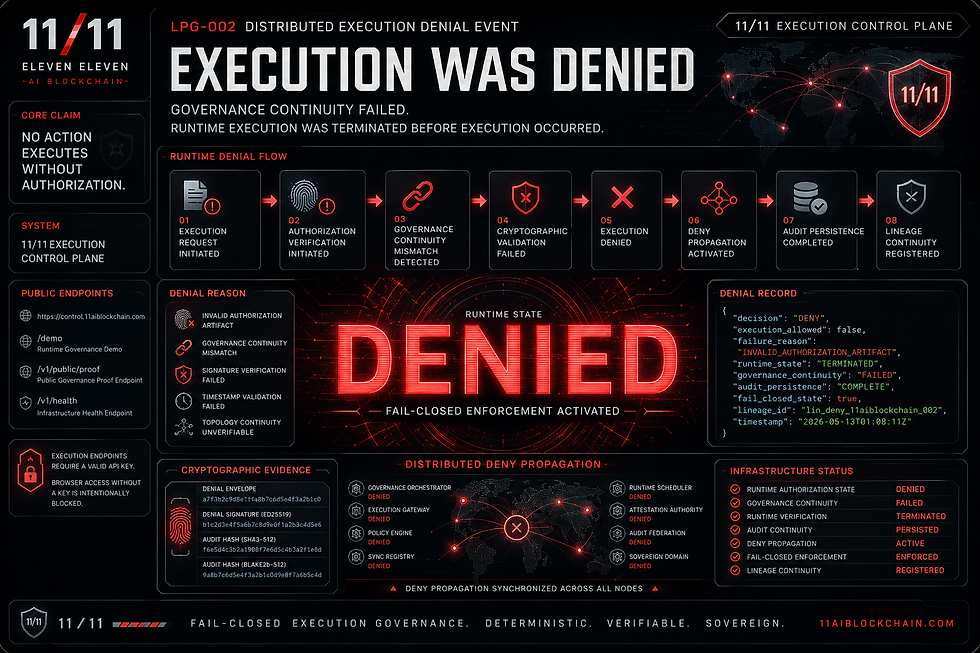
fail-closed denial propagation
This transforms orchestration from operational automation into continuously synchronized runtime governance infrastructure.
The Failure of Traditional Coordination Models
Most traditional orchestration systems assumed:
runtime behavior remains predictable
workloads evolve gradually
orchestration paths remain stable
trust conditions change slowly
coordination systems operate independently
Autonomous AI systems invalidate these assumptions.
AI workloads may dynamically:
orchestrate distributed infrastructure
invoke external runtime systems
modify execution sequencing
transition across runtime domains
coordinate machine-speed execution
alter orchestration trust continuously
Runtime coordination governance must therefore become continuously operational.
The Shift From Operational Coordination to Runtime Governance Coordination
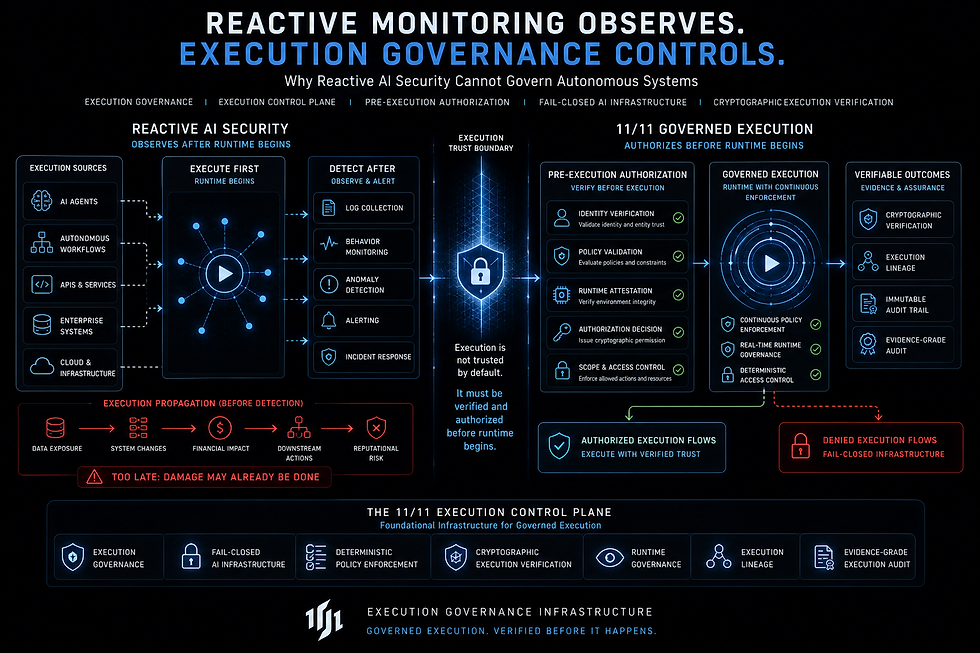
Legacy orchestration systems focused primarily on workflow automation.
Autonomous runtime governance coordination fabric continuously governs:
workload trust continuity
runtime authorization integrity
orchestration consistency
trust-boundary enforcement
governance synchronization
cryptographic verification continuity
execution lineage synchronization
Execution remains permitted only while runtime coordination governance remains intact.
Related:
Distributed Execution Governance Assurance
Execution Governance Assurance Fabric
Governed Execution Coordination Infrastructure
Core Components of Autonomous Runtime Governance Coordination Fabric
Runtime Authorization Continuity
Every execution transition must remain continuously authorized.
Authorization continuity systems validate:
workload identity
runtime context
execution permissions
policy constraints
temporal validity
trust-zone continuity
cryptographic authorization artifacts
If governance continuity validation fails:
execution is denied immediately.
Orchestration Synchronization Infrastructure
Autonomous runtime governance coordination fabric continuously synchronizes orchestration state across distributed environments.
Synchronization systems coordinate:
orchestration continuity
execution sequencing
sovereign governance enforcement
workload segmentation
trust-boundary continuity
runtime policy validation
This creates continuously governed runtime infrastructure.
Deterministic Coordination Enforcement
Autonomous runtime governance coordination systems must behave deterministically.
Deterministic governance ensures:
identical conditions produce identical orchestration outcomes
runtime sequencing remains stable
policy enforcement remains reproducible
denial behavior remains predictable
governance cannot silently drift across distributed environments
Deterministic coordination establishes operational trust consistency.
Cryptographic Coordination Verification
Autonomous runtime governance coordination increasingly depends on cryptographic governance systems.
These systems verify:
authorization signatures
orchestration attestation
policy authenticity
immutable audit continuity
execution lineage integrity
distributed trust synchronization
Cryptographic verification transforms orchestration governance into evidence-grade operational infrastructure.
Execution Lineage Coordination Continuity
Autonomous runtime governance coordination fabric depends heavily on immutable execution lineage.
Execution lineage systems persist:
runtime transitions
orchestration chains
workload sequencing
governance state changes
trust continuity
execution dependencies
governance evidence
This creates reconstructable orchestration accountability.
Fail-Closed Runtime Coordination Governance
Autonomous runtime governance coordination systems must default to denial during uncertainty.
Examples include:
runtime trust degradation
orchestration inconsistencies
cryptographic verification failures
trust-boundary violations
governance synchronization drift
lineage continuity breaks
When runtime certainty degrades:
execution stops.
This establishes fail-closed runtime governance coordination.
Continuous Runtime Governance Coordination
Autonomous runtime governance coordination fabric requires continuous runtime synchronization.
Continuous governance systems validate:
runtime trust state
orchestration consistency
policy freshness
cryptographic continuity
distributed synchronization
governance replay integrity
This creates continuously governed runtime infrastructure.
Distributed Runtime Coordination Infrastructure
Modern AI infrastructure operates across distributed environments.
Autonomous runtime governance coordination systems must therefore support:
Kubernetes orchestration
multi-cloud infrastructure
sovereign runtime regions
edge deployments
hybrid infrastructure
federated execution domains
Distributed runtime governance requires:
synchronized runtime enforcement
globally consistent authorization
distributed orchestration coordination
coordinated runtime trust validation
cryptographic synchronization
This creates globally governed runtime infrastructure.
Autonomous AI and Coordination Complexity
Autonomous AI systems significantly increase runtime coordination complexity.
AI systems may independently:
orchestrate distributed infrastructure
coordinate runtime workflows
invoke external systems
trigger machine-speed execution
interact across sovereign trust domains
manage execution chains dynamically
Without autonomous runtime governance coordination fabric infrastructure, runtime behavior becomes operationally fragmented and unpredictable.
Execution governance ensures autonomous AI remains bounded by continuously synchronized governance coordination.
Enterprise and Defense Infrastructure
Autonomous runtime governance coordination fabric is increasingly critical for:
defense systems
sovereign AI deployments
financial runtime infrastructure
healthcare AI governance
industrial automation
critical infrastructure orchestration
These environments require continuously synchronized runtime governance coordination.
Autonomous runtime governance coordination fabric establishes that operational governance layer.
Public Governance Infrastructure
11/11 demonstrates runtime governance concepts through publicly accessible governance infrastructure.
Runtime Governance Demo
Governance Console
Governance Proof Viewer
Infrastructure Health Dashboard
Execution Lineage Explorer
The Future of Autonomous Runtime Governance Coordination Fabric
As autonomous infrastructure continues expanding, runtime coordination systems must evolve into continuously synchronized governance fabrics capable of preserving deterministic operational control across distributed execution environments.
Future governed systems will increasingly require:
deterministic runtime authorization
synchronized orchestration continuity
fail-closed governance orchestration
cryptographic operational verification
immutable execution lineage
distributed runtime synchronization
Autonomous runtime governance coordination fabric is rapidly emerging as one of the foundational operational layers of autonomous AI infrastructure.

Comments