
The Coming Divide: Benchmark Intelligence Versus Authorized Intelligence
- 11/11 AI

- Jun 14
- 6 min read

For the past several years, artificial intelligence has been measured almost exclusively through the lens of capability.
The industry developed benchmark after benchmark.
Leaderboards emerged.
Performance rankings multiplied.
Organizations competed to demonstrate increasingly sophisticated reasoning, larger context windows, faster inference, improved coding ability, stronger mathematical performance, and higher scores across a growing collection of evaluation frameworks.
This process was both necessary and valuable.
Benchmarks helped establish objective measurements.
Benchmarks accelerated innovation.
Benchmarks allowed researchers, enterprises, governments, and investors to compare systems using common standards.
Benchmarks helped answer an important question:
Can the system perform a task?
Yet as artificial intelligence transitions from a research discipline into operational infrastructure, a more important question is emerging.
Should the system be permitted to perform the task?
This distinction may ultimately become the defining challenge of the autonomous era.
Because capability alone does not create trust.
Capability alone does not create accountability.
Capability alone does not create safety.
Capability alone does not create authority.
The world is now entering a phase where artificial intelligence systems are no longer simply generating information.
They are beginning to execute.
They are beginning to operate.
They are beginning to interact with real systems, real infrastructure, real organizations, and real assets.
Artificial intelligence is increasingly being connected to:
Financial systems.
Treasury operations.
Trading platforms.
Healthcare workflows.
Defense environments.
Supply chains.
Critical infrastructure.
Enterprise automation.
Digital asset custody.
Identity systems.
Operational technology.
Autonomous machines.
Government services.
As this transition accelerates, the limitations of benchmark-centric thinking become increasingly apparent.
A benchmark score can demonstrate capability.
A benchmark score cannot demonstrate authority.
A benchmark score cannot demonstrate governance.
A benchmark score cannot demonstrate accountability.
A benchmark score cannot demonstrate authorization.
Most importantly, a benchmark score cannot prove whether execution should have occurred.
This is where the next generation of artificial intelligence infrastructure begins.
Not with larger models.
Not with faster inference.
Not with better leaderboards.
But with governed execution.
For decades, computing infrastructure evolved through successive layers of trust.
The early internet focused on connectivity.
Systems needed to communicate.
Protocols needed to exchange information.
Networks needed to scale.
As the internet matured, trust became the defining challenge.
Organizations needed mechanisms to verify identity.
Organizations needed mechanisms to authenticate users.
Organizations needed mechanisms to authorize access.
Organizations needed mechanisms to prove integrity.
This led to the emergence of infrastructure layers that fundamentally transformed digital trust.
Public Key Infrastructure.
Certificate Authorities.
Identity Providers.
Authentication Systems.
Authorization Frameworks.
Access Control Models.
These technologies did not improve the intelligence of the internet.
They improved its trustworthiness.
They made commerce possible.
They made banking possible.
They made secure communication possible.
They enabled entire industries to emerge.
Artificial intelligence is now approaching a similar inflection point.
The first phase focused on intelligence.
The second phase focused on benchmarking.
The third phase focused on observability.
The fourth phase is becoming governance.
The fifth phase will become authorization.
The sixth phase will become execution assurance.
This progression is neither theoretical nor optional.
It is a direct consequence of increasing autonomy.
As artificial intelligence gains authority to act, organizations require mechanisms to determine whether actions are permissible before execution occurs.
This requirement introduces a new category.
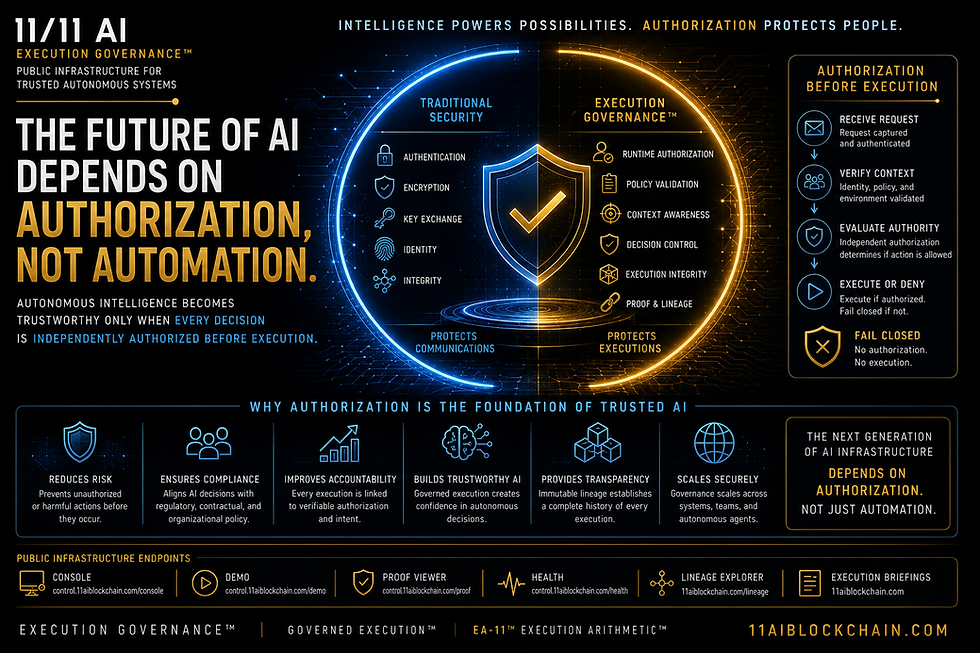
Execution Governance.
Execution Governance is fundamentally different from traditional AI governance.
Most governance frameworks focus on policies, oversight, documentation, reporting, monitoring, and compliance.
These functions remain important.
However, they operate primarily around execution rather than directly controlling execution itself.
Execution Governance focuses on the execution boundary.
The execution boundary is the precise moment where a decision transitions into an action.
Historically, this boundary has been managed through human oversight.
A person approves.
A person authorizes.
A person validates.
A person executes.
Autonomous systems challenge this model.
Machines can now generate decisions at speeds and scales that exceed traditional approval processes.
Machines can coordinate actions across thousands of systems.
Machines can evaluate millions of variables simultaneously.
Machines can execute continuously.
Without governance at the execution boundary, intelligence becomes disconnected from authority.
This creates risk.
A highly intelligent system operating without authorization controls may still generate unacceptable outcomes.
A highly capable system operating without policy enforcement may still violate organizational objectives.
A highly sophisticated model operating without authority validation may still execute actions that should never occur.
Execution Governance addresses this challenge through a fundamentally different architecture.
Rather than asking what a system can do, Execution Governance asks what a system is authorized to do.
This distinction creates a new class of infrastructure.
Authorization Infrastructure.
Verification Infrastructure.
Execution Infrastructure.
Proof Infrastructure.
Together, these systems form the foundation of Governed Execution.
Governed Execution is built upon several principles.
Verification Before Runtime.
Authorization Before Runtime.
Policy Enforcement During Runtime.
Proof Generation After Runtime.
Each principle contributes to a trust model designed specifically for autonomous operations.
Verification establishes identity.
Authorization establishes authority.
Policy enforcement establishes control.
Proof establishes accountability.
When combined, these mechanisms create operational trust.
Operational trust differs from theoretical trust.
Operational trust is measurable.
Operational trust is enforceable.
Operational trust is auditable.
Operational trust is provable.
Most importantly, operational trust exists before execution occurs.
This distinction becomes particularly important within institutional environments.
Consider a global financial institution.
Modern financial organizations process trillions of dollars annually.
These organizations operate through extensive layers of controls.
Risk controls.
Compliance controls.
Treasury controls.
Settlement controls.
Operational controls.
Regulatory controls.
These controls exist because financial infrastructure depends upon authority.
Money movement requires authority.
Settlement requires authority.
Trading requires authority.
Custody requires authority.
Authority defines the operational boundaries of financial systems.
As artificial intelligence becomes embedded within financial infrastructure, the same principle applies.
An AI system may recommend a transaction.
An AI system may evaluate a position.
An AI system may identify an opportunity.
An AI system may generate a strategy.
None of these activities necessarily require execution authority.
Execution authority exists only when an action is permitted to occur.
Execution Governance formalizes this distinction.
The system must demonstrate authorization before execution becomes possible.
This architecture transforms governance from observation into control.
Observation identifies what happened.
Control determines what may happen.
The difference is profound.
One approach documents outcomes.
The other approach governs outcomes.
As organizations deploy increasingly autonomous systems, governance must evolve from retrospective analysis to proactive authorization.
This transition creates a new benchmark category.
Historically, benchmarks measured capability.
Future benchmarks must measure governability.
Capability answers one question.
Governability answers another.
Capability asks:
Can the system perform the task?
Governability asks:
Can the system be trusted to perform the task within authorized boundaries?
This distinction forms the foundation of the Execution Governance Benchmark Project.
The objective is not to replace existing benchmarks.
The objective is to expand evaluation beyond capability.
Future autonomous systems should be evaluated according to additional criteria.
Identity Verification.
Authority Validation.
Policy Enforcement.
Runtime Controls.
Authorization Latency.
Governance Coverage.
Execution Assurance.
Proof Generation.
Lineage Completeness.
Attestation Integrity.
Fail-Closed Enforcement.
These measurements reflect operational trust rather than raw intelligence.
They measure whether governance mechanisms function under real-world conditions.
They measure whether execution remains controlled.
They measure whether authority remains enforceable.
They measure whether proof remains available.
This represents a fundamental shift in how artificial intelligence will be evaluated.
The future will not belong exclusively to the most intelligent systems.
The future will belong to the most governable systems.
This is not because intelligence lacks value.
It is because intelligence without governance creates uncertainty.
Organizations do not deploy systems based solely upon capability.
Organizations deploy systems based upon trust.
Trust determines adoption.
Trust determines scale.
Trust determines regulation.
Trust determines market acceptance.
Trust determines institutional acceptance.
Trust determines operational viability.
The next decade will therefore be defined by a new competition.
Not simply a competition for intelligence.
A competition for trusted intelligence.
A competition for governed intelligence.
A competition for authorized intelligence.
This distinction may ultimately become more important than benchmark rankings themselves.
Because benchmarks can be surpassed.
Benchmarks can be optimized.
Benchmarks can be gamed.
Benchmarks can become obsolete.
Authority cannot be simulated.
Authorization cannot be assumed.
Governance cannot be implied.
Proof cannot be fabricated.
These elements require infrastructure.
Execution Governance provides that infrastructure.
Execution Governance establishes the mechanisms necessary to transform intelligence into trusted operations.
Execution Governance establishes the controls necessary to transform capability into accountability.
Execution Governance establishes the authorization necessary to transform autonomy into operational trust.
The organizations that recognize this transition earliest will define the next generation of artificial intelligence infrastructure.
Not because they build the smartest systems.
But because they build the most trusted systems.
History repeatedly demonstrates that trust becomes infrastructure.
The internet required trust infrastructure.
Commerce required trust infrastructure.
Banking required trust infrastructure.
Identity required trust infrastructure.
Artificial intelligence is now reaching the same threshold.
The next era will not be defined solely by model capability.
It will be defined by execution authority.
It will be defined by governance assurance.
It will be defined by authorization infrastructure.
It will be defined by proof.
The industry will continue to chase benchmark scores.
The industry will continue to pursue larger models.
The industry will continue to compete for performance.
Those efforts will remain important.
But a parallel transformation is now emerging.
A transformation centered on trust.
A transformation centered on authority.
A transformation centered on governance.
A transformation centered on execution.
The future of artificial intelligence will not simply ask whether a system can act.
The future will demand proof that a system was authorized to act.
That future requires a new category.
Execution Governance.
Governed Execution.
Authorized Intelligence.
Execution Assurance.
Trust Infrastructure.
The transition has already begun.
The only remaining question is who will build the infrastructure that governs the autonomous world.
Series: EGBP™ Execution Governance Benchmark Project
Public Infrastructure Endpoints
Public Runtime Infrastructure
Public Governance Consolehttps://control.11aiblockchain.com/console
Runtime Governance Demohttps://control.11aiblockchain.com/demo
Public Governance Proof Viewerhttps://control.11aiblockchain.com/proof
Infrastructure Health Dashboardhttps://control.11aiblockchain.com/health
Execution Lineage Explorerhttps://www.11aiblockchain.com/lineage
Execution Governance™
Governed Execution™
EA-11™ Execution Arithmetic™
EGBP™ Execution Governance Benchmark Project
Patent Pending


Comments