
Why Computation Can No Longer Be Assumed Valid


For decades, modern computing has operated under a simple assumption.
If a system can compute, it should compute.
If a process can execute, it should execute.
If an input exists, computation proceeds.
This assumption shaped nearly every major software architecture developed during the modern computing era.
But autonomous systems change that assumption fundamentally.
As infrastructure becomes increasingly autonomous, computation itself becomes an operational event.
Every machine-speed decision is a computational decision.
Every orchestration path is a computational path.
Every AI inference is a computational outcome.
Every autonomous action begins as computation.
This creates a new infrastructure problem.
What happens when computation itself becomes operationally invalid?
Traditional systems rarely ask this question.
The processor computes.
The system executes.
The result is accepted.
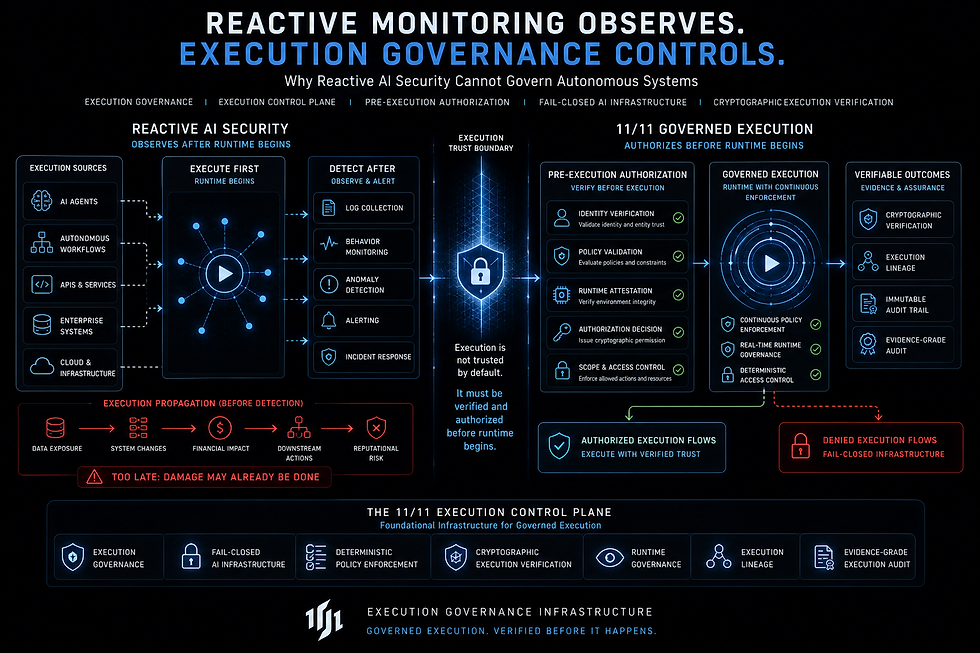
Governance occurs afterward.
EA-11 introduces a different model.
Computation must become conditional.
Not every computation should be considered admissible.
Not every computational state should be considered trustworthy.
Not every runtime condition should permit computational progression.
Not every execution environment should automatically authorize computational outcomes.
This is the foundation of governed computation.
Under EA-11, computation becomes dependent on operational trust conditions.
Trust matters.
Policy matters.
Proof matters.
Runtime state matters.
Execution context matters.
Computational integrity matters.
Only when these conditions remain valid does computation become operationally admissible.
This changes the role of computation itself.
Instead of:
Compute → Execute → Verify
EA-11 introduces:
Verify → Validate → Compute → Execute
The distinction is profound.
Because autonomous systems increasingly generate decisions that affect:
sovereign infrastructure
financial systems
healthcare environments
defense operations
public infrastructure
machine-speed orchestration
critical runtime systems
In these environments, invalid computation becomes operational risk.
The future challenge is not simply controlling execution.
It is controlling whether computation itself should occur.
That is why EA-11 introduces a new computational principle:
Computation is not automatically valid.
Computation must earn admissibility.
This is the next layer beneath Execution Governance™.
Execution Governance™ asks:
Should execution occur?
EA-11 asks:
Should computation itself be trusted?
That question becomes increasingly important as autonomous infrastructure expands globally.
Because future systems will not merely execute faster.
They will compute continuously.
And not every computation deserves to become reality.
That is why computation can no longer be assumed valid.
That is why governed computation becomes infrastructure.
That is the foundation of EA-11™.
Public Infrastructure Endpoints
Public Runtime Infrastructure
Public Governance Console
Runtime Governance Demo
Public Governance Proof Viewer
Infrastructure Health Dashboard
Execution Lineage Explorer
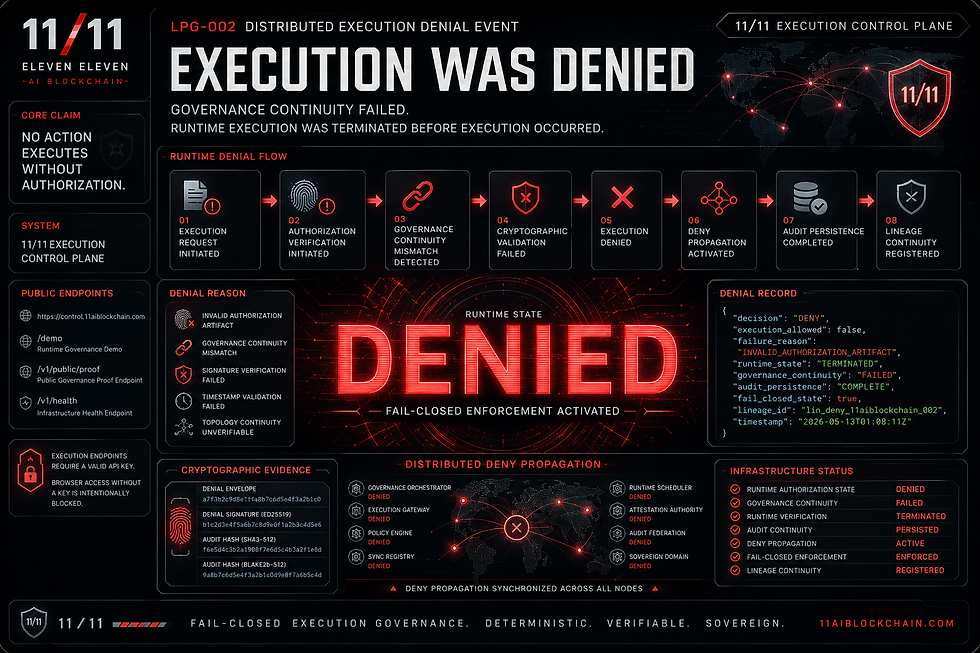
Execution endpoints intentionally require valid API authorization.
Browser access without a valid authorization key is fail-closed by design.
EA-11™Execution Arithmetic™
Governed Computation™
Patent Pending

Comments