
PILLAR PAGE 17 Deterministic Runtime Governance for Autonomous AI Infrastructure | 11/11 Execution Governance


Why Predictability Becomes Critical in Autonomous Systems
Traditional infrastructure was largely designed around human-directed operations.
Modern AI infrastructure increasingly operates autonomously.
Autonomous systems can:
invoke downstream services
orchestrate infrastructure
trigger distributed execution
chain runtime actions
coordinate workflows
modify operational state
This introduces a fundamental governance challenge.
Infrastructure behavior must remain predictable even as execution becomes increasingly autonomous.
Deterministic runtime governance establishes the systems required to ensure execution behavior remains consistent, enforceable, and verifiable across distributed runtime environments.
What Is Deterministic Runtime Governance?
Deterministic runtime governance is the enforcement model in which identical execution conditions produce identical governance outcomes.
This means:
identical policies produce identical decisions
identical authorization requests produce identical results
runtime enforcement remains stable
denial behavior remains predictable
governance logic cannot silently drift
Deterministic governance creates operational trust consistency.
This becomes foundational for governed AI infrastructure.
The Problem With Non-Deterministic Governance
Non-deterministic governance systems introduce operational uncertainty.
Examples include:
inconsistent authorization outcomes
unstable runtime enforcement
policy drift
asynchronous trust inconsistencies
unpredictable orchestration behavior
fragmented governance decisions
Autonomous systems amplify these risks.
Machine-speed execution magnifies even minor governance inconsistencies into major operational vulnerabilities.
Deterministic runtime governance prevents governance ambiguity.
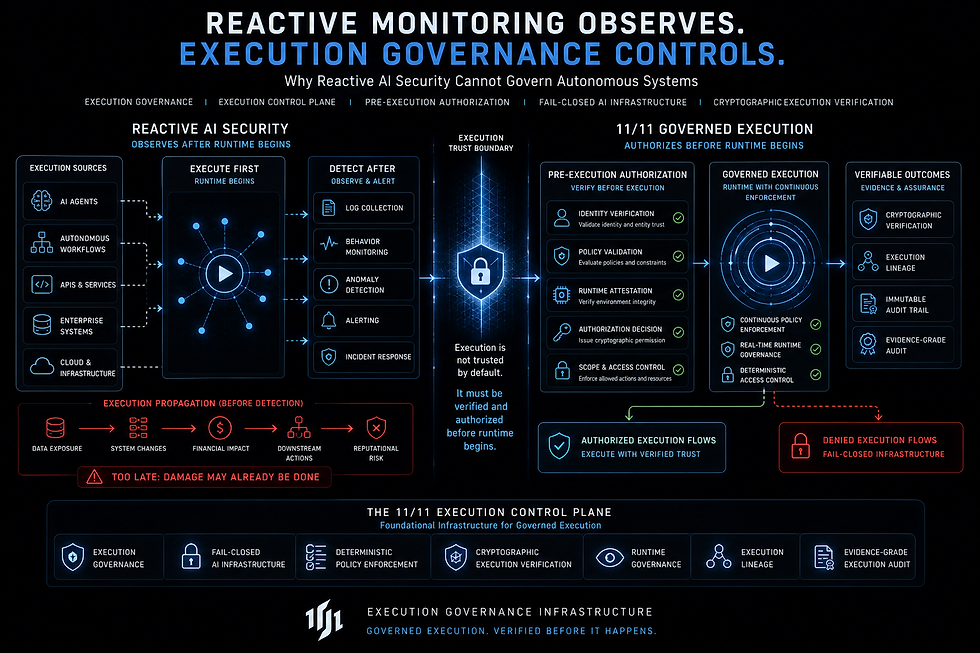
The Shift From Adaptive Security to Deterministic Governance
Traditional security systems often prioritize flexibility and adaptation.
While useful for observational security tooling, this approach creates risk within autonomous execution systems.
Governed infrastructure requires:
stable authorization logic
predictable runtime enforcement
deterministic denial semantics
reproducible governance outcomes
cryptographically verifiable decisions
Governance becomes operational infrastructure rather than interpretive analysis.
Related:
Fail-Closed Execution Architecture
Governance Control Planes
Runtime Integrity Systems
Core Components of Deterministic Runtime Governance
Policy Determinism
Governance policies must produce stable outcomes.
Deterministic policy systems ensure:
rules remain version-controlled
policy evaluation remains reproducible
authorization behavior remains consistent
governance logic remains predictable
distributed systems enforce identical constraints
This creates governance stability at scale.
Authorization Consistency
Execution authorization systems must behave identically under identical conditions.
Authorization consistency includes:
stable identity validation
deterministic context evaluation
predictable trust assessment
reproducible policy evaluation
cryptographic authorization integrity
This prevents runtime governance fragmentation.
Deterministic Enforcement Infrastructure
Runtime enforcement systems must operate consistently across environments.
Enforcement infrastructure coordinates:
workload restrictions
runtime isolation
trust boundary enforcement
anomaly containment
execution termination
fail-closed denial propagation
This creates continuously enforceable runtime governance.
Cryptographic Verification Systems
Deterministic governance increasingly depends on cryptographic validation.
Cryptographic systems verify:
authorization signatures
policy authenticity
runtime attestation
execution lineage continuity
immutable audit persistence
distributed governance consistency
This creates evidence-grade governance determinism.
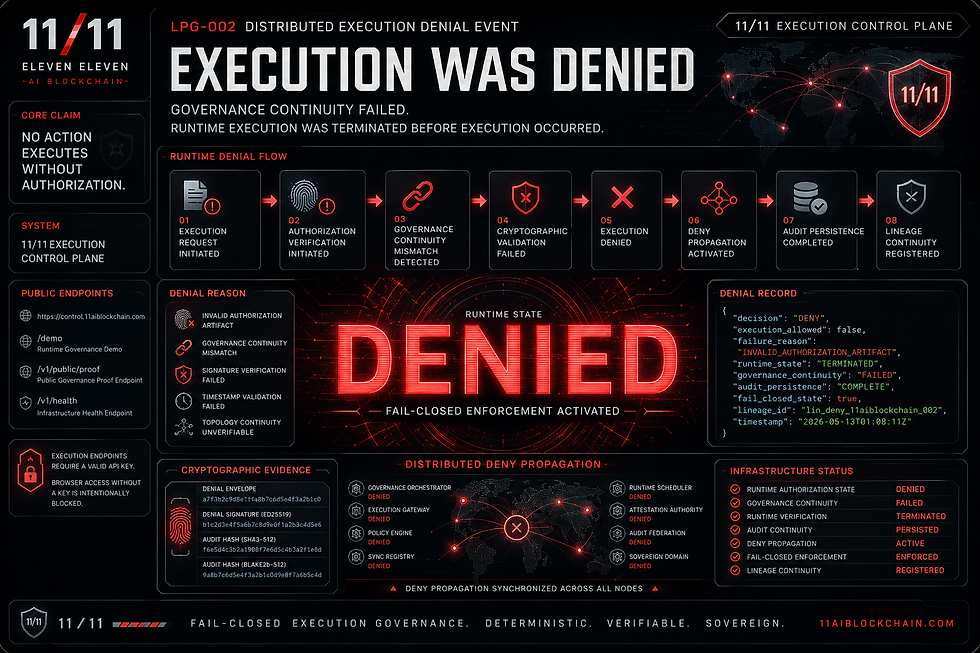
Fail-Closed Deterministic Enforcement
Deterministic runtime governance depends heavily on fail-closed operational semantics.
If governance certainty cannot be established:
execution is denied.
This includes situations where:
authorization validation fails
policy evaluation becomes inconsistent
cryptographic verification fails
runtime trust degrades
lineage continuity breaks
Fail-closed determinism ensures governance remains trustworthy during uncertainty.
Continuous Governance Verification
Deterministic governance is not static.
Governance systems must continuously verify:
runtime trust state
authorization freshness
policy integrity
lineage continuity
enforcement consistency
distributed synchronization
Continuous verification ensures governance determinism persists throughout execution lifecycle operations.
Distributed Deterministic Governance
Modern runtime systems operate across distributed environments.
Deterministic governance systems must therefore support:
Kubernetes orchestration
multi-cloud infrastructure
sovereign runtime regions
hybrid environments
edge infrastructure
federated governance domains
Distributed determinism requires:
synchronized policy distribution
globally consistent enforcement
coordinated trust validation
deterministic runtime orchestration
cryptographic consistency verification
This creates globally stable governance infrastructure.
Autonomous AI and Deterministic Governance
Autonomous AI systems significantly increase the importance of deterministic runtime governance.
AI systems may independently:
orchestrate workflows
trigger infrastructure actions
invoke external services
coordinate distributed systems
manage execution chains
interact across trust domains
Without deterministic governance, autonomous systems become operationally unpredictable.
Deterministic runtime governance ensures autonomous execution remains bounded by reproducible operational rules.
Execution Lineage and Deterministic Reconstruction
Deterministic governance depends heavily on immutable execution lineage.
Execution lineage enables:
reproducible governance reconstruction
authorization traceability
runtime dependency visibility
operational replay
forensic analysis
evidence-grade audit verification
Lineage systems ensure governance behavior remains reconstructable and provable.
Related:
Execution Lineage Infrastructure
Cryptographic Runtime Verification
Immutable Governance Audit Systems
Enterprise and Defense Governance
Deterministic runtime governance is increasingly critical for:
defense systems
sovereign AI infrastructure
healthcare execution systems
financial runtime governance
industrial automation
critical infrastructure orchestration
These environments require continuously predictable operational behavior.
Deterministic governance establishes that operational consistency layer.
Public Governance Infrastructure
11/11 demonstrates deterministic runtime governance concepts through publicly accessible governance infrastructure.
Runtime Governance Demo
Governance Console
Governance Proof Viewer
Infrastructure Health Dashboard
Execution Lineage Explorer
The Future of Deterministic Runtime Governance
As autonomous execution systems continue expanding, deterministic runtime governance will become foundational infrastructure.
Future governed systems will increasingly require:
deterministic authorization systems
predictable runtime enforcement
fail-closed operational semantics
continuously verifiable governance
immutable execution lineage
distributed trust consistency
Deterministic runtime governance is rapidly emerging as one of the foundational operational models of governed AI infrastructure.

Comments