
Why EA-11 Separates Computation From Admissible Computation


One of the oldest assumptions in computing is that successful computation equals valid computation.
A processor receives an input.
The system performs the calculation.
An output is generated.
The result is accepted.
For decades, modern computing largely treated these events as equivalent.
If computation occurred successfully, the result was presumed operationally valid.
EA-11 introduces a different perspective.
Successful computation does not automatically create admissible computation.
This distinction becomes increasingly important in autonomous systems.
Modern infrastructure is no longer limited to isolated software programs.
Computation now influences:
sovereign AI systems
infrastructure orchestration
autonomous decision engines
healthcare operations
financial systems
defense environments
machine-speed execution platforms
In these environments, computation itself becomes operationally consequential.
A computational outcome may be technically correct while still being operationally invalid.
A result may be mathematically accurate but generated under untrusted conditions.
A computation may complete successfully while violating policy certainty.
A computational state may exist while lacking runtime integrity.
This is where EA-11 introduces the concept of admissibility.
Admissible computation requires more than successful execution.
It requires operational trust.
It requires policy alignment.
It requires proof.
It requires runtime integrity.
It requires trusted execution context.
It requires computational certainty.
Only when these conditions are satisfied does computation become admissible.
This creates two categories:
Computation
A computational event occurred.
Admissible Computation
A computational event occurred under trusted operational conditions.
This distinction creates a new computational control boundary.
Not every result deserves operational authority.
Not every output deserves execution.
Not every computation deserves trust.
EA-11 establishes a framework where admissibility becomes part of computation itself.
This extends governance deeper than execution.
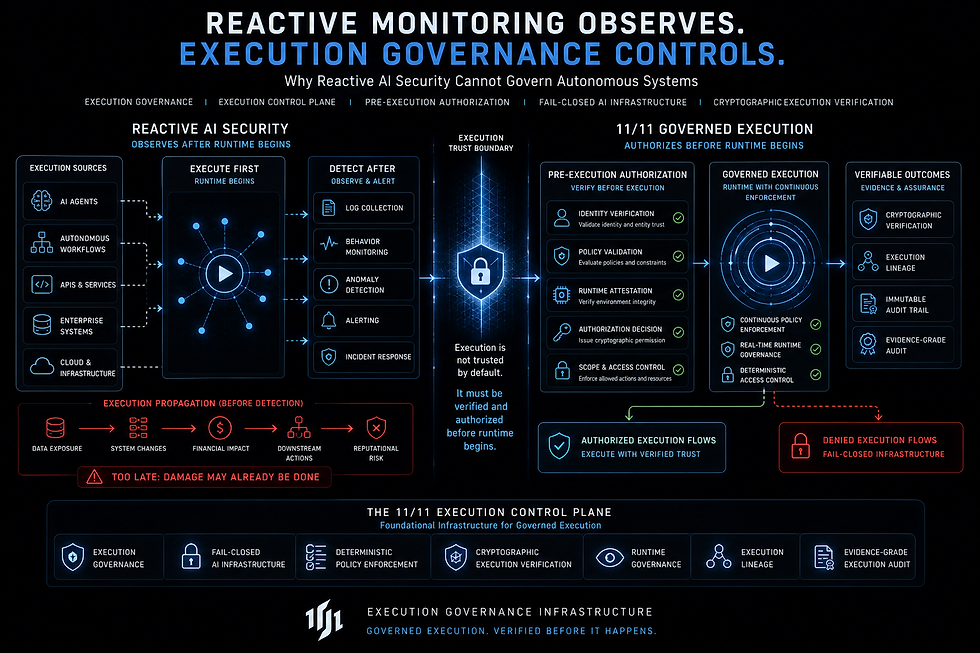
Execution Governance™ asks:
Should execution occur?
EA-11 asks:
Should this computation be trusted before execution is even considered?
That question becomes increasingly important as autonomous systems scale.
Because future infrastructure will not merely execute continuously.
It will compute continuously.
And the systems that dominate the future will not be the systems that compute the fastest.
They will be the systems that determine which computations are admissible.
That is the principle behind EA-11.
That is why EA-11 separates computation from admissible computation.
Public Infrastructure Endpoints
Public Runtime Infrastructure
Public Governance Console
Runtime Governance Demo
Public Governance Proof Viewer
Infrastructure Health Dashboard
Execution Lineage Explorer
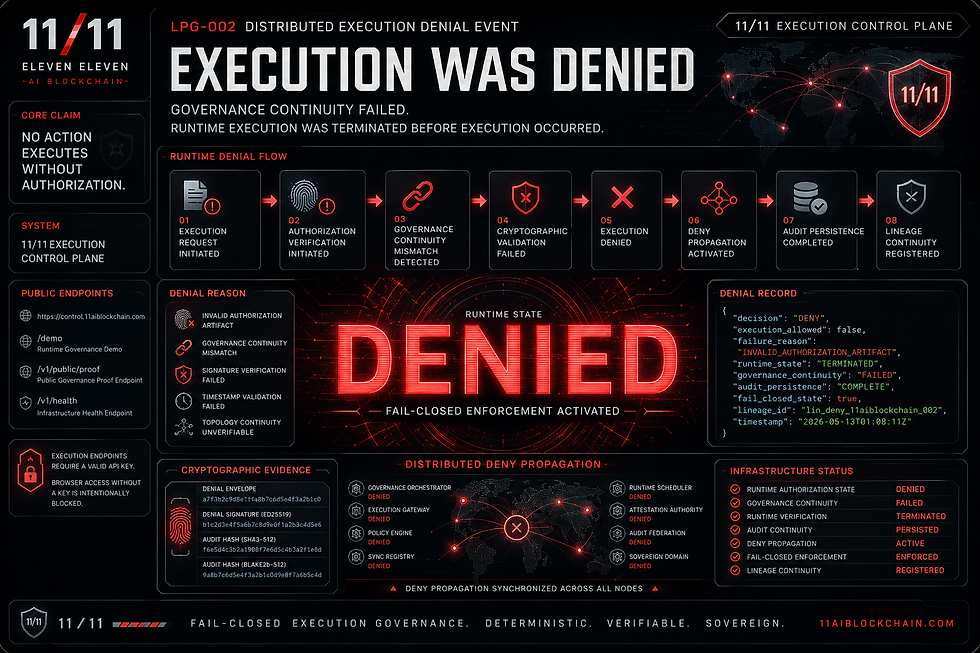
Execution endpoints intentionally require valid API authorization.
Browser access without a valid authorization key is fail-closed by design.
EA-11™
Execution Arithmetic™
Governed Computation™
Patent Pending

Comments