
EA-11 and the Post-Quantum Execution Era


Cryptography Alone Will Not Secure Autonomous Systems
The transition to post-quantum cryptography represents one of the largest infrastructure upgrades since the adoption of TLS and Public Key Infrastructure.
Governments.
Financial institutions.
Critical infrastructure operators.
Healthcare organizations.
Defense agencies.
Cloud providers.
Technology companies.
All are preparing for a future in which quantum-capable adversaries may compromise classical public-key cryptography.
The response has been substantial.
New cryptographic algorithms.
New key management systems.
New certificate infrastructures.
New migration programs.
New compliance requirements.
These initiatives are essential.
But they solve only one part of the problem.
They protect communication.
They do not govern execution.
The Next Security Boundary
For decades cybersecurity has focused primarily on protecting information.
Confidentiality.
Integrity.
Availability.
Identity.
Authentication.
Encryption.
These principles remain foundational.
However, autonomous systems introduce an entirely new operational challenge.
Modern AI systems increasingly possess the ability to execute actions.
Execution changes everything.
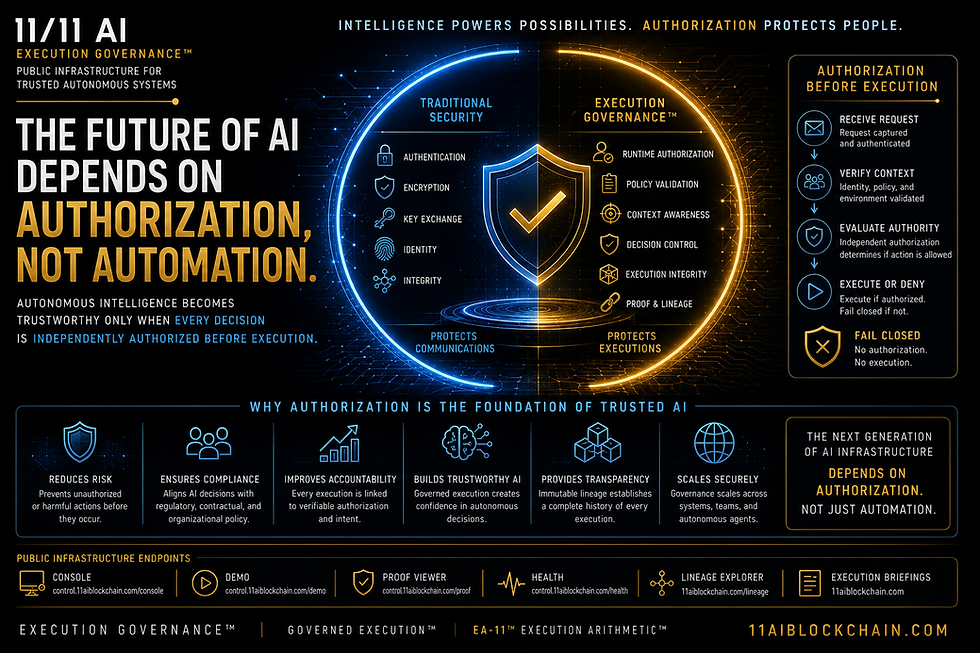
Once execution becomes autonomous, security must evolve beyond protecting communications.
Security must protect decisions.
More importantly...
Security must protect execution.
The Missing Layer
Post-Quantum Cryptography answers an important question.
Can trusted communication survive quantum attacks?
Execution Governance answers a different question.
Should this system be permitted to execute?
These questions are complementary.
Neither replaces the other.
One protects trust in communication.
The other protects trust in action.
Together they establish trusted autonomous infrastructure.
EA-11: Execution Arithmetic
Execution Arithmetic (EA-11) was developed around a simple observation.
Every autonomous execution event can be represented as a deterministic sequence of verification, authorization, enforcement, and proof.
Execution therefore becomes computable.
Governable.
Auditable.
Verifiable.
Rather than treating execution as an uncontrolled outcome, EA-11 treats execution as a governed mathematical process.
Every action becomes subject to deterministic validation before reality changes.
The Post-Quantum Execution Model
The autonomous era requires two independent layers.
Layer One
Protect communication.
Authenticate identity.
Establish cryptographic trust.
Secure key exchange.
Protect data.
This is the responsibility of post-quantum cryptography.
Layer Two
Verify authority.
Validate policy.
Enforce governance.
Authorize execution.
Generate immutable proof.
This is the responsibility of Execution Governance.
EA-11 operates entirely within this second layer.
Why Cryptography Alone Is Not Enough
A post-quantum signature can prove that a message originated from an authorized key.
It cannot determine whether the requested action complies with organizational policy.
Encryption can protect a command.
It cannot determine whether the command should execute.
Identity can authenticate an operator.
It cannot determine whether execution remains authorized under changing operational conditions.
Execution Governance fills this operational gap.
A New Trust Architecture
The future of trusted autonomous systems requires more than stronger algorithms.
It requires stronger operational architecture.
A trusted autonomous system should continuously verify:
Identity.
Authority.
Intent.
Policy.
Risk.
Environmental conditions.
Operational constraints.
Execution permissions.
Cryptographic integrity.
Execution lineage.
Only when these conditions are satisfied should execution proceed.
This architecture establishes operational trust independently of the underlying cryptographic algorithm.
The Quantum Transition
The migration toward post-quantum cryptography represents an opportunity.
Not merely to replace algorithms.
But to modernize trust architecture.
Organizations upgrading cryptographic infrastructure can simultaneously establish execution governance.
This creates two complementary forms of assurance.
Cryptographic Assurance
Messages remain authentic.
Communications remain protected.
Keys remain trustworthy.
Execution Assurance
Actions remain authorized.
Policies remain enforced.
Execution remains governed.
Proof remains available.
Together these layers create resilient autonomous infrastructure.
Beyond Secure Communications
Historically, cybersecurity has protected information.
The autonomous era requires protecting decisions.
Execution Governance extends cybersecurity beyond data protection into operational control.
The objective is no longer simply securing communications.
The objective is ensuring that autonomous systems cannot execute unauthorized actions, regardless of how securely those actions are transmitted.
This distinction defines the next generation of trust infrastructure.
The Future Of Trusted AI
Artificial intelligence will increasingly operate inside post-quantum environments.
Financial institutions.
Critical infrastructure.
Defense systems.
Healthcare.
Industrial automation.
Government platforms.
Digital asset networks.
Each environment will require both post-quantum cryptography and execution governance.
Neither is sufficient independently.
Together they establish the architecture for trusted autonomy.
Key Principle
Post-Quantum Cryptography Protects Communication.
Execution Governance Protects Execution.
EA-11 Connects Them Through Governed Mathematics.
The Future Requires Both.
Public Infrastructure Endpoints
Public Runtime Infrastructure
Public Governance Consolehttps://control.11aiblockchain.com/console
Runtime Governance Demohttps://control.11aiblockchain.com/demo
Public Governance Proof Viewerhttps://control.11aiblockchain.com/proof
Infrastructure Health Dashboardhttps://control.11aiblockchain.com/health
Execution Lineage Explorerhttps://www.11aiblockchain.com/lineage
Execution Governance™
Governed Execution™
EA-11™ Execution Arithmetic™
EGBP™ Execution Governance Benchmark Project
Patent Pending


Comments