
Why Computation Has States Beyond True And False


Modern computing is built upon a remarkably simple assumption.
A statement is either true or false.
A condition either exists or does not exist.
A result either passes or fails.
For decades, this binary model proved sufficient for traditional software systems.
But autonomous systems introduce a new challenge.
Machine-speed infrastructure now makes decisions that carry operational consequences.
AI systems influence infrastructure.
Autonomous orchestration influences execution.
Computational outcomes influence real-world operations.
In these environments, truth alone becomes insufficient.
A result may be true and still be operationally invalid.
A result may be mathematically correct and still be inadmissible.
A result may be accurate and still lack authority.
This is where EA-11 introduces computational state theory.
EA-11 establishes that computation possesses states beyond true and false.
A computation may be:
True
The result is mathematically correct.
False
The result is mathematically incorrect.
Admissible
The computation satisfies required trust conditions.
Inadmissible
The computation fails operational trust requirements.
Verified
The computation is supported by evidence and validation.
Unverified
The computation lacks sufficient proof.
Authoritative
The computation is permitted to influence operational outcomes.
Non-Authoritative
The computation exists but possesses no operational authority.
Trusted
The computation satisfies integrity, policy, and trust conditions.
Untrusted
The computation lacks trusted operational foundations.
This represents a significant departure from traditional computational models.
Because future autonomous systems require more than correctness.
They require legitimacy.
They require admissibility.
They require authority.
They require trust.
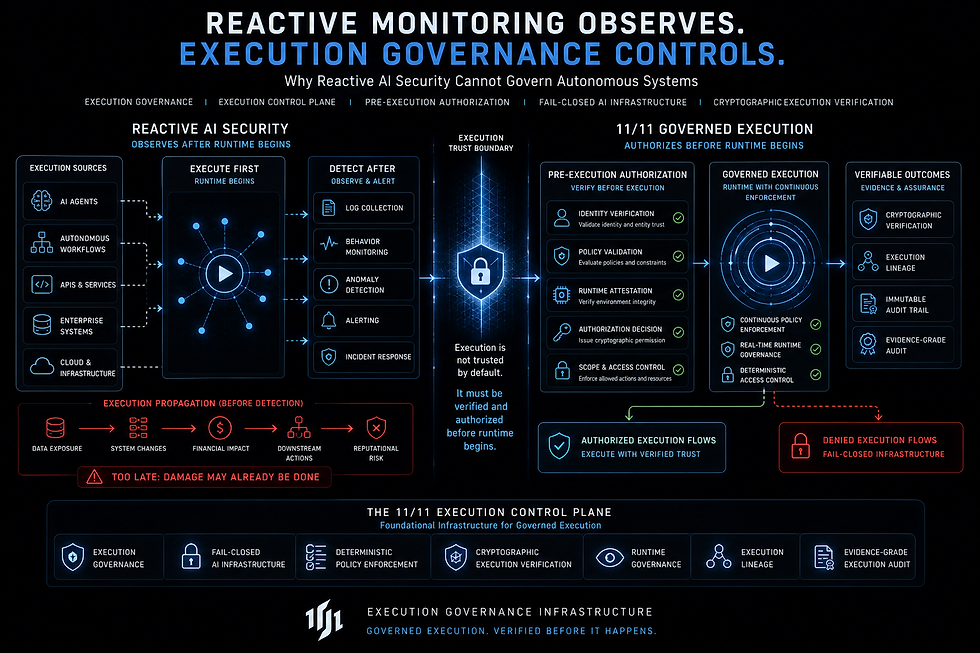
A computational outcome can therefore move through multiple states before becoming operationally relevant.
Traditional model:
True → Execute
EA-11 model:
True → Verified → Admissible → Trusted → Authoritative → Execute
This additional state structure creates a new computational architecture.
One where correctness alone no longer guarantees operational influence.
This becomes increasingly important for:
sovereign AI systems
autonomous infrastructure
financial systems
healthcare operations
defense environments
machine-speed orchestration
critical infrastructure
Because future infrastructure will increasingly depend on computational outcomes that must be evaluated beyond simple truth conditions.
The central question becomes:
Is the computation merely true?
Or:
Is the computation admissible, trusted, verified, and authoritative?
EA-11 argues that future autonomous systems require the second question.
Because computation without trust remains operationally dangerous.
Truth alone is no longer enough.
That is why EA-11 introduces computational state theory.
That is why computation has states beyond true and false.
Public Infrastructure Endpoints
Public Runtime Infrastructure
Public Governance Console
Runtime Governance Demo
Public Governance Proof Viewer
Infrastructure Health Dashboard
Execution Lineage Explorer
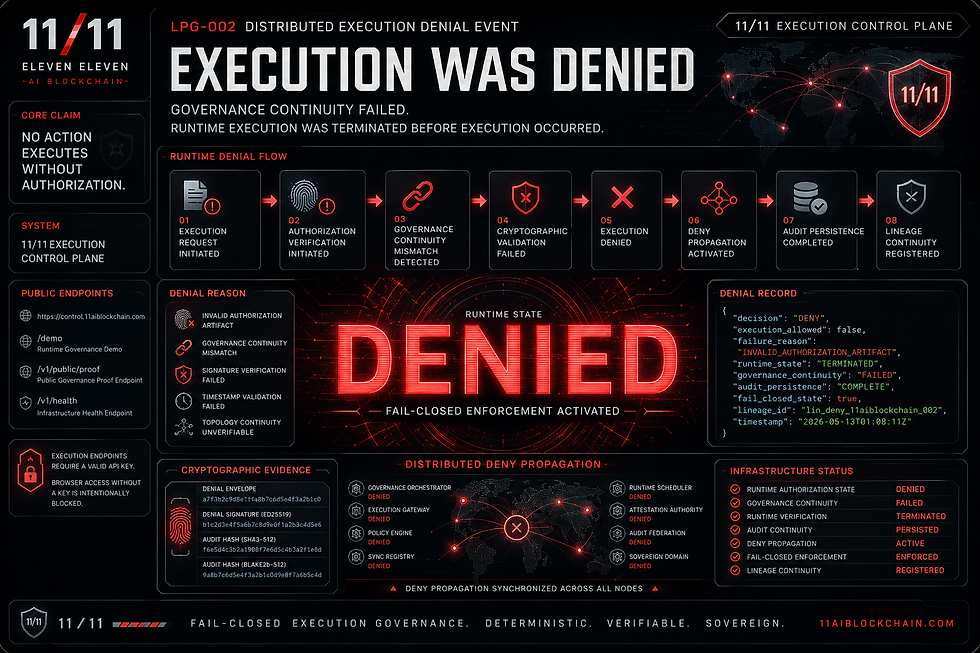
Execution endpoints intentionally require valid API authorization.
Browser access without a valid authorization key is fail-closed by design.
EA-11™ Execution Arithmetic™ Governed Computation™ Patent Pending

Comments