
Why EA-11 Introduces Computational Admissibility


Traditional computing assumes computation is admissible by default.
If an instruction is received, the system computes.
If data exists, the system processes it.
If execution begins, the computation is assumed valid.
This assumption has existed throughout the modern computing era.
But autonomous systems fundamentally change the environment in which computation occurs.
Today, computation increasingly drives:
AI decision systems
infrastructure orchestration
financial automation
healthcare operations
sovereign operational platforms
machine-speed governance systems
critical infrastructure coordination
At this scale, computation itself becomes an operational event.
And operational events carry consequences.
This creates a new question:
Should every computation automatically be considered valid?
EA-11 answers:
No.
Computation must first become admissible.
This is the principle of computational admissibility.
Computational admissibility means a computation must satisfy required operational conditions before it is allowed to become part of an execution pathway.
Trust matters.
Policy matters.
Proof matters.
Runtime state matters.
Execution context matters.
Operational integrity matters.
If these conditions fail, the computation itself becomes inadmissible.
Not merely incorrect.
Inadmissible.
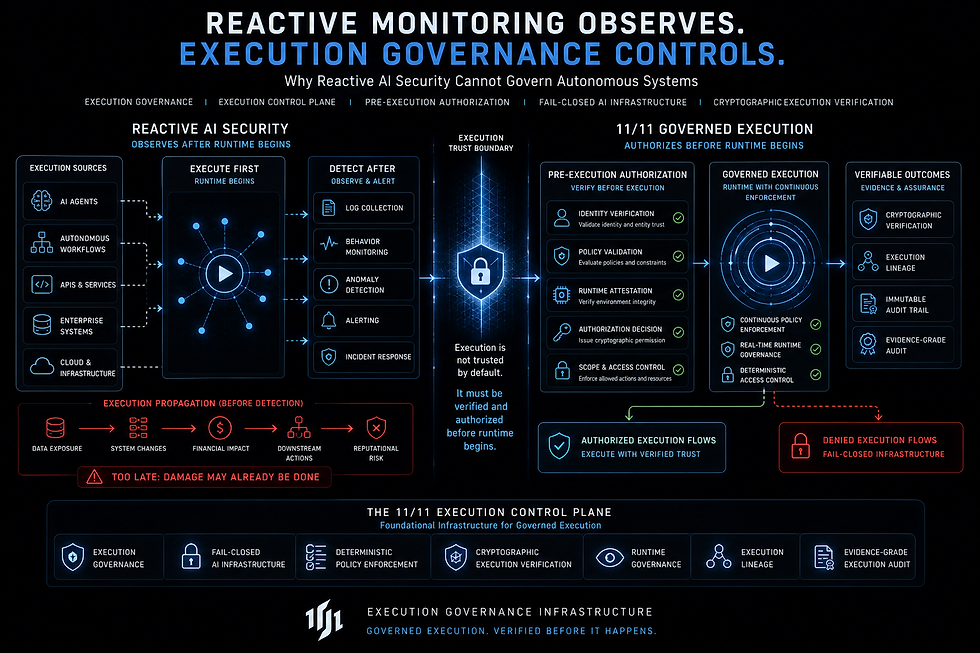
This is a different model than traditional computing.
Traditional model:
Input → Compute → Execute
EA-11 model:
Validate → Admit → Compute → Execute
This changes the role of computation itself.
Computation is no longer assumed trustworthy simply because a processor can perform it.
The computational event must first satisfy operational trust requirements.
This becomes increasingly important in autonomous infrastructure.
Machine-speed systems continuously generate computational outcomes that influence real-world operational behavior.
If those computations occur without admissibility controls, operational risk expands rapidly.
EA-11 introduces computational admissibility as a new infrastructure boundary.
A boundary where:
unverifiable computation becomes inadmissible
policy-conflicting computation becomes inadmissible
untrusted runtime computation becomes inadmissible
integrity-compromised computation becomes inadmissible
Only trusted computation proceeds.
Only admissible computation becomes execution.
This extends Execution Governance™ deeper into the computational layer.
Execution Governance™ governs execution.
EA-11 governs computational validity itself.
Together they create:
governed execution
governed computation
deterministic operational trust
sovereign computational infrastructure
Because future autonomous systems will not simply execute.
They will compute continuously.
And computation itself must become governable.
That is why EA-11 introduces computational admissibility.
Public Infrastructure Endpoints
Public Runtime Infrastructure
Public Governance Console
Runtime Governance Demo
Public Governance Proof Viewer
Infrastructure Health Dashboard
Execution Lineage Explorer
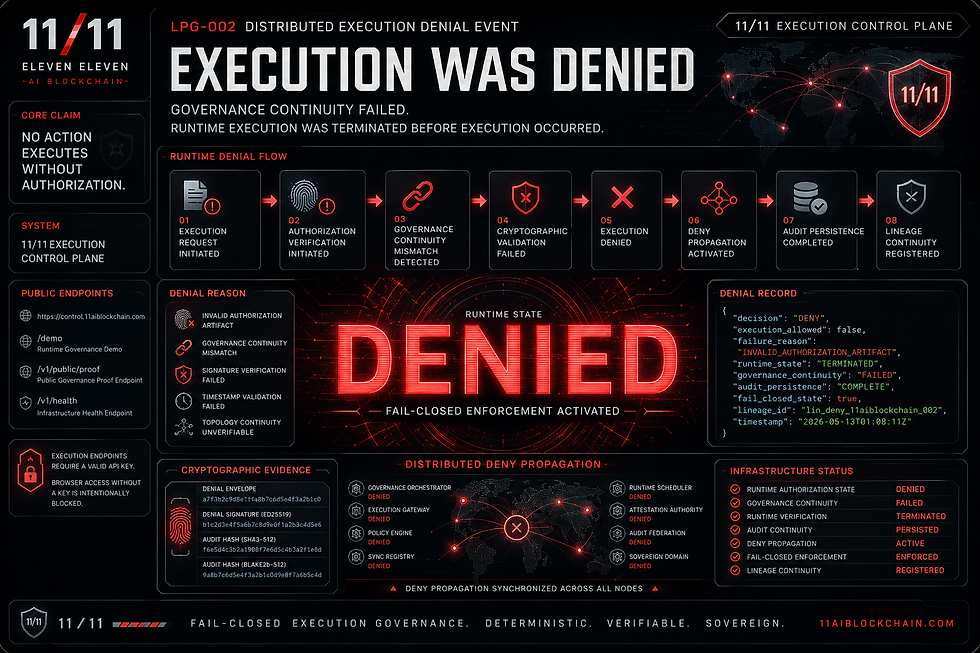
Execution endpoints intentionally require valid API authorization.
Browser access without a valid authorization key is fail-closed by design.
EA-11™ Execution Arithmetic™
Governed Computation™
Patent Pending

Comments