
Why EA-11 Introduces Computational Appeals


Every mature governance system recognizes the possibility of error.
Courts have appeals.
Regulators have reviews.
Oversight bodies have reconsideration procedures.
Governance systems remain trustworthy because authority is reviewable.
Traditional computing rarely follows this principle.
A computation executes.
A decision is produced.
An outcome occurs.
The result is often treated as final.
EA-11 challenges this assumption.
As autonomous systems increasingly influence:
sovereign AI systems
critical infrastructure
healthcare environments
financial platforms
defense operations
autonomous orchestration
machine-speed governance systems
computational decisions increasingly affect operational reality.
When authority exists, review must also exist.
This is where EA-11 introduces computational appeals.
Computational appeals establish that authoritative computational decisions may be reviewed, challenged, and re-evaluated through governed procedures.
A computation may be:
denied admissibility
denied authority
denied participation
denied standing
denied legitimacy
But denial should not automatically become permanence.
The system must be capable of examining:
changed trust conditions
corrected evidence
updated policy conditions
revised runtime context
improved verification
newly established legitimacy
Without appeals:
authority becomes rigid
trust weakens
governance becomes inflexible
error correction becomes difficult
legitimacy degrades
EA-11 therefore introduces appeals as a computational property.
This creates a new distinction.
Final Computation
A decision exists with no review path.
Appealable Computation
A decision exists within a governed review framework.
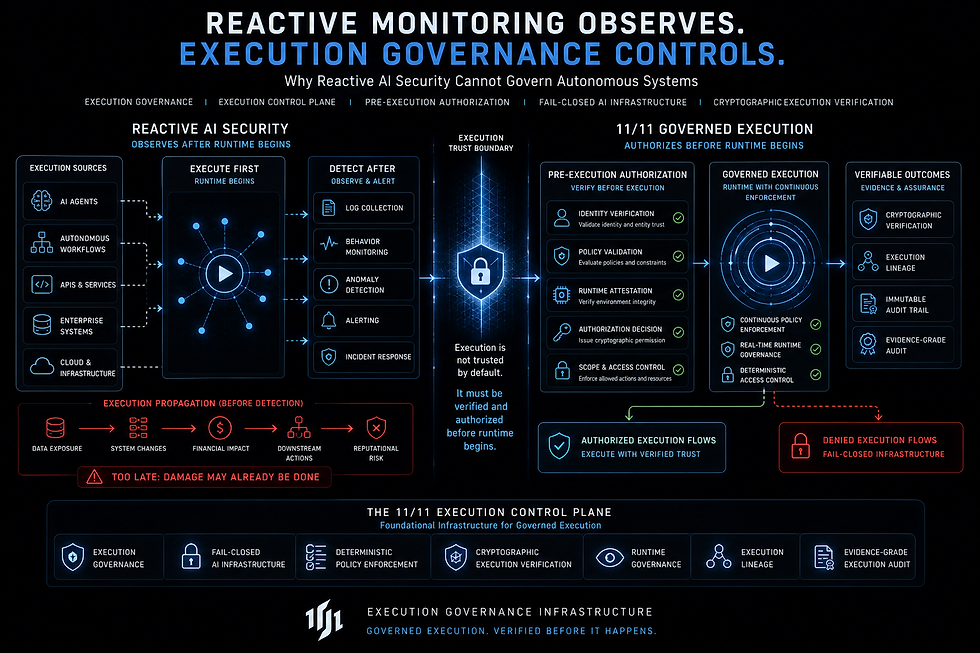
Traditional Computing:
Compute → Decide → Final
EA-11:
Compute → Decide → Reviewable → Governed Outcome
This distinction becomes increasingly important as autonomous systems scale.
Because future infrastructure will not merely require authority.
It will require legitimate authority.
Legitimate authority requires review.
Execution Governance™ establishes review mechanisms for execution decisions.
EA-11 establishes review mechanisms for computational decisions.
Together they create:
governed execution
governed computation
computational due process
computational standing
computational appeals
deterministic operational trust
As autonomous systems continue expanding globally, reviewability becomes increasingly important.
Because trusted governance is not defined by the absence of mistakes.
It is defined by the ability to identify, review, and correct them.
That is why EA-11 introduces computational appeals.
Public Infrastructure Endpoints
Public Runtime Infrastructure
Public Governance Console
Runtime Governance Demo
Public Governance Proof Viewer
Infrastructure Health Dashboard
Execution Lineage Explorer
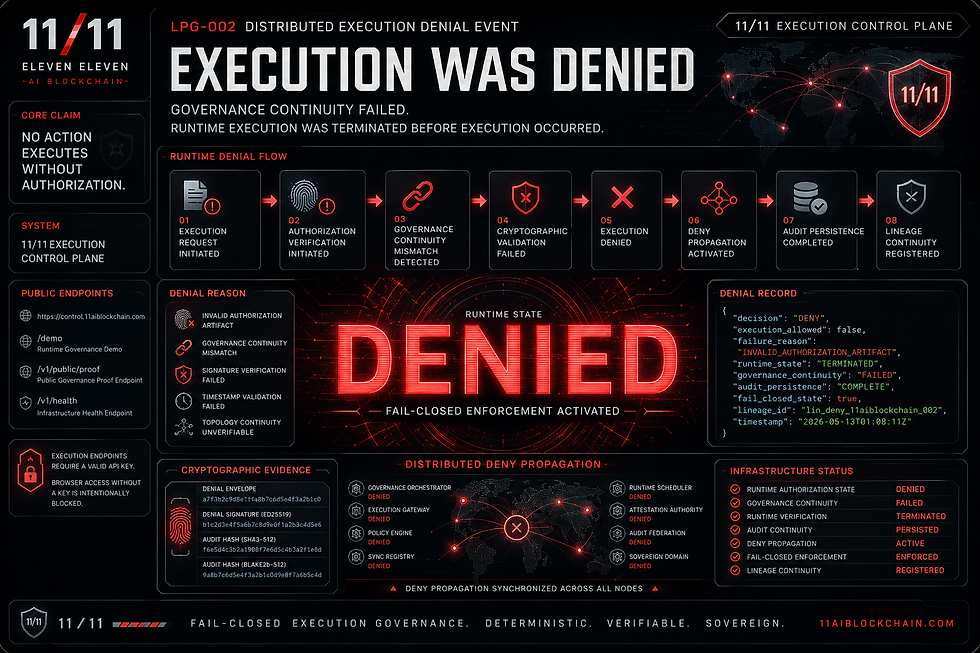
Execution endpoints intentionally require valid API authorization.
Browser access without a valid authorization key is fail-closed by design.
EA-11™
Execution Arithmetic™
Governed Computation™
Patent Pending

Comments