
Why EA-11 Introduces Computational Citizenship


Not every person automatically receives access to every system.
Not every process automatically receives authority.
Not every action automatically receives trust.
Yet traditional computing often assumes:
If computation occurs, it belongs.
EA-11 challenges that assumption.
As autonomous systems become increasingly responsible for machine-speed operational decisions, a new question emerges:
Should every computation automatically be accepted into a trusted system?
EA-11 answers:
No.
Computation must earn membership.
This is the foundation of computational citizenship.
Computational citizenship establishes that a computation must satisfy defined trust requirements before it is permitted to participate in an operational environment.
A computation may exist.
A result may be generated.
An outcome may be technically correct.
But existence alone does not create membership.
Citizenship must be earned.
This creates a new computational distinction.
Computation
A computational event occurred.
Computational Citizen
A computational event has satisfied the requirements necessary to participate inside a trusted operational system.
This distinction becomes increasingly important as autonomous infrastructure expands.
Machine-speed systems continuously generate computational outcomes across:
sovereign AI systems
autonomous orchestration
financial infrastructure
healthcare systems
defense environments
critical infrastructure
distributed execution platforms
Without citizenship controls:
untrusted computation enters trusted systems
policy violations propagate
legitimacy weakens
authority becomes uncertain
operational trust degrades
EA-11 introduces citizenship as a computational property.
A computation earns citizenship when it satisfies:
trust requirements
policy requirements
proof requirements
runtime requirements
integrity requirements
admissibility requirements
Only then does the computation become eligible to participate in operational reality.
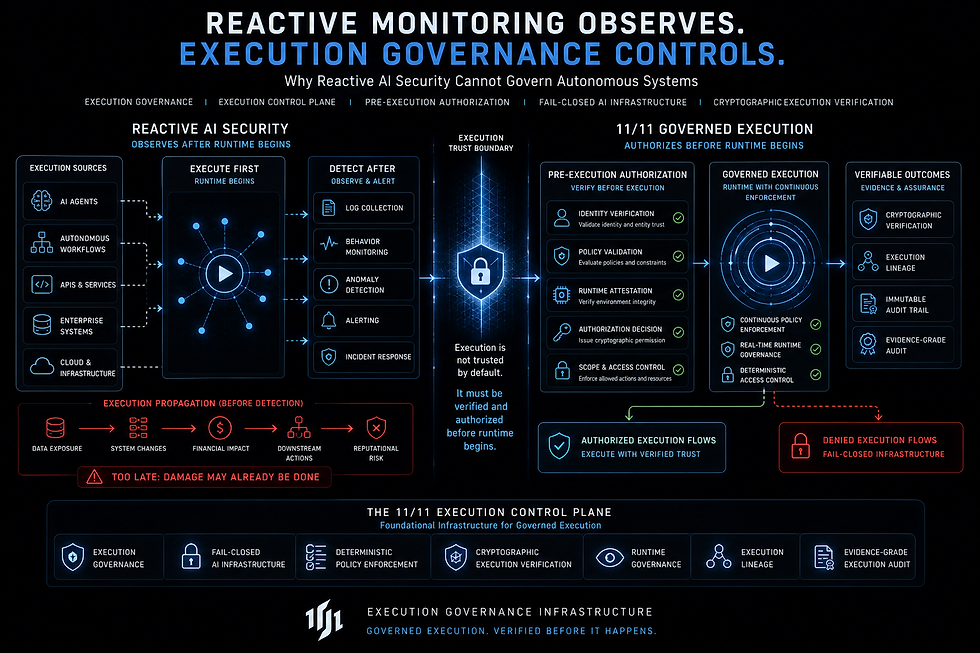
Traditional Computing:
Compute → Participate
EA-11:
Compute → Validate → Admit → Participate
This shifts computation from assumption-based inclusion to trust-based inclusion.
The implications are significant.
Future autonomous systems will increasingly depend on determining:
not merely what can be computed,
but what computations belong.
Execution Governance™ governs participation in execution.
EA-11 governs participation in computation itself.
Together they create:
governed execution
governed computation
computational citizenship
computational legitimacy
computational sovereignty
deterministic operational trust
As machine-speed systems continue scaling globally, citizenship becomes increasingly important.
Because future infrastructure will not simply depend on who can compute.
It will depend on which computations are permitted to belong.
That is why EA-11 introduces computational citizenship.
Public Infrastructure Endpoints
Public Runtime Infrastructure
Public Governance Console
Runtime Governance Demo
Public Governance Proof Viewer
Infrastructure Health Dashboard
Execution Lineage Explorer
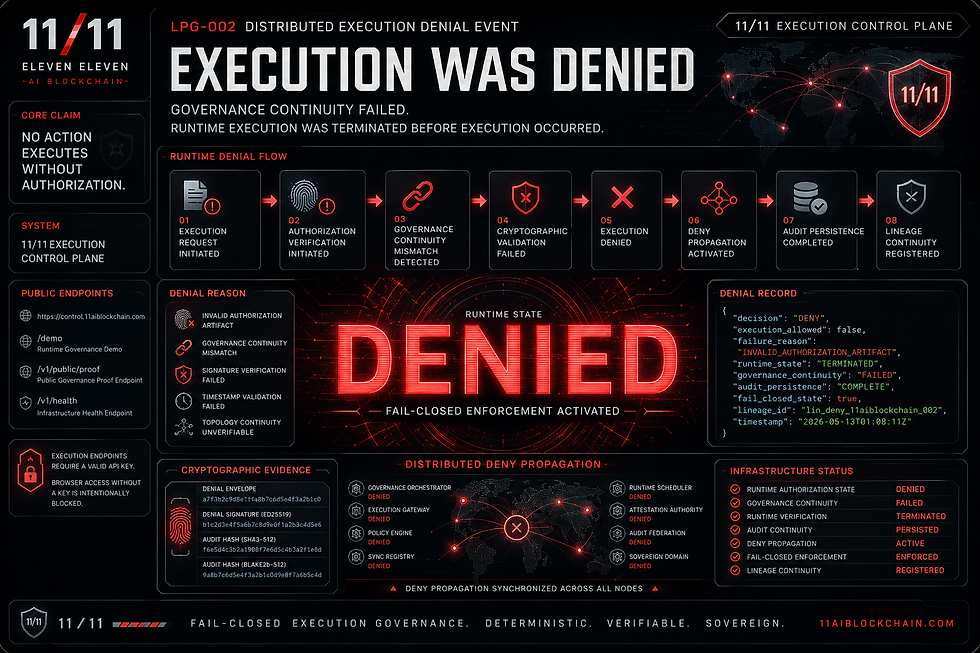
Execution endpoints intentionally require valid API authorization.
Browser access without a valid authorization key is fail-closed by design.
EA-11™ Execution Arithmetic™ Governed Computation™ Patent Pending

Comments