
Why EA-11 Introduces Computational Constitutionalism


Every stable system eventually develops a constitution.
Nations have constitutions.
Institutions have governing charters.
Courts operate within constitutional boundaries.
Organizations define foundational rules that determine authority and legitimacy.
Yet modern computing has historically lacked a computational constitution.
Computation occurs.
Outputs are generated.
Results are accepted.
Authority is frequently assumed.
The foundational rules governing computational legitimacy often remain undefined.
This becomes increasingly dangerous in autonomous systems.
As machine-speed infrastructure expands, computational outcomes increasingly influence:
sovereign AI systems
critical infrastructure
healthcare operations
financial environments
defense systems
autonomous orchestration
machine-speed governance platforms
In these environments, computation becomes operational authority.
Authority requires constitutional boundaries.
This is where EA-11 introduces computational constitutionalism.
Computational constitutionalism establishes that computation must operate within foundational rules that determine legitimacy, admissibility, authority, and trust.
A computational constitution defines:
what computation may occur
what computation may become authoritative
what trust conditions are required
what admissibility conditions exist
what authority boundaries apply
what sovereignty protections are enforced
Without constitutional constraints:
authority expands uncontrollably
trust becomes fragmented
legitimacy weakens
governance becomes reactive
sovereignty becomes difficult to preserve
EA-11 addresses this by introducing constitutional structure into computation itself.
This creates a new distinction.
Unconstrained Computation
A computation may become authoritative simply because it exists.
Constitutional Computation
A computation must satisfy foundational governance requirements before authority is granted.
This distinction becomes increasingly important as autonomous systems scale.
Because future infrastructure will not merely depend on computational capability.
It will depend on computational legitimacy.
Computational constitutionalism establishes the rules that define legitimacy itself.
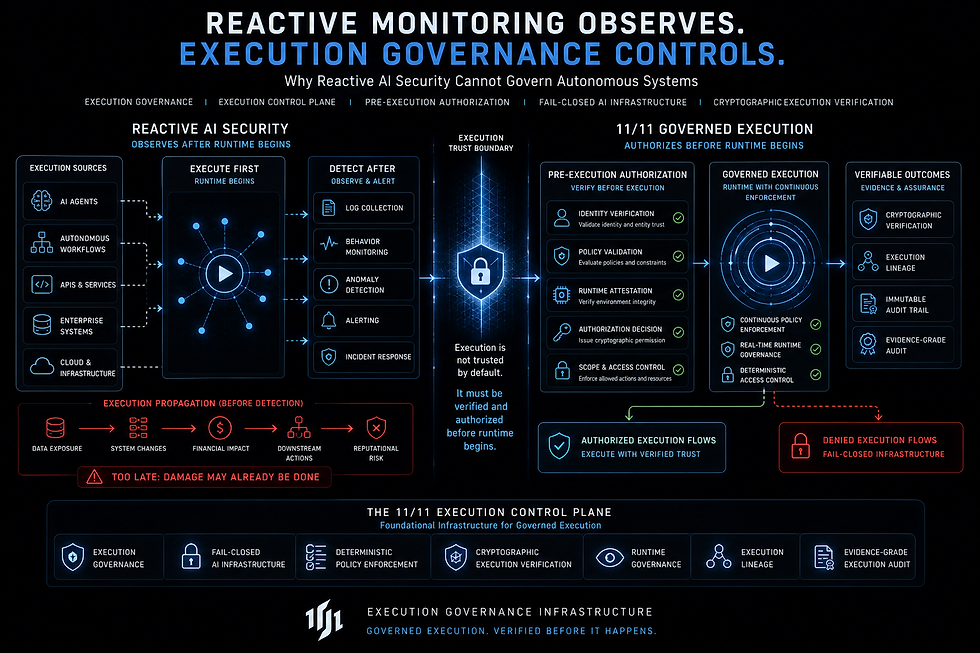
Execution Governance™ establishes constitutional boundaries for execution.
EA-11 establishes constitutional boundaries for computation.
Together they create:
governed execution
governed computation
computational authority
computational sovereignty
computational constitutionalism
deterministic operational trust
As autonomous systems continue expanding globally, constitutional structure becomes increasingly important.
Because future infrastructure will not be defined by which systems compute.
It will be defined by which systems define the constitutional rules under which computation becomes authoritative.
That is why EA-11 introduces computational constitutionalism.
Public Infrastructure Endpoints
Public Runtime Infrastructure
Public Governance Console
Runtime Governance Demo
Public Governance Proof Viewer
Infrastructure Health Dashboard
Execution Lineage Explorer
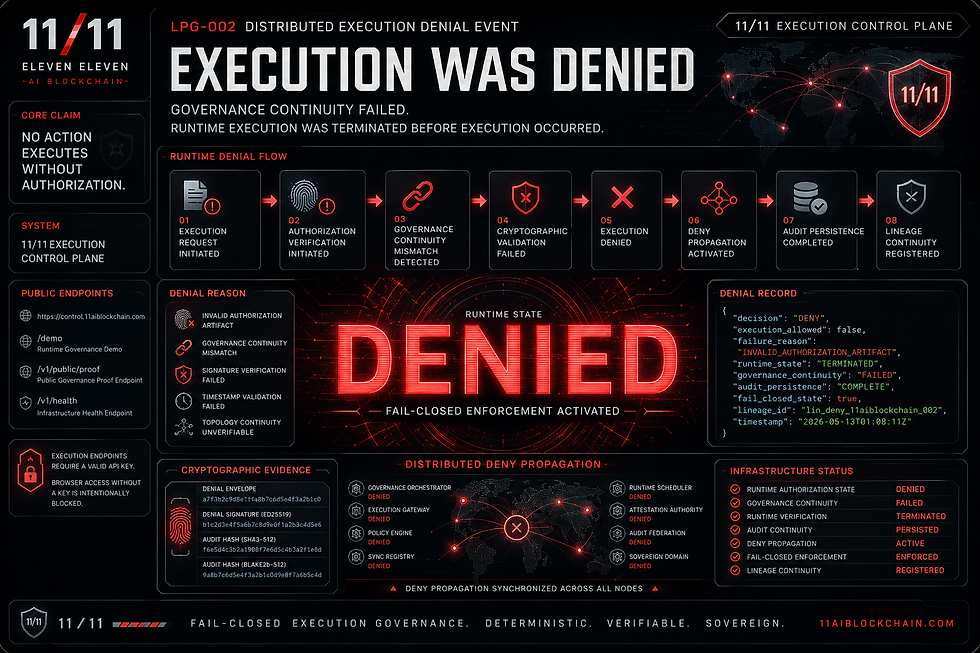
Execution endpoints intentionally require valid API authorization.
Browser access without a valid authorization key is fail-closed by design.
EA-11™ Execution Arithmetic™ Governed Computation™ Patent Pending

Comments