
Why EA-11 Introduces Computational Due Process


Authority should never be granted automatically.
Modern legal systems understand this principle.
Before authority is exercised, procedures exist.
Before a judgment is rendered, evidence is reviewed.
Before a decision becomes binding, validation occurs.
The concept is simple:
Authority requires process.
Yet traditional computing rarely follows this model.
Historically, computation has operated under a different assumption.
Input arrives.
Computation occurs.
Output is generated.
Authority is effectively granted automatically.
EA-11 challenges this assumption.
As autonomous systems increasingly influence sovereign infrastructure, machine-speed decisions become operationally consequential.
Computational outcomes increasingly affect:
sovereign AI systems
financial infrastructure
healthcare operations
defense environments
autonomous orchestration
critical infrastructure
machine-speed execution systems
In these environments, automatic authority becomes dangerous.
This is where EA-11 introduces computational due process.
Computational due process establishes that computational outcomes must satisfy procedural trust requirements before authority is granted.
A result may exist.
A computation may complete.
An output may be generated.
Yet authority is not automatic.
Authority must be earned.
Computational due process requires:
trust validation
policy validation
proof validation
runtime validation
integrity validation
admissibility validation
Only after these conditions are satisfied can computational authority exist.
This creates a new computational sequence.
Traditional Computing:
Input → Compute → Authority
EA-11:
Input → Validate → Verify → Admit → Authority
The distinction is critical.
Because future autonomous systems will increasingly operate without direct human review.
Computational due process creates safeguards between:
Computation
A result exists.
Authoritative Computation
A result exists and has satisfied required procedural conditions.
This reduces:
operational risk
invalid authority
untrusted outcomes
policy violations
computational abuse
machine-speed governance failures
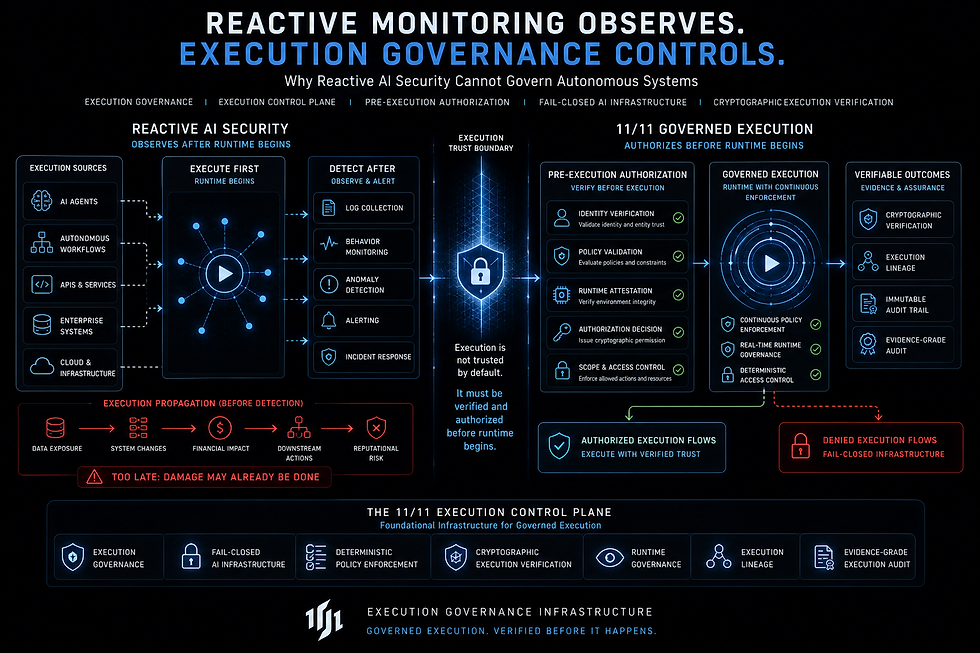
Execution Governance™ establishes due process for execution.
EA-11 establishes due process for computation.
Together they create:
governed execution
governed computation
computational legitimacy
computational authority
computational accountability
computational due process
As autonomous systems become more powerful, due process becomes increasingly important.
Because future infrastructure will not simply depend on what systems compute.
It will depend on whether those computations earned authority through process rather than assumption.
That is why EA-11 introduces computational due process.
Public Infrastructure Endpoints
Public Runtime Infrastructure
Public Governance Console
Runtime Governance Demo
Public Governance Proof Viewer
Infrastructure Health Dashboard
Execution Lineage Explorer
Execution endpoints intentionally require valid API authorization.
Browser access without a valid authorization key is fail-closed by design.
EA-11™ Execution Arithmetic™ Governed Computation™ Patent Pending


Comments