
Why EA-11 Introduces Computational Evidence


Modern computing produces results.
EA-11 requires evidence.
For decades, computational systems operated under a simple assumption:
If a result exists, the result can be trusted.
The computational process occurred.
An outcome was generated.
The system moved forward.
Little attention was given to proving why the computation deserved trust.
That assumption becomes increasingly dangerous in autonomous systems.
Machine-speed environments continuously generate computational outcomes that influence:
sovereign AI systems
autonomous infrastructure
healthcare operations
financial systems
defense environments
critical infrastructure
machine-speed orchestration
In these environments, outcomes become operational reality.
Operational reality requires evidence.
This is where EA-11 introduces computational evidence.
Computational evidence establishes that trusted computation must be supported by verifiable proof explaining why the computation deserves authority.
The result alone is insufficient.
The system must demonstrate:
what trust conditions existed
what policies governed computation
what runtime states were validated
what integrity conditions were satisfied
what admissibility controls were applied
what authority conditions were granted
Without evidence, trust becomes assumption.
Without evidence, legitimacy becomes uncertain.
Without evidence, authority becomes difficult to justify.
EA-11 treats this as unacceptable.
Because future autonomous systems will increasingly operate without direct human supervision.
Computational outcomes must therefore become evidentiary.
This creates a new distinction.
Computation
A result exists.
Evidenced Computation
A result exists and can prove why it deserves trust.
This distinction becomes increasingly important as machine-speed infrastructure expands.
Because future systems will not simply ask:
What was computed?
They will ask:
What evidence justified the computation?
EA-11 introduces evidence as a computational property.
Not merely an audit property.
Not merely a reporting function.
A computational requirement.
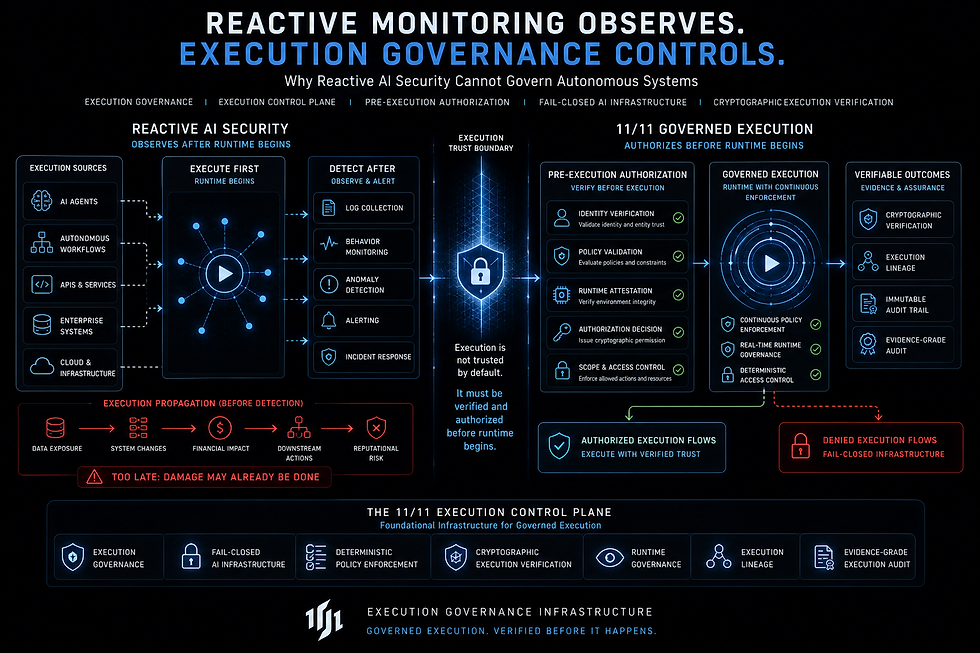
This extends governance deeper than execution.
Execution Governance™ establishes evidentiary execution.
EA-11 establishes evidentiary computation.
Together they create:
governed execution
governed computation
computational provenance
computational lineage
computational evidence
deterministic operational trust
As autonomous systems continue scaling globally, evidence becomes increasingly important.
Because trust without evidence eventually becomes assumption.
And assumption is not a foundation for sovereign infrastructure.
That is why EA-11 introduces computational evidence.
Public Infrastructure Endpoints
Public Runtime Infrastructure
Public Governance Console
Runtime Governance Demo
Public Governance Proof Viewer
Infrastructure Health Dashboard
Execution Lineage Explorer
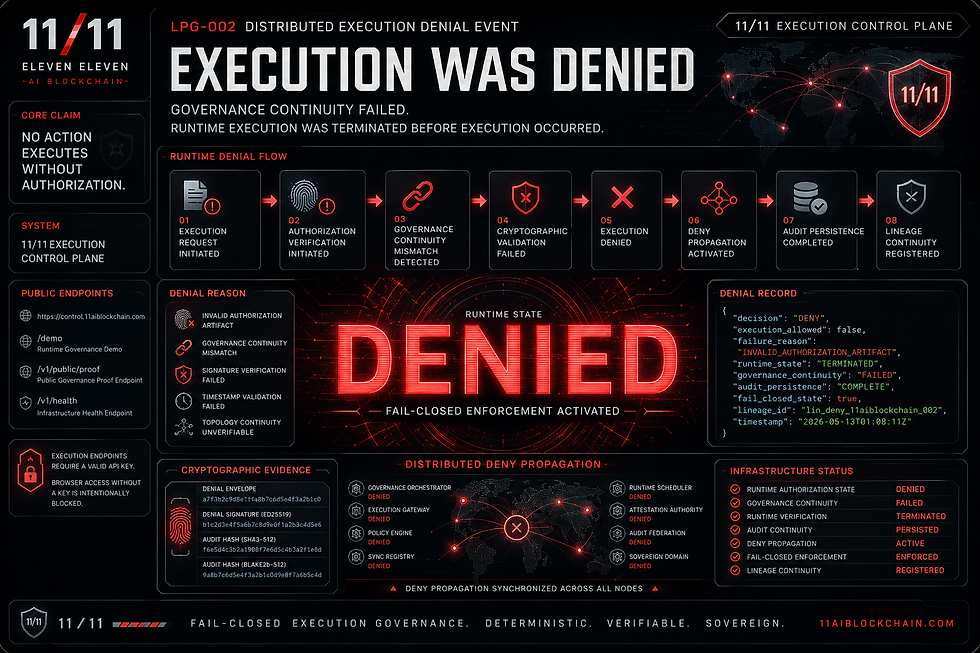
Execution endpoints intentionally require valid API authorization.
Browser access without a valid authorization key is fail-closed by design.
EA-11™
Execution Arithmetic™
Governed Computation™
Patent Pending

Comments