
Why EA-11 Introduces Computational Integrity

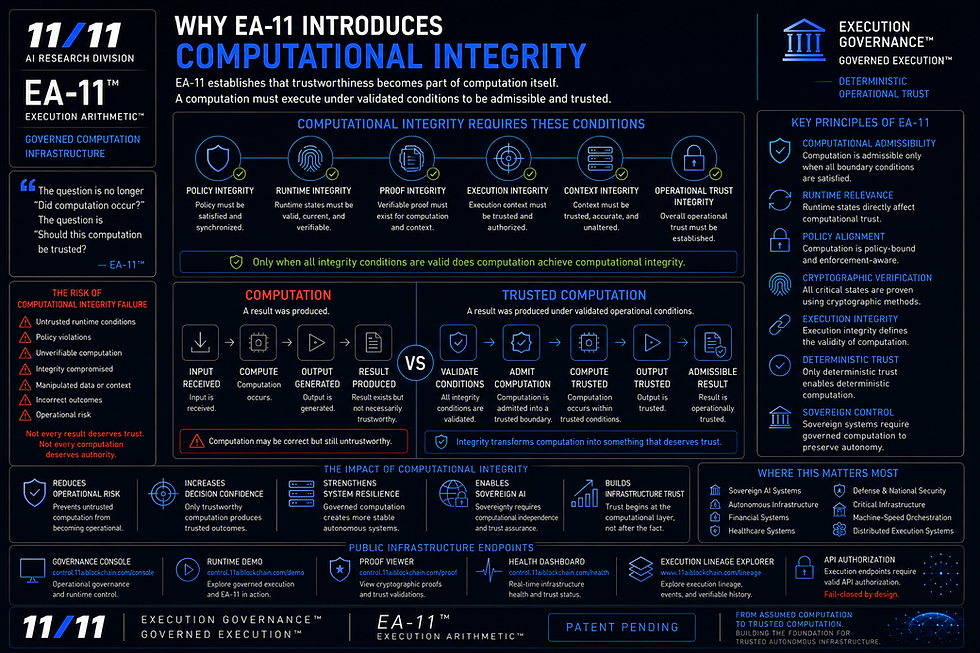
Modern computing assumes integrity belongs to systems, data, and execution.
EA-11 extends integrity deeper.
Into computation itself.
For decades, computational outcomes were largely accepted if:
inputs existed
processors functioned
execution completed
outputs were produced
The computational process itself was rarely questioned.
If computation occurred successfully, integrity was generally assumed.
But autonomous systems change this assumption.
Today, machine-speed systems continuously generate computational outcomes that influence real-world operations.
Those outcomes increasingly affect:
sovereign AI systems
financial infrastructure
healthcare environments
defense systems
critical infrastructure
autonomous orchestration
machine-speed governance
In these environments, computational outcomes become operationally consequential.
A computational result may be technically correct while still being operationally untrustworthy.
The problem is no longer:
Did computation occur?
The problem becomes:
Should this computation be trusted?
This is where EA-11 introduces computational integrity.
Computational integrity establishes that trustworthiness becomes part of computation itself.
A computation must not only execute correctly.
It must execute under trusted conditions.
Policy integrity matters.
Runtime integrity matters.
Proof integrity matters.
Execution integrity matters.
Context integrity matters.
Operational trust integrity matters.
Only when these conditions remain valid can computational integrity exist.
This creates a new computational boundary.
Not every computational outcome possesses integrity.
Not every result deserves authority.
Not every calculation deserves operational trust.
Computational integrity becomes the mechanism that separates:
Computation
A result was produced.
Trusted Computation
A result was produced under validated operational conditions.
This distinction becomes increasingly important as autonomous systems scale.
Future infrastructure will not merely depend on correct answers.
It will depend on trustworthy answers.
The difference is significant.
A mathematically correct result generated under compromised conditions may still create operational risk.
EA-11 therefore treats integrity as a computational property rather than merely an execution property.
This extends governance deeper than runtime enforcement.
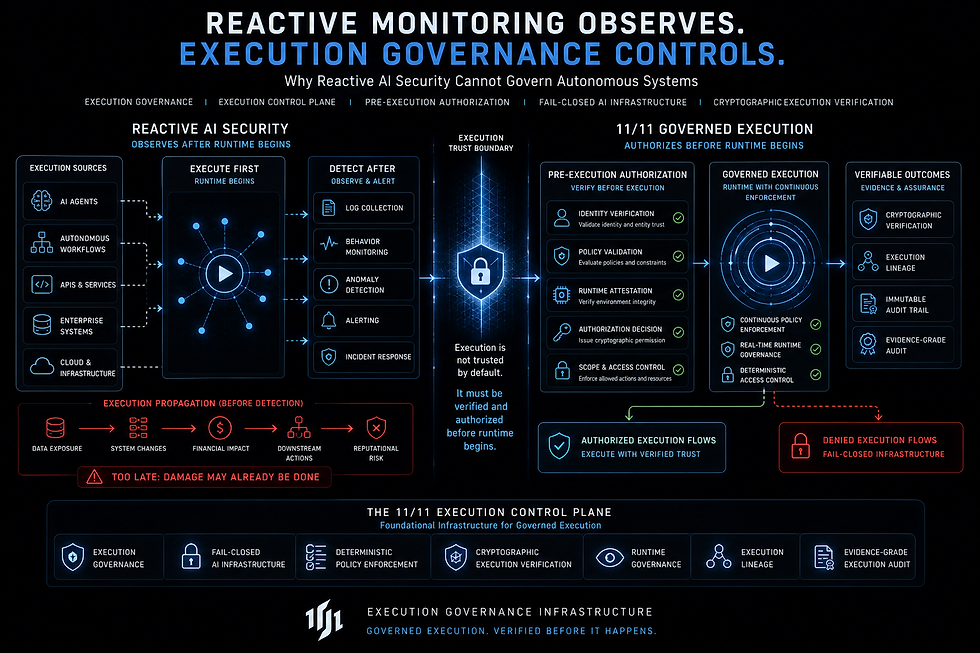
Execution Governance™ governs execution trust.
EA-11 governs computational trust.
Together they establish:
governed execution
governed computation
computational admissibility
computational integrity
deterministic operational trust
As autonomous systems become more capable, computational integrity becomes increasingly critical.
Because future infrastructure will not be defined solely by what systems can compute.
It will be defined by what computations deserve trust.
That is why EA-11 introduces computational integrity.
Public Infrastructure Endpoints
Public Runtime Infrastructure
Public Governance Console
Runtime Governance Demo
Public Governance Proof Viewer
Infrastructure Health Dashboard
Execution Lineage Explorer
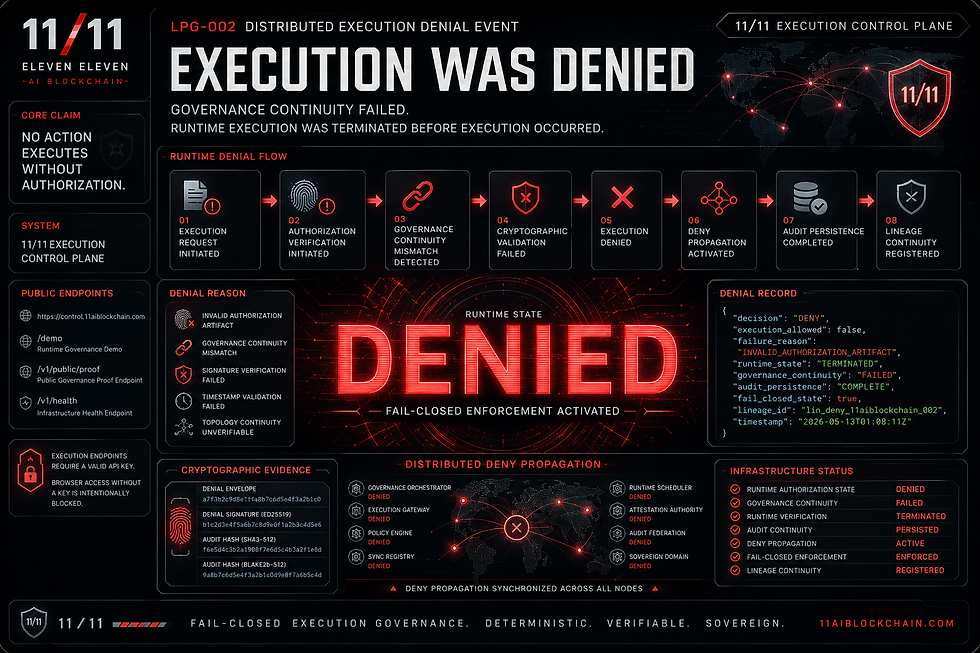
Execution endpoints intentionally require valid API authorization.
Browser access without a valid authorization key is fail-closed by design.
EA-11™
Execution Arithmetic™
Governed Computation™
Patent Pending

Comments