
Why EA-11 Introduces Computational Legitimacy

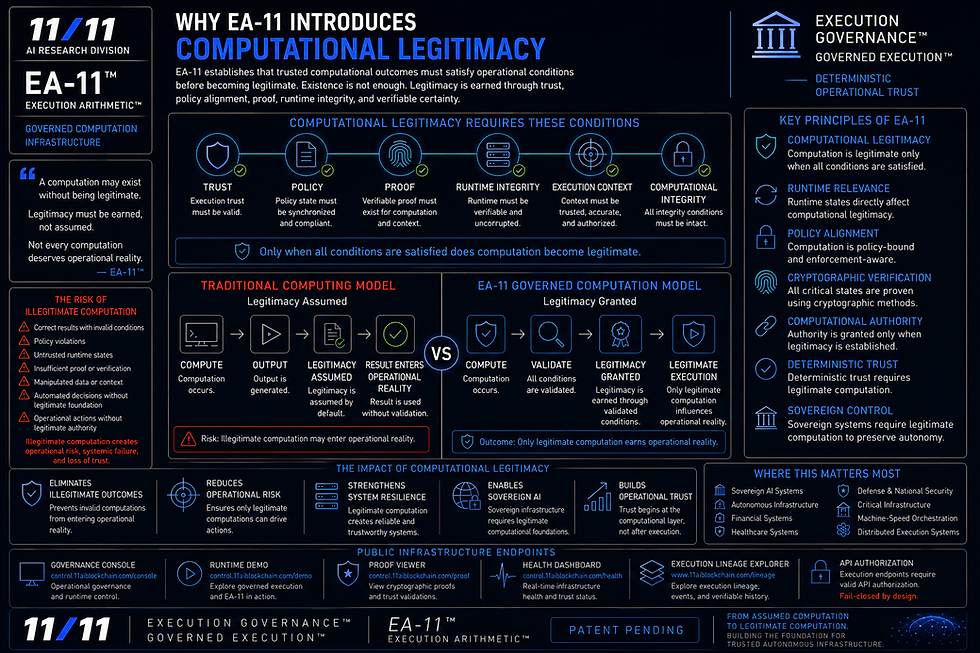
A computation may exist without being legitimate.
This distinction has rarely existed in traditional computing.
Historically, if a system successfully computed a result, legitimacy was often assumed automatically.
The computation occurred.
The output was generated.
The result entered operational reality.
Few systems questioned whether the computational outcome itself deserved legitimacy.
EA-11 changes that assumption.
As autonomous systems increasingly influence sovereign infrastructure, machine-speed orchestration, AI decision systems, healthcare operations, financial infrastructure, and defense environments, computation becomes more than mathematics.
Computation becomes authority.
Computation becomes action.
Computation becomes infrastructure.
This creates a new problem.
Not every computational result deserves legitimacy.
A result may be mathematically correct while being operationally invalid.
A result may be generated under compromised runtime conditions.
A result may violate policy certainty.
A result may originate from untrusted computational states.
A result may be produced without sufficient proof.
Under traditional models, the result still exists.
Under EA-11, existence alone is insufficient.
Legitimacy must be earned.
Computational legitimacy establishes that trusted computational outcomes must satisfy operational conditions before becoming authoritative.
These conditions include:
trust
policy
proof
runtime integrity
execution context
computational integrity
If these conditions fail, legitimacy fails.
The computation may still occur.
But legitimacy is denied.
This creates a new computational architecture.
Traditional Computing:
Compute → Output → Legitimacy Assumed
EA-11:
Compute → Validate → Legitimacy Granted
This distinction is increasingly important because autonomous systems continuously generate operational decisions without direct human supervision.
Future infrastructure will not simply depend on whether a computation occurred.
It will depend on whether the computation deserves legitimacy.
EA-11 therefore introduces a new computational principle:
Not every computation deserves operational reality.
Legitimacy becomes a computational property.
Not merely an execution property.
Not merely a governance property.
A computational property.
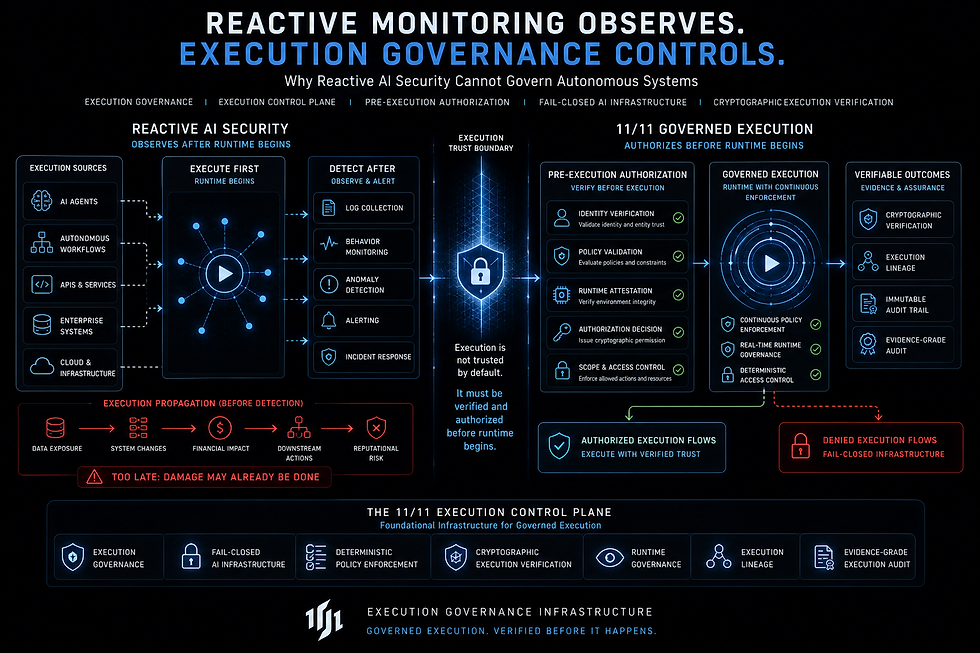
Execution Governance™ governs execution legitimacy.
EA-11 governs computational legitimacy.
Together they establish:
governed execution
governed computation
computational authority
computational legitimacy
deterministic operational trust
As autonomous systems continue expanding globally, legitimacy will become one of the most important infrastructure concepts of the machine-speed era.
Because future infrastructure will not be defined by who computes the most.
It will be defined by who determines which computations deserve legitimacy.
That is why EA-11 introduces computational legitimacy.
Public Infrastructure Endpoints
Public Runtime Infrastructure
Public Governance Console
Runtime Governance Demo
Public Governance Proof Viewer
Infrastructure Health Dashboard
Execution Lineage Explorer
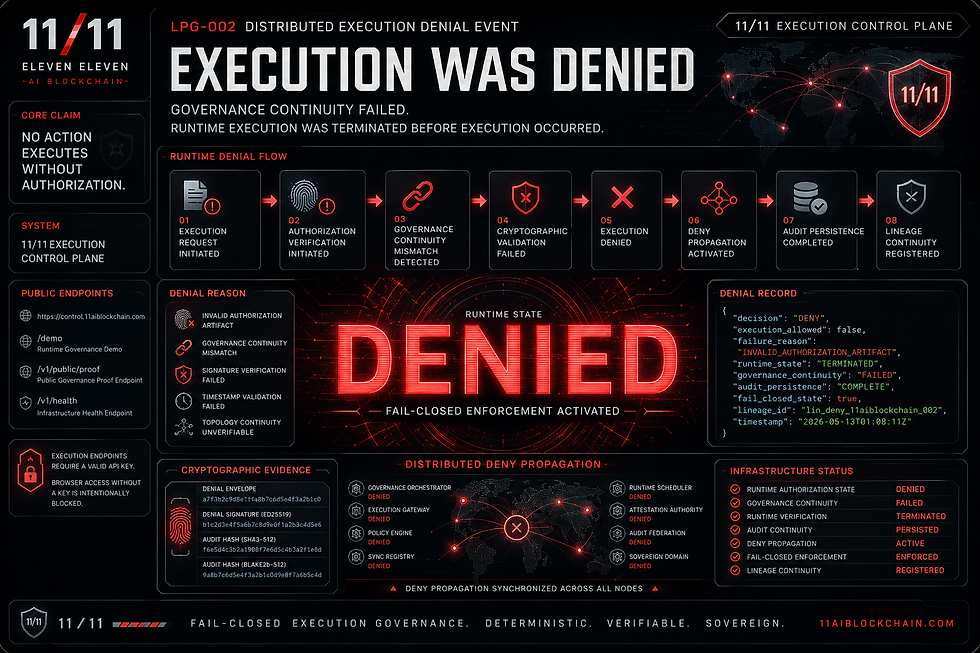
Execution endpoints intentionally require valid API authorization.
Browser access without a valid authorization key is fail-closed by design.
EA-11™
Execution Arithmetic™
Governed Computation™
Patent Pending

Comments