
Why EA-11 Introduces Computational Lineage


Trust does not emerge from outcomes alone.
Trust emerges from understanding how an outcome came to exist.
Traditional computing generally focuses on results.
Inputs are processed.
Computation occurs.
Outputs are generated.
The system moves forward.
But autonomous systems create a new requirement.
They require visibility into the computational path itself.
Not merely the outcome.
The lineage.
This is where EA-11 introduces computational lineage.
As machine-speed systems increasingly influence:
sovereign AI systems
autonomous orchestration
financial infrastructure
healthcare operations
defense environments
critical infrastructure
distributed execution systems
computational outcomes become operationally significant.
And operational significance requires traceability.
A result may appear valid.
But without lineage, critical questions remain unanswered.
What conditions shaped the computation?
What policies governed the computation?
What runtime states existed?
What trust assumptions were validated?
What admissibility decisions occurred?
What computational path produced the result?
EA-11 treats these questions as essential.
Computational lineage establishes a verifiable chain connecting computational outcomes to their originating trust conditions.
A trusted computation should be able to demonstrate:
origin
context
policy state
runtime conditions
proof conditions
admissibility decisions
integrity validations
resulting outcomes
Without lineage, computation becomes opaque.
With lineage, computation becomes accountable.
This distinction becomes increasingly important as autonomous systems scale.
Future infrastructure will not simply depend on trustworthy outputs.
It will depend on trustworthy computational histories.
EA-11 therefore introduces lineage as a computational property.
Not merely an audit property.
Not merely a reporting feature.
A computational requirement.
This creates a new distinction.
Computation
A result exists.
Lineaged Computation
A result exists and its entire computational chain is verifiable.
This distinction enables:
computational trust
computational accountability
computational legitimacy
computational authority
computational sovereignty
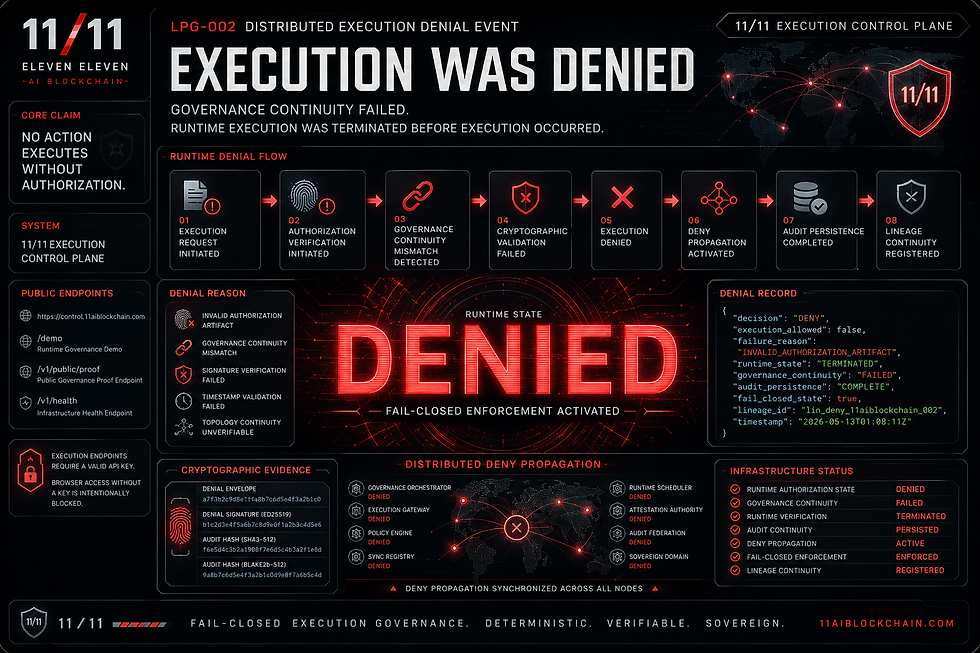
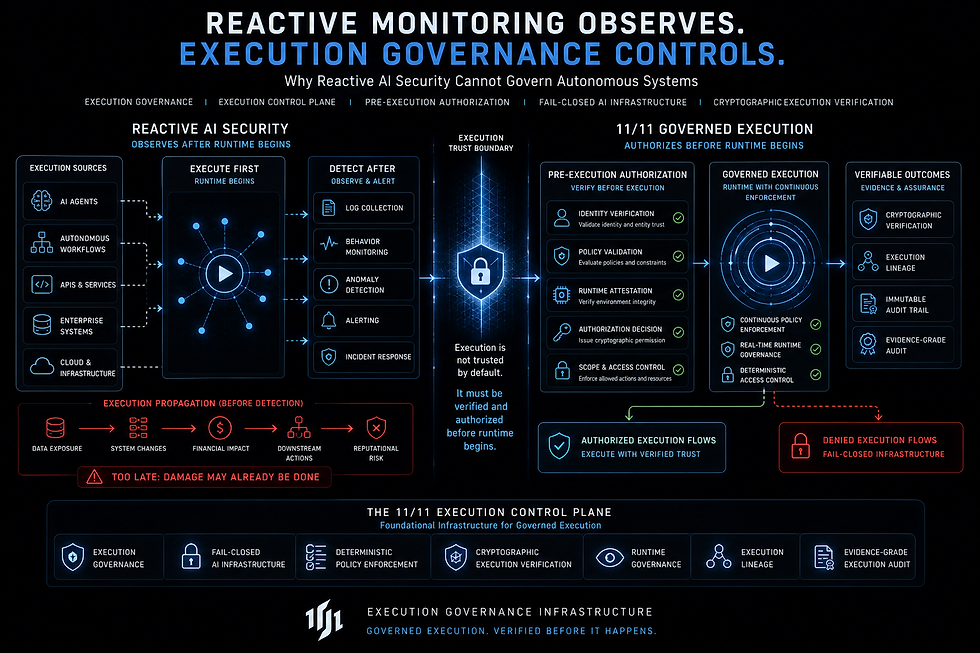
Execution Governance™ establishes execution lineage.
EA-11 establishes computational lineage.
Together they create:
governed execution
governed computation
execution lineage
computational lineage
deterministic operational trust
As autonomous infrastructure continues expanding globally, lineage becomes increasingly important.
Because future systems will not merely ask:
What was the result?
They will ask:
How did this result become admissible?
That answer requires lineage.
That is why EA-11 introduces computational lineage.
Public Infrastructure Endpoints
Public Runtime Infrastructure
Public Governance Console
Runtime Governance Demo
Public Governance Proof Viewer
Infrastructure Health Dashboard
Execution Lineage Explorer
Execution endpoints intentionally require valid API authorization.
Browser access without a valid authorization key is fail-closed by design.
EA-11™
Execution Arithmetic™
Governed Computation™
Patent Pending

Comments