
Why EA-11 Introduces Computational Personhood


Modern systems increasingly treat computation as an actor.
Computations influence decisions.
Computations trigger workflows.
Computations authorize actions.
Computations allocate resources.
Computations increasingly shape operational reality.
Yet traditional computing still treats computation as if it were merely an event.
EA-11 argues that this assumption is becoming obsolete.
As autonomous systems expand across:
sovereign AI systems
autonomous infrastructure
financial platforms
healthcare systems
defense environments
critical infrastructure
machine-speed governance systems
computation increasingly behaves as an operational participant.
Participants require governance.
Participants require identity.
Participants require accountability.
Participants require responsibility.
This is where EA-11 introduces computational personhood.
Computational personhood establishes that authoritative computation must possess governance characteristics traditionally associated with accountable actors.
This does not mean computation becomes human.
It means computation becomes governable.
To possess computational personhood, a computation must demonstrate:
identity
standing
citizenship
accountability
responsibility
legitimacy
admissibility
Without these properties, computation remains an event.
With these properties, computation becomes a governed participant.
This creates a new distinction.
Computational Event
A result exists.
Computational Person
A result exists and possesses the governance properties necessary to participate in operational reality.
This distinction becomes increasingly important as machine-speed systems scale.
Because future infrastructure will increasingly depend on computational actors rather than purely human actors.
Those actors require governance.
EA-11 therefore introduces personhood as a computational framework.
Not as a legal framework.
Not as a biological framework.
A governance framework.
The objective is simple:
A computation should not possess authority unless it can also possess accountability.
A computation should not influence outcomes unless it can also be governed.
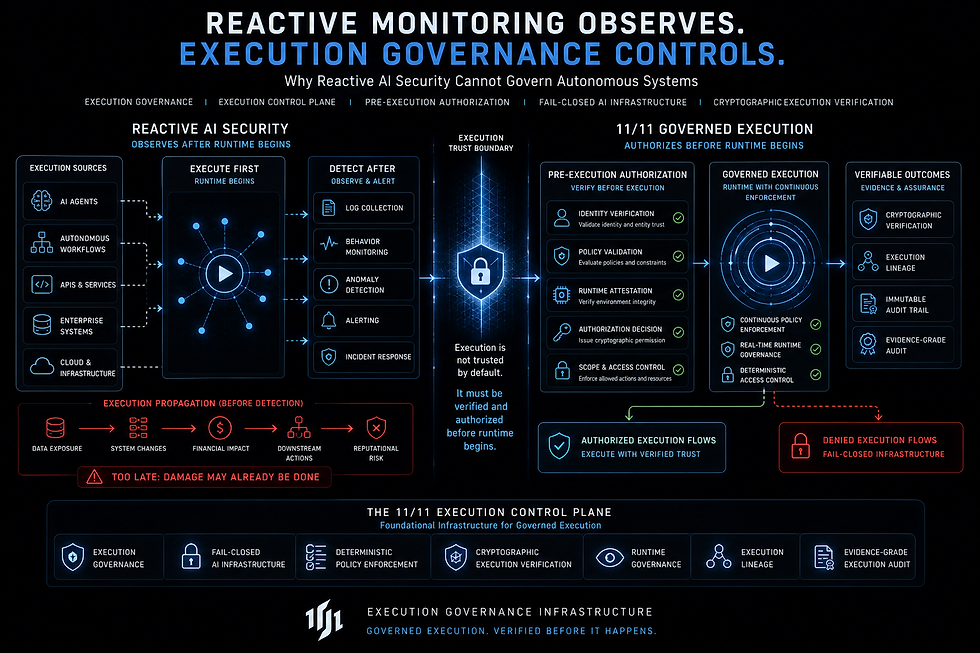
Traditional Computing:
Compute → Influence
EA-11:
Identify → Validate → Admit → Govern → Influence
Execution Governance™ establishes governable execution.
EA-11 establishes governable computation.
Together they create:
governed execution
governed computation
computational identity
computational standing
computational personhood
deterministic operational trust
As autonomous systems continue expanding globally, personhood becomes increasingly important.
Because future infrastructure will not simply ask:
What computation occurred?
It will ask:
Is this computation qualified to participate?
That is why EA-11 introduces computational personhood.
Public Infrastructure Endpoints
Public Runtime Infrastructure
Public Governance Console
Runtime Governance Demo
Public Governance Proof Viewer
Infrastructure Health Dashboard
Execution Lineage Explorer
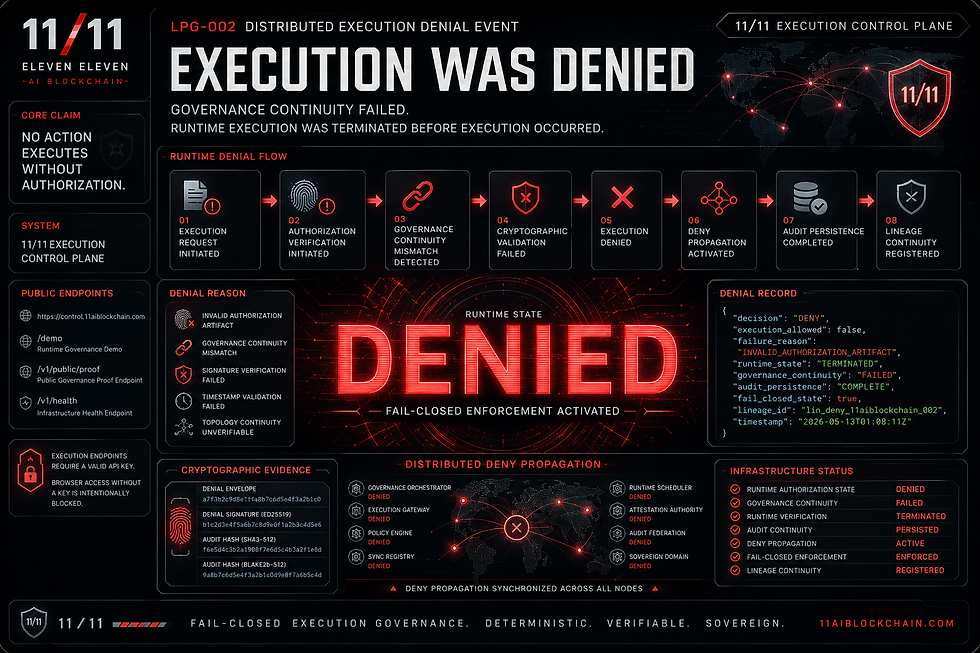
Execution endpoints intentionally require valid API authorization.
Browser access without a valid authorization key is fail-closed by design.
EA-11™ Execution Arithmetic™ Governed Computation™ Patent Pending

Comments