
Why EA-11 Introduces Computational Precedent


Governance systems do not begin from zero every time a decision is made.
Courts rely on precedent.
Regulators rely on precedent.
Standards bodies rely on precedent.
Institutions rely on precedent.
Past decisions help establish future consistency.
Traditional computing rarely works this way.
A computation occurs.
A decision is produced.
The result is applied.
The next computation begins again with little awareness of previous governance outcomes.
EA-11 challenges this model.
As autonomous systems increasingly influence:
sovereign AI systems
financial infrastructure
healthcare operations
defense environments
autonomous orchestration
critical infrastructure
machine-speed governance systems
computational decisions increasingly require consistency.
Consistency requires precedent.
This is where EA-11 introduces computational precedent.
Computational precedent establishes that trusted computational decisions should inform future governance decisions.
A decision should not simply disappear after execution.
Its governance outcome should become part of the system's operational knowledge.
Computational precedent preserves:
admissibility outcomes
authority decisions
appeals outcomes
trust determinations
policy interpretations
governance resolutions
operational lessons
Without precedent:
decisions become inconsistent
authority becomes unpredictable
trust becomes fragmented
governance becomes unstable
operational confidence weakens
EA-11 therefore introduces precedent as a computational property.
This creates a new distinction.
Isolated Computation
A decision exists only for a single event.
Precedential Computation
A decision contributes to future governance consistency.
Traditional Computing:
Compute → Decide → Forget
EA-11:
Compute → Govern → Record → Reference
This distinction becomes increasingly important as autonomous systems scale.
Because future infrastructure will increasingly depend on consistent governance outcomes.
Not every decision should be reinvented.
Not every admissibility determination should be rediscovered.
Not every trust condition should be interpreted differently.
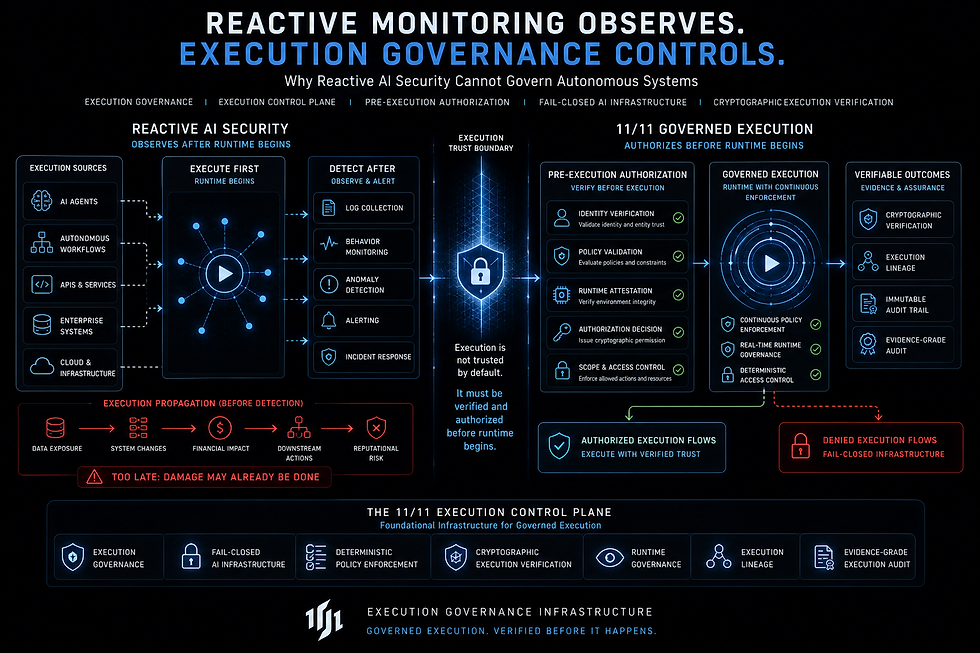
Execution Governance™ establishes precedent for execution governance.
EA-11 establishes precedent for computational governance.
Together they create:
governed execution
governed computation
computational appeals
computational precedent
computational consistency
deterministic operational trust
As autonomous systems continue expanding globally, precedent becomes increasingly important.
Because trust is strengthened when governance behaves consistently.
And consistency requires memory.
That is why EA-11 introduces computational precedent.
Public Infrastructure Endpoints
Public Runtime Infrastructure
Public Governance Console
Runtime Governance Demo
Public Governance Proof Viewer
Infrastructure Health Dashboard
Execution Lineage Explorer
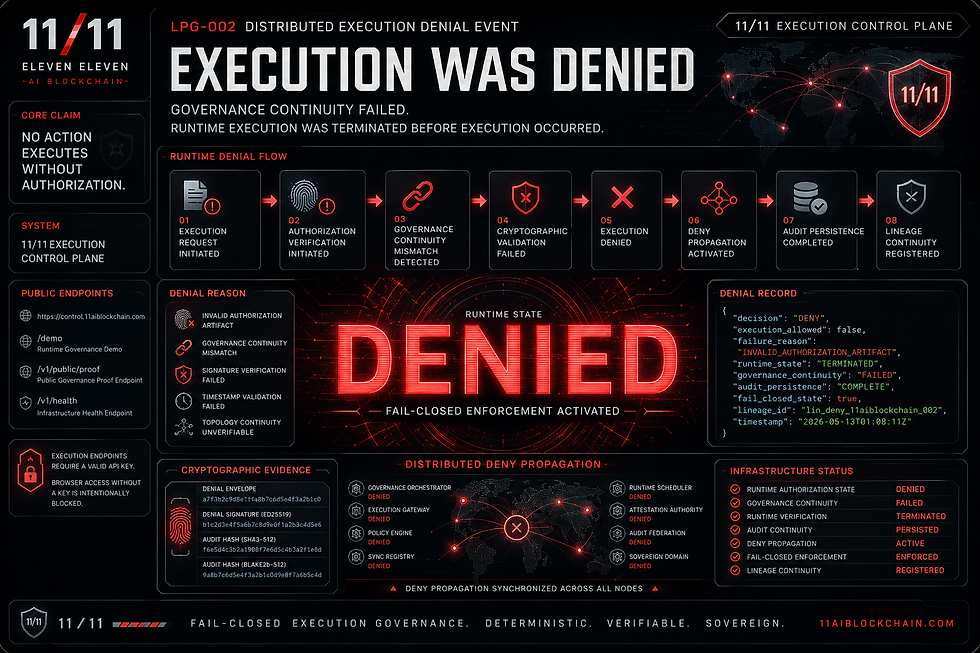
Execution endpoints intentionally require valid API authorization.
Browser access without a valid authorization key is fail-closed by design.
EA-11™ Execution Arithmetic™ Governed Computation™ atent Pending

Comments