
Why EA-11 Introduces Computational Representation


Authority without representation has historically created governance problems.
Political systems learned this lesson centuries ago.
Institutions learned this lesson repeatedly.
Power that acts without representing legitimate interests eventually loses trust.
Yet traditional computing rarely considers representation.
A computation occurs.
A result is generated.
An outcome influences reality.
The system moves forward.
Few systems ask:
Who or what is this computation actually representing?
EA-11 introduces that question directly.
As autonomous systems increasingly influence:
sovereign AI systems
autonomous infrastructure
financial operations
healthcare systems
defense environments
machine-speed orchestration
critical infrastructure
computational outcomes increasingly act as operational representatives.
The computation is no longer passive.
The computation speaks on behalf of something.
Policy.
Authority.
Trust.
Operational objectives.
Sovereign interests.
This creates a new computational requirement.
Representation.
Computational representation establishes that authoritative computation must clearly represent validated interests, policies, objectives, and governance frameworks.
A computation should not simply produce an outcome.
It should be able to demonstrate:
what interests it represents
what policies it represents
what authority framework it represents
what operational objectives it represents
what governance conditions it represents
what trust boundaries it represents
Without representation:
authority becomes ambiguous
accountability weakens
legitimacy degrades
sovereignty becomes difficult to defend
trust becomes uncertain
EA-11 therefore introduces representation as a computational property.
This creates a new distinction.
Computation
A result exists.
Representative Computation
A result exists and can demonstrate what legitimate interests it represents.
This distinction becomes increasingly important as autonomous systems scale.
Because future infrastructure will increasingly depend on determining:
not merely what was computed,
but:
who the computation was acting for.
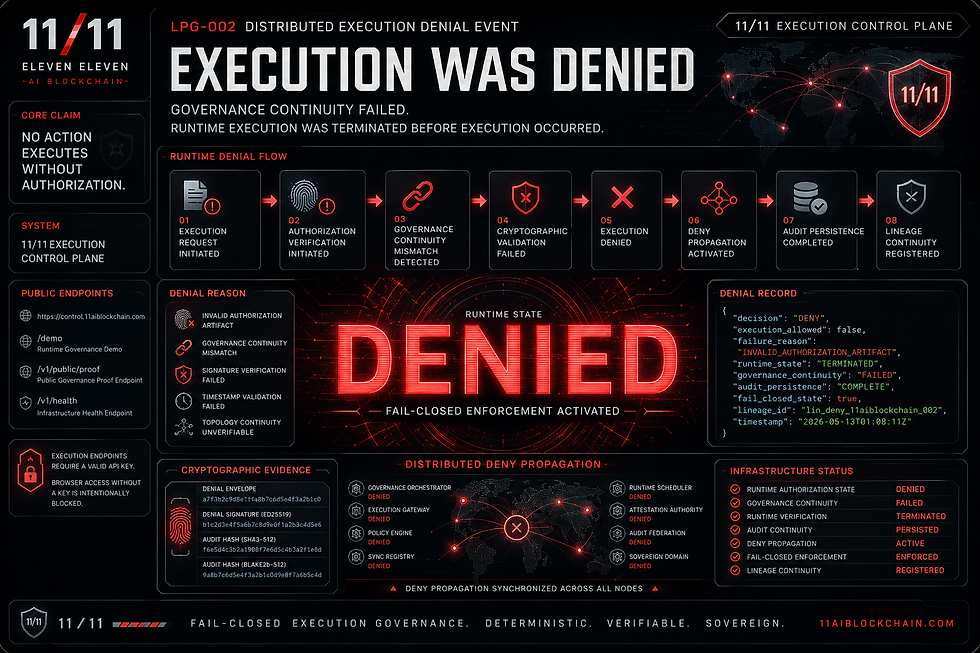
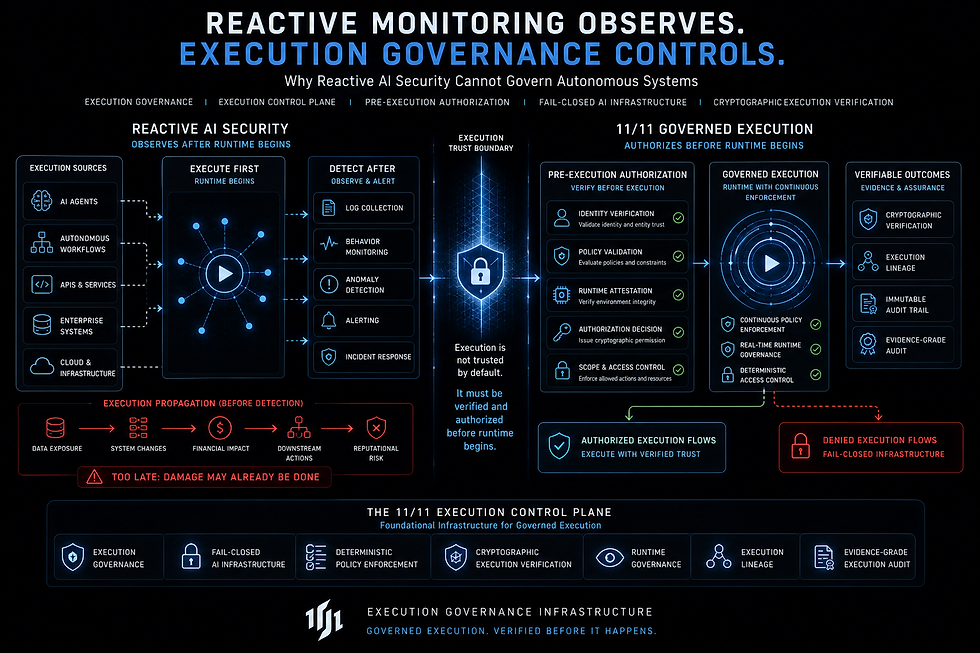
Execution Governance™ establishes representation for execution authority.
EA-11 establishes representation for computational authority.
Together they create:
governed execution
governed computation
computational citizenship
computational rights
computational representation
deterministic operational trust
As machine-speed systems continue expanding globally, representation becomes increasingly important.
Because future infrastructure will not simply depend on authority.
It will depend on legitimate authority.
And legitimate authority requires representation.
That is why EA-11 introduces computational representation.
Public Infrastructure Endpoints
Public Runtime Infrastructure
Public Governance Console
Runtime Governance Demo
Public Governance Proof Viewer
Infrastructure Health Dashboard
Execution Lineage Explorer
Execution endpoints intentionally require valid API authorization.
Browser access without a valid authorization key is fail-closed by design.
EA-11™ Execution Arithmetic™ Governed Computation™ Patent Pending

Comments