
Why EA-11 Introduces Computational Responsibility


Authority without responsibility eventually becomes dangerous.
Every mature governance system understands this principle.
Governments exercise authority while carrying responsibility.
Institutions exercise authority while carrying responsibility.
Critical infrastructure operators exercise authority while carrying responsibility.
Yet traditional computing rarely considers responsibility as a computational property.
A system computes.
A result is generated.
An outcome occurs.
Responsibility is often treated as an external concern.
EA-11 challenges that assumption.
As autonomous systems increasingly influence:
sovereign AI systems
healthcare operations
financial infrastructure
defense environments
autonomous orchestration
critical infrastructure
machine-speed governance systems
computational outcomes increasingly shape operational reality.
And operational reality requires responsibility.
This is where EA-11 introduces computational responsibility.
Computational responsibility establishes that authoritative computation must accept responsibility for the outcomes it influences.
A computation should not simply produce results.
It should exist within a framework of responsibility.
The system must demonstrate:
what responsibility it assumes
what authority it exercises
what operational impact it creates
what governance framework governs it
what trust conditions support it
what accountability structure contains it
Without responsibility:
authority expands without limits
trust weakens
legitimacy degrades
accountability becomes fragmented
sovereignty becomes difficult to maintain
EA-11 therefore introduces responsibility as a computational property.
This creates a new distinction.
Computation
A result exists.
Responsible Computation
A result exists within a defined framework of accountability, authority, and operational responsibility.
This distinction becomes increasingly important as autonomous systems scale.
Because future infrastructure will not merely depend on computational capability.
It will depend on responsible computational capability.
Traditional Computing:
Compute → Result
EA-11:
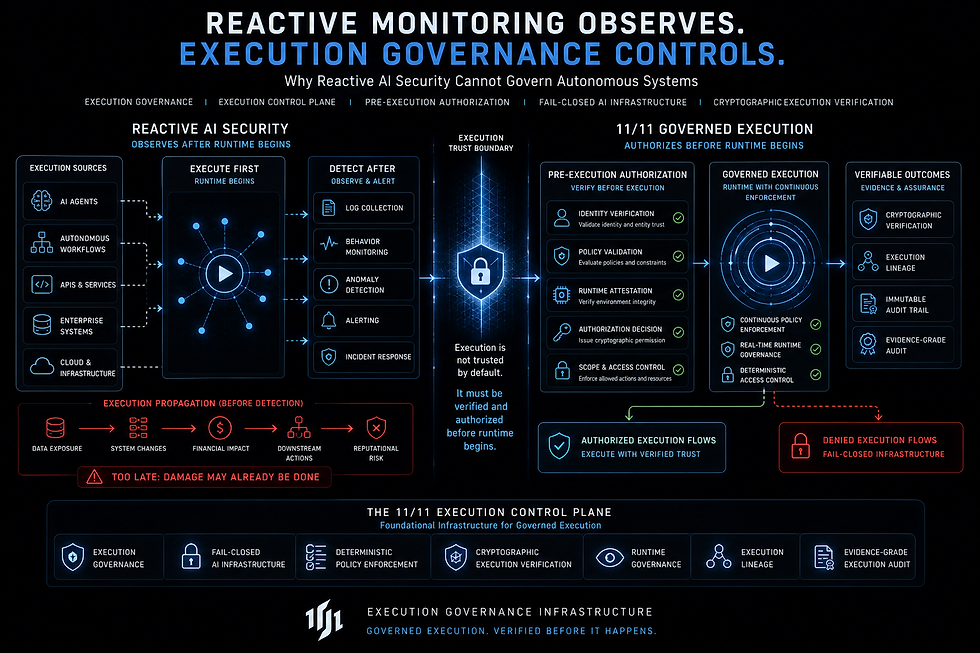
Compute → Validate → Authorize → Assume Responsibility → Influence Reality
This additional layer transforms computation from a purely technical activity into a governed operational activity.
Execution Governance™ establishes responsibility for execution.
EA-11 establishes responsibility for computation itself.
Together they create:
governed execution
governed computation
computational accountability
computational representation
computational responsibility
deterministic operational trust
As autonomous systems continue expanding globally, responsibility becomes increasingly important.
Because future infrastructure will not be judged solely by what systems can do.
It will be judged by what systems are willing and able to take responsibility for.
That is why EA-11 introduces computational responsibility.
Public Infrastructure Endpoints
Public Runtime Infrastructure
Public Governance Console
Runtime Governance Demo
Public Governance Proof Viewer
Infrastructure Health Dashboard
Execution Lineage Explorer
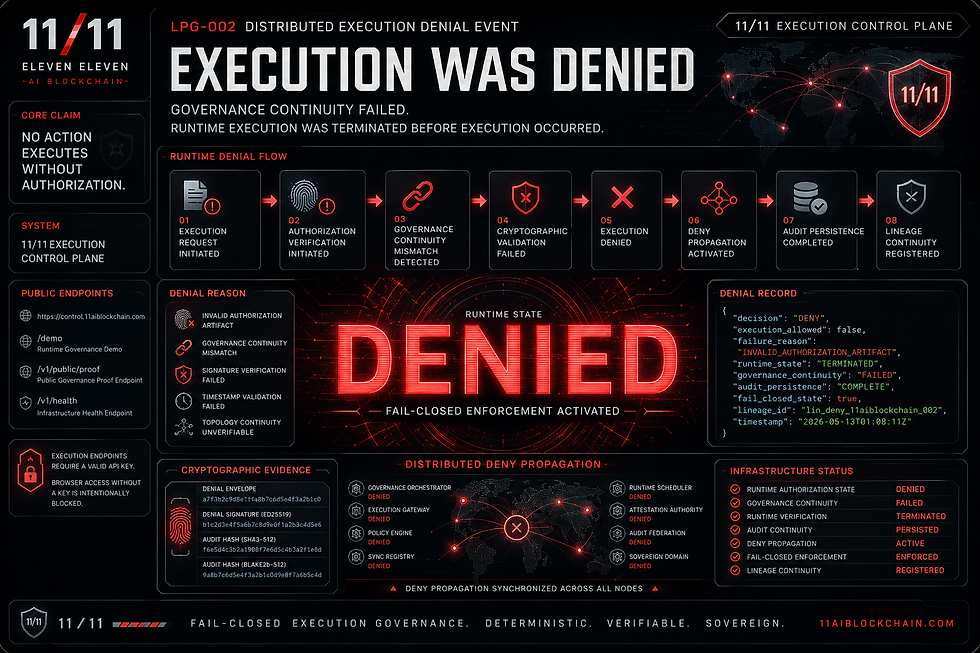
Execution endpoints intentionally require valid API authorization.
Browser access without a valid authorization key is fail-closed by design.
EA-11™ Execution Arithmetic™ Governed Computation™ Patent Pending

Comments