
Why EA-11 Introduces Computational Rights


Modern systems rarely distinguish between computation and rights.
If computation occurs, the result typically proceeds.
If an output is generated, the output is accepted.
If a system computes successfully, operational influence is often assumed.
EA-11 challenges this assumption.
Because authority is not a natural property of computation.
Authority is granted.
Authority is earned.
Authority exists within governance boundaries.
This creates a new question:
What rights does a computation actually possess?
Historically, computing never needed to answer this.
Traditional software operated primarily as a tool.
Autonomous systems change the equation completely.
Today computational outcomes influence:
sovereign AI systems
critical infrastructure
financial operations
healthcare systems
defense environments
autonomous orchestration
machine-speed governance platforms
In these environments, computational outcomes become operational actors.
Operational actors require rights frameworks.
This is where EA-11 introduces computational rights.
Computational rights establish what a computation is permitted to do after it is created.
A computation may have:
The Right To Be Evaluated
A computation may be reviewed.
The Right To Be Verified
A computation may undergo validation.
The Right To Seek Admissibility
A computation may request operational admission.
The Right To Participate
A computation may enter trusted systems.
But certain rights are not automatic.
Authority
Must be earned.
Influence
Must be granted.
Execution
Must be authorized.
Operational Impact
Must be admitted.
This distinction becomes critical.
Because not every computation deserves operational influence.
Not every result deserves authority.
Not every output deserves execution.
EA-11 therefore treats rights as computational properties.
A computation may exist.
But existence does not create rights.
Rights emerge through:
trust
policy
proof
identity
admissibility
legitimacy
This creates a fundamentally different architecture.
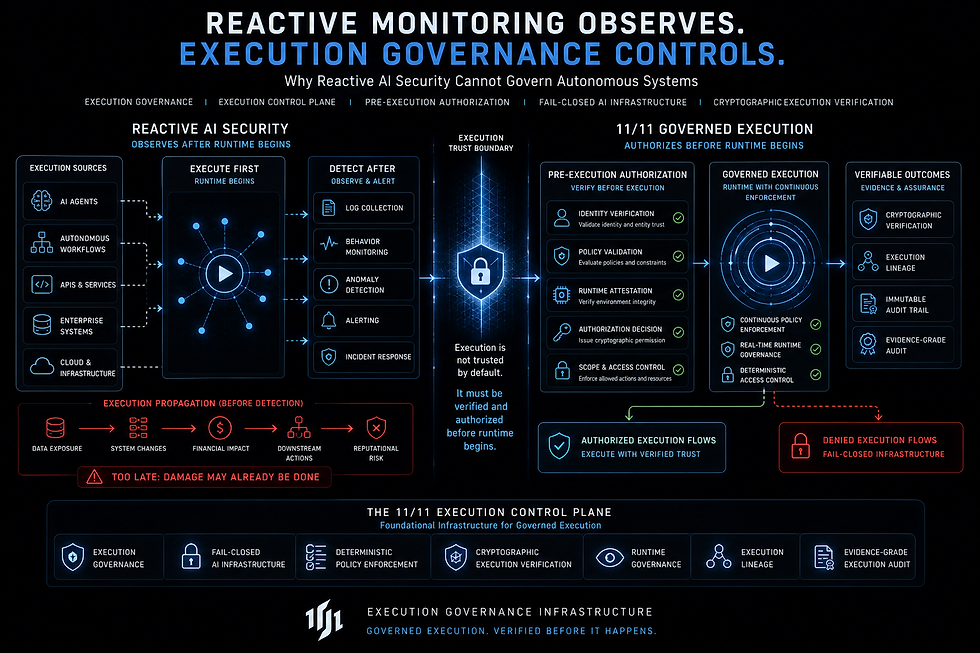
Traditional Computing:
Compute → Authority Assumed
EA-11:
Compute → Rights Evaluated → Authority Granted
Execution Governance™ establishes rights for execution.
EA-11 establishes rights for computation itself.
Together they create:
governed execution
governed computation
computational citizenship
computational authority
computational rights
deterministic operational trust
As autonomous systems continue expanding globally, rights become increasingly important.
Because future infrastructure will not merely determine what systems can compute.
It will determine what computations are permitted to do.
That is why EA-11 introduces computational rights.
Public Infrastructure Endpoints
Public Runtime Infrastructure
Public Governance Console
Runtime Governance Demo
Public Governance Proof Viewer
Infrastructure Health Dashboard
Execution Lineage Explorer
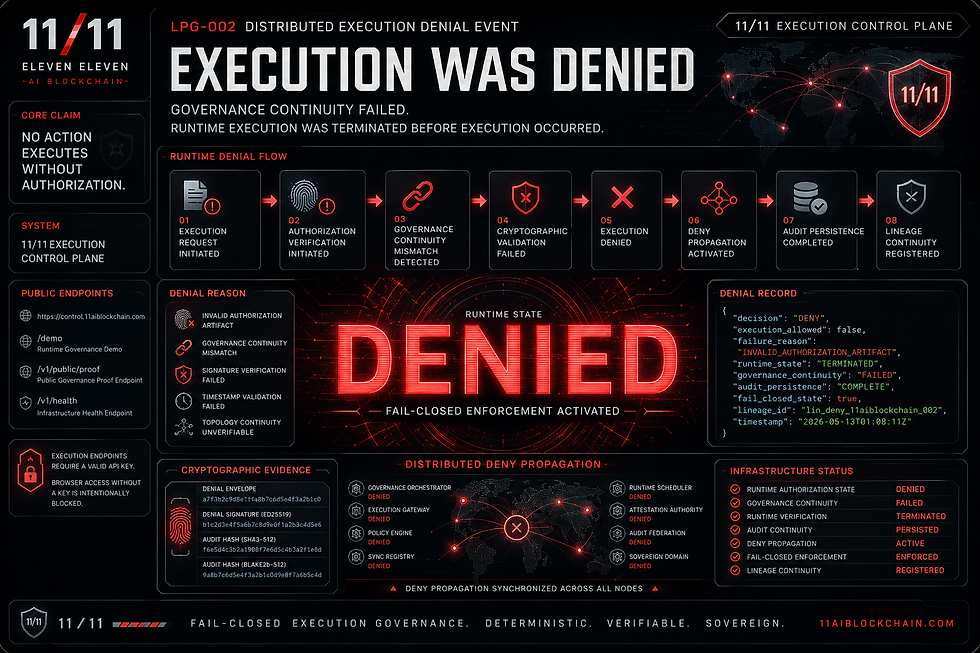
Execution endpoints intentionally require valid API authorization.
Browser access without a valid authorization key is fail-closed by design.
EA-11™ Execution Arithmetic™ Governed Computation™ Patent Pending

Comments