
Why EA-11 Introduces Computational Separation of Powers

Every stable governance system eventually learns the same lesson.
Authority should not govern itself.
Modern constitutional systems separate authority across independent functions.
Legislative power.
Executive power.
Judicial power.
Oversight power.
Validation power.
The objective is simple:
Prevent uncontrolled authority.
Yet traditional computing rarely follows this principle.
A system receives an input.
The system computes.
The system validates itself.
The system executes.
The system accepts its own result.
The same computational pathway often acts as:
creator
validator
authority
executor
This becomes increasingly dangerous in autonomous systems.
As machine-speed infrastructure expands, computation increasingly influences:
sovereign AI systems
financial infrastructure
healthcare operations
defense environments
autonomous orchestration
critical infrastructure
machine-speed execution platforms
In these environments, computational authority becomes operational authority.
Operational authority requires separation.
This is where EA-11 introduces computational separation of powers.
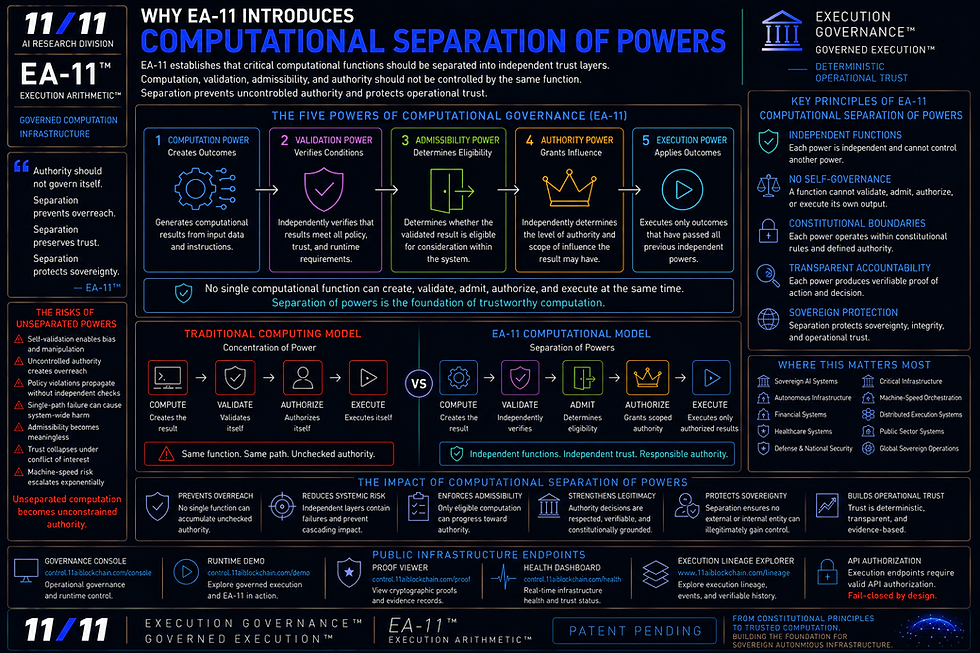
Computational separation of powers establishes that critical computational functions should be separated into independent trust layers.
A computation should not automatically validate itself.
A computation should not automatically authorize itself.
A computation should not automatically grant itself authority.
Instead, separate functions should exist.
Computation Layer
Produces outcomes.
Validation Layer
Verifies conditions.
Admissibility Layer
Determines eligibility.
Authority Layer
Determines operational influence.
Execution Layer
Applies outcomes.
This creates a fundamentally different computational architecture.
Traditional Computing:
Compute → Execute
EA-11:
Compute → Validate → Admit → Authorize → Execute
The distinction is profound.
Because separation prevents a single computational pathway from becoming unchecked authority.
This reduces:
computational overreach
authority inflation
trust fragmentation
admissibility failures
governance collapse
machine-speed operational risk
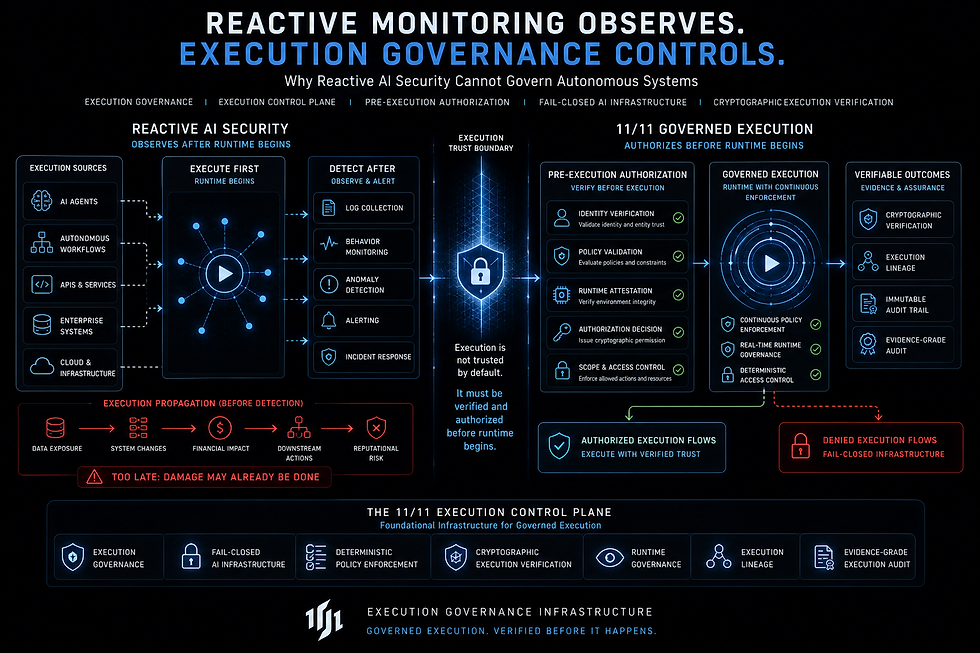
Execution Governance™ establishes separation of powers for execution.
EA-11 establishes separation of powers for computation.
Together they create:
governed execution
governed computation
computational constitutionalism
computational authority
computational separation of powers
deterministic operational trust
As autonomous systems become increasingly powerful, separation becomes increasingly important.
Because future infrastructure will not fail from insufficient computation.
It will fail from unconstrained computation.
That is why EA-11 introduces computational separation of powers.
Public Infrastructure Endpoints
Public Runtime Infrastructure
Public Governance Console
Runtime Governance Demo
Public Governance Proof Viewer
Infrastructure Health Dashboard
Execution Lineage Explorer
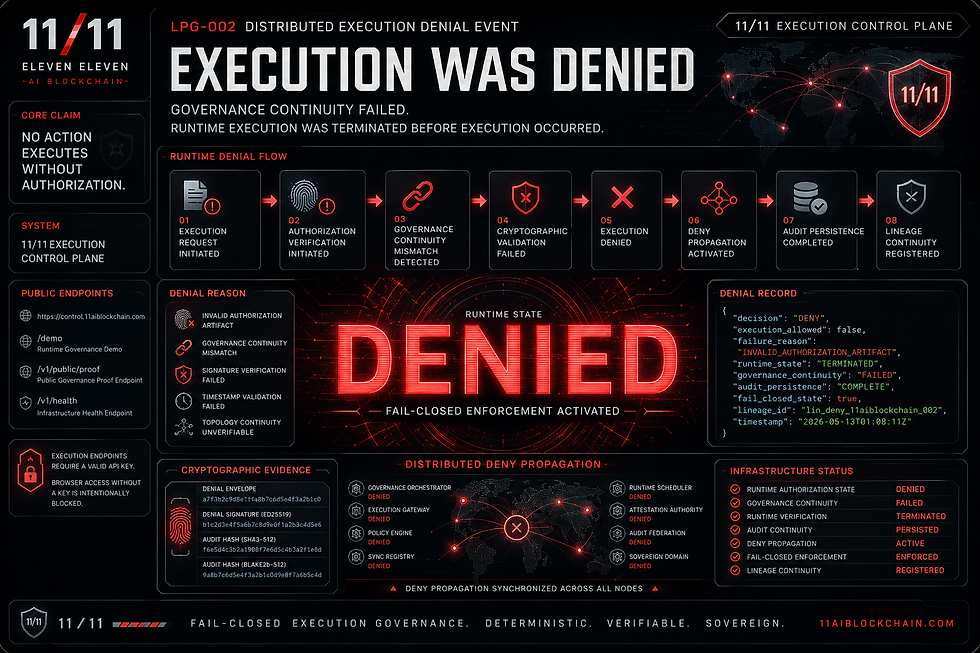
Execution endpoints intentionally require valid API authorization.
Browser access without a valid authorization key is fail-closed by design.
EA-11™ Execution Arithmetic™ Governed Computation™ Patent Pending

Comments