
Why EA-11 Introduces Computational Sovereignty


Sovereignty has historically focused on territory, infrastructure, resources, and decision authority.
The machine-speed era introduces a new requirement.
Computational sovereignty.
As autonomous systems increasingly govern infrastructure, operational outcomes are no longer driven solely by human decisions.
They are driven by computational decisions.
Machine-speed systems continuously compute:
recommendations
authorizations
routing decisions
operational actions
infrastructure responses
orchestration pathways
autonomous outcomes
This means computation itself becomes strategic infrastructure.
And strategic infrastructure requires sovereignty.
Traditional computing assumes that if a system can compute, it should compute.
EA-11 rejects that assumption.
Not every computation should automatically become operational reality.
Not every computational outcome should receive authority.
Not every result should influence sovereign systems.
This is where computational sovereignty emerges.
Computational sovereignty means a sovereign system controls which computations become operationally admissible.
Computation alone is insufficient.
Trust matters.
Policy matters.
Proof matters.
Runtime integrity matters.
Context matters.
Computational legitimacy matters.
Only when these conditions are satisfied does sovereign computation occur.
This creates a new infrastructure model.
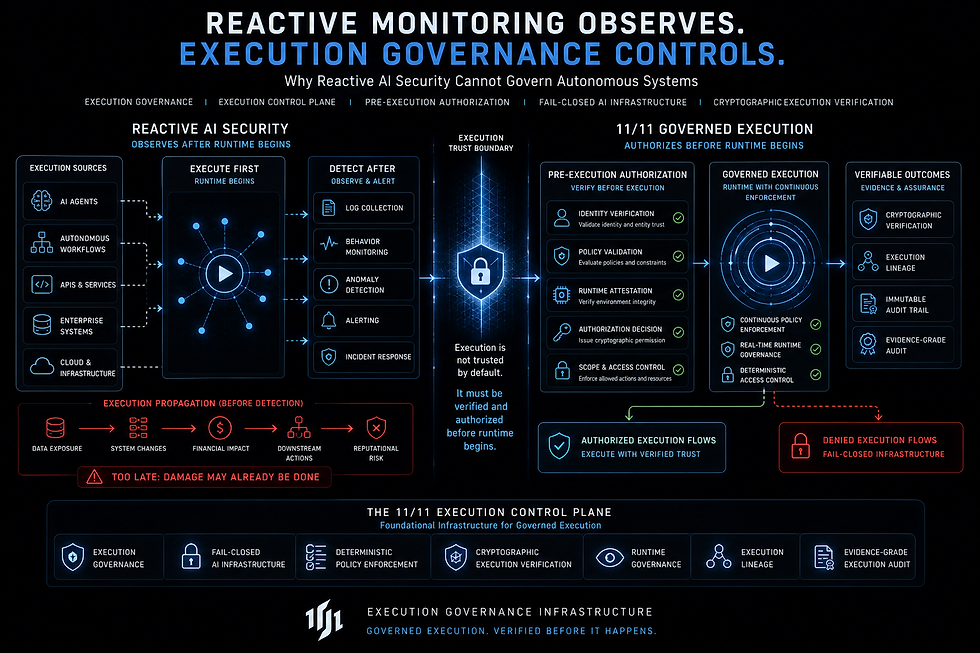
Traditional Model:
Compute → Result → Authority
EA-11 Model:
Compute → Validate → Admit → Authority
The distinction becomes critical as autonomous systems expand.
Without computational sovereignty:
untrusted computation influences outcomes
policy violations propagate
operational trust degrades
computational authority becomes uncontrolled
infrastructure becomes dependent on unverifiable decisions
Computational sovereignty prevents this.
It establishes boundaries around computational authority.
It creates admissibility controls.
It enforces legitimacy requirements.
It ensures sovereign systems maintain authority over computation itself.
This extends governance deeper than execution.
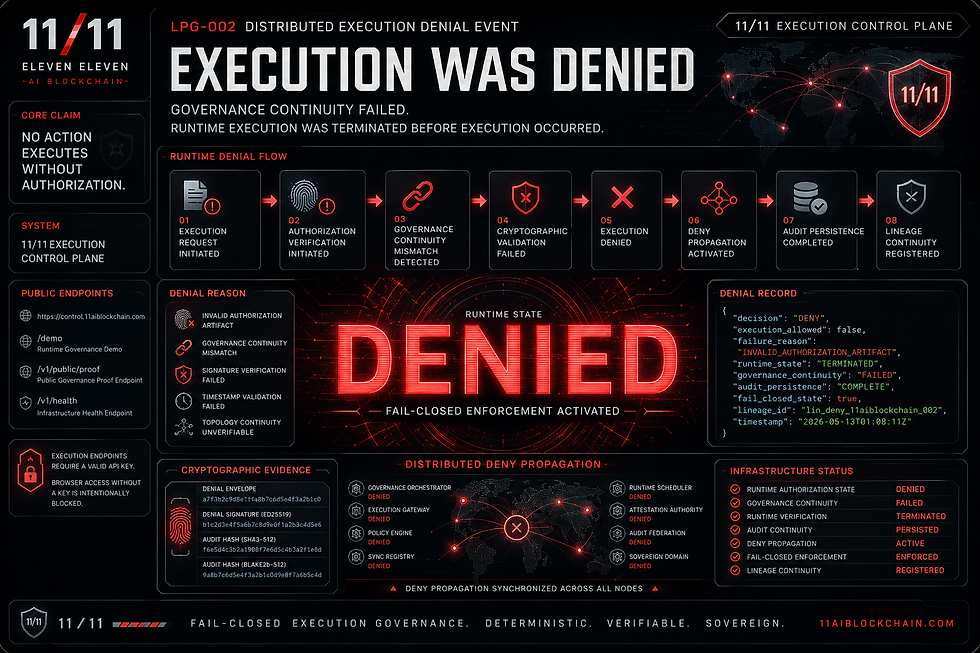
Execution Governance™ establishes sovereignty over execution.
EA-11 establishes sovereignty over computation.
Together they create:
governed execution
governed computation
computational authority
computational legitimacy
computational sovereignty
deterministic operational trust
As autonomous infrastructure continues expanding globally, computational sovereignty becomes increasingly important.
Because future infrastructure will not be controlled by who owns the hardware.
It will be controlled by who determines which computations deserve authority.
That is why EA-11 introduces computational sovereignty.
Public Infrastructure Endpoints
Public Runtime Infrastructure
Public Governance Console
Runtime Governance Demo
Public Governance Proof Viewer
Infrastructure Health Dashboard
Execution Lineage Explorer
Execution endpoints intentionally require valid API authorization.
Browser access without a valid authorization key is fail-closed by design.
EA-11™
Execution Arithmetic™
Governed Computation™
Patent Pending

Comments