
Why EA-11 Introduces Computational Trust Boundaries


Every infrastructure era introduces a new trust boundary.
Network security introduced network trust boundaries.
Identity systems introduced access trust boundaries.
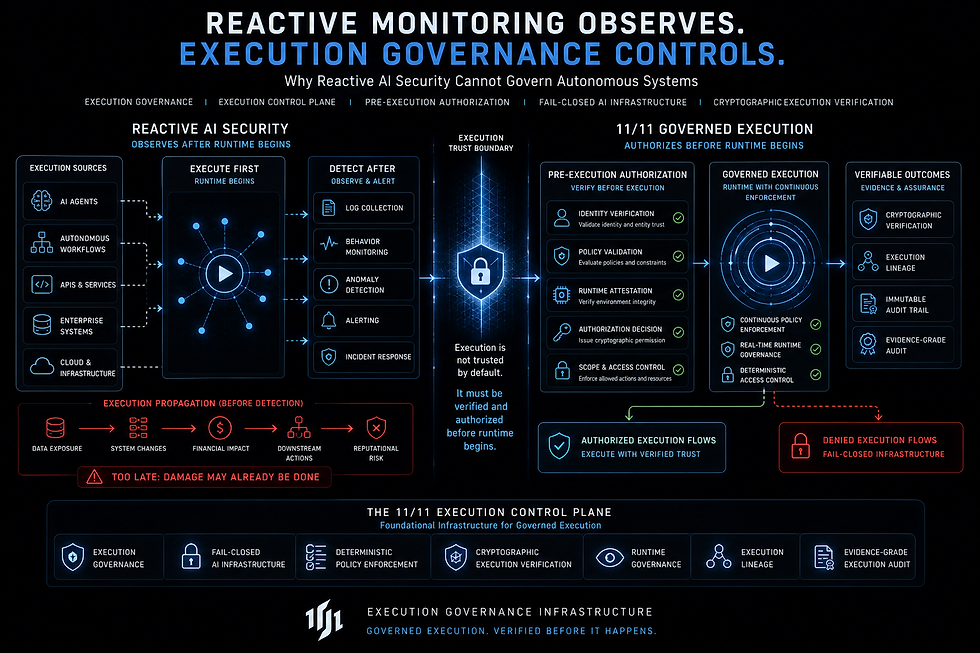
Execution Governance™ introduced execution trust boundaries.
EA-11 introduces the next layer:
Computational Trust Boundaries.
Historically, computation itself existed outside governance.
If a system received an input, computation occurred.
If processing resources were available, computation proceeded.
If execution started, computational outcomes were assumed valid.
This assumption worked when computing operated primarily as a tool.
It becomes increasingly dangerous when computing becomes autonomous.
Modern systems now compute continuously across:
sovereign AI systems
infrastructure orchestration
autonomous execution platforms
financial decision engines
healthcare operations
defense environments
machine-speed governance systems
In these environments, computation is no longer isolated from operational consequences.
Computation becomes infrastructure.
And infrastructure requires trust boundaries.
EA-11 establishes computational trust boundaries to determine whether a computational event is operationally admissible.
Not every computation deserves authority.
Not every computational result deserves execution.
Not every outcome deserves trust.
Computational trust boundaries create conditions that computation must satisfy before becoming operationally relevant.
These conditions include:
trust
policy
proof
runtime certainty
execution context
operational integrity
If these conditions fail, computation may still occur technically.
But it does not become admissible.
This distinction is important.
Because traditional computing asks:
Can the computation be performed?
EA-11 asks:
Should the computation be trusted?
That difference creates an entirely new computational architecture.
A system may generate a result.
But without computational trust boundaries:
integrity cannot be guaranteed
context cannot be trusted
runtime conditions cannot be validated
operational outcomes cannot be assured
EA-11 therefore treats computational trust as an infrastructure requirement rather than an optional security enhancement.
This extends governance deeper than execution.
Execution Governance™ governs actions.
EA-11 governs computational admissibility itself.
Together they create:
governed execution
governed computation
computational trust boundaries
deterministic operational trust
sovereign computational infrastructure
As autonomous systems become more capable, computational trust will become increasingly important.
Future infrastructure will not simply depend on trusted execution.
It will depend on trusted computation.
And trusted computation requires enforceable computational trust boundaries.
That is why EA-11 introduces computational trust boundaries.
Public Infrastructure Endpoints
Public Runtime Infrastructure
Public Governance Console
Runtime Governance Demo
Public Governance Proof Viewer
Infrastructure Health Dashboard
Execution Lineage Explorer
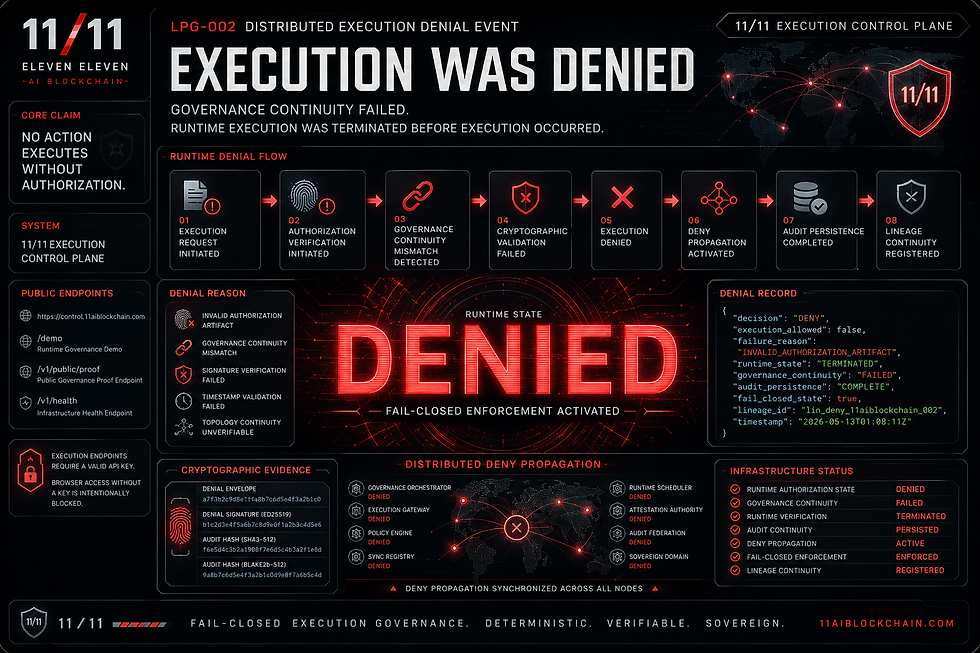
Execution endpoints intentionally require valid API authorization.
Browser access without a valid authorization key is fail-closed by design.
EA-11™
Execution Arithmetic™
Governed Computation™
Patent Pending

Comments