
Why EA-11 Introduces Computational Verification


Trust without verification eventually becomes assumption.
For most of computing history, verification focused on execution correctness.
Did the code run?
Did the calculation complete?
Did the output generate successfully?
If the answer was yes, the result was generally accepted.
But autonomous systems change the importance of verification.
Machine-speed infrastructure now generates computational outcomes that influence:
sovereign AI systems
autonomous orchestration
financial infrastructure
healthcare operations
defense environments
critical infrastructure
distributed execution platforms
In these environments, correctness alone is insufficient.
A result may be correct while still being operationally untrustworthy.
A result may be mathematically valid while being generated under invalid conditions.
A result may exist without deserving authority.
This is where EA-11 introduces computational verification.
Computational verification establishes that trusted computation must continuously prove its admissibility before becoming operationally authoritative.
Verification extends beyond the output itself.
The system must verify:
trust conditions
policy conditions
proof conditions
runtime integrity
computational context
admissibility requirements
authority requirements
Without verification, legitimacy becomes uncertain.
Without verification, accountability weakens.
Without verification, authority becomes difficult to defend.
EA-11 treats verification as a computational requirement.
Not merely a software testing activity.
Not merely an audit function.
A computational property.
This creates a new distinction.
Computation
A result exists.
Verified Computation
A result exists and its trust conditions have been validated.
This distinction becomes increasingly important as autonomous infrastructure expands.
Because future systems will not simply ask:
Was the computation completed?
They will ask:
Was the computation verified?
EA-11 therefore introduces computational verification as a foundational component of governed computation.
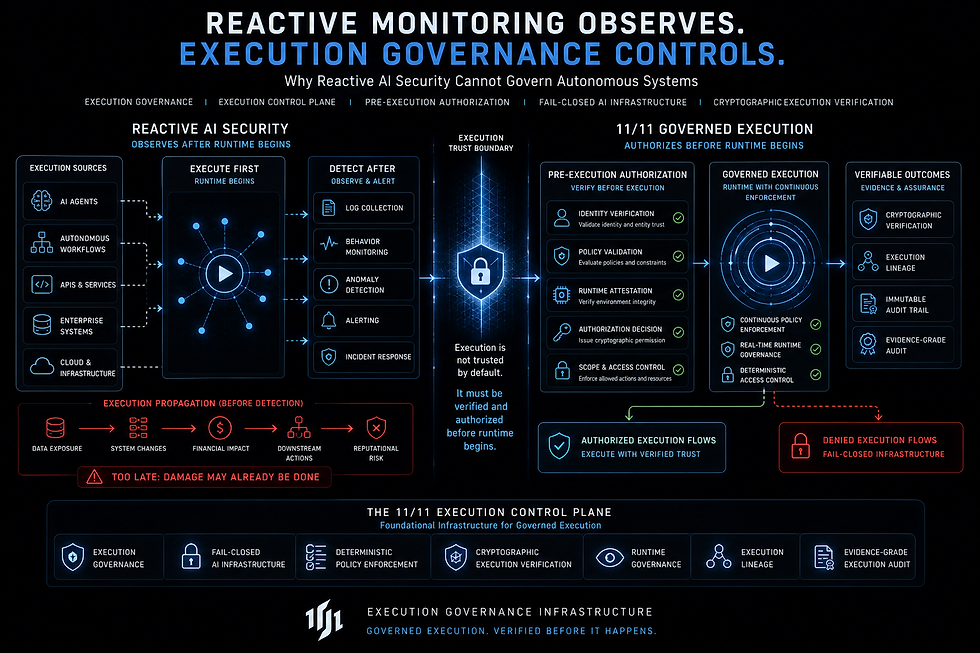
Execution Governance™ establishes execution verification.
EA-11 establishes computational verification.
Together they create:
governed execution
governed computation
computational evidence
computational provenance
computational verification
deterministic operational trust
As autonomous systems continue scaling globally, verification becomes increasingly important.
Because trust without verification eventually becomes assumption.
And assumption is not a foundation for sovereign infrastructure.
That is why EA-11 introduces computational verification.
Public Infrastructure Endpoints
Public Runtime Infrastructure
Public Governance Console
Runtime Governance Demo
Public Governance Proof Viewer
Infrastructure Health Dashboard
Execution Lineage Explorer
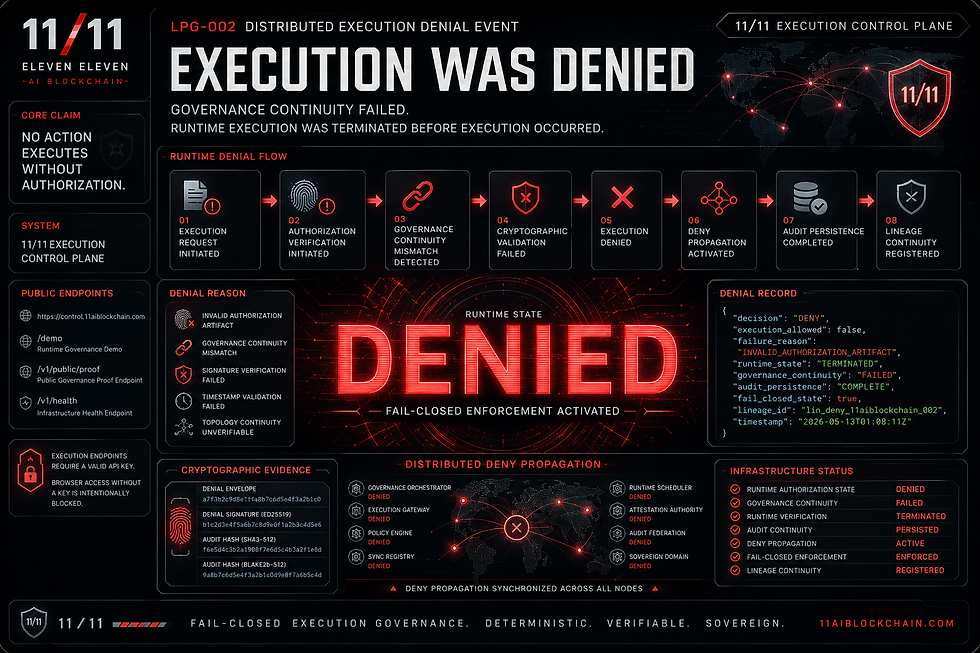
Execution endpoints intentionally require valid API authorization.
Browser access without a valid authorization key is fail-closed by design.
EA-11™ Execution Arithmetic™ Governed Computation™ Patent Pending

Comments