
Why EA-11 Introduces Governed Computation Infrastructure


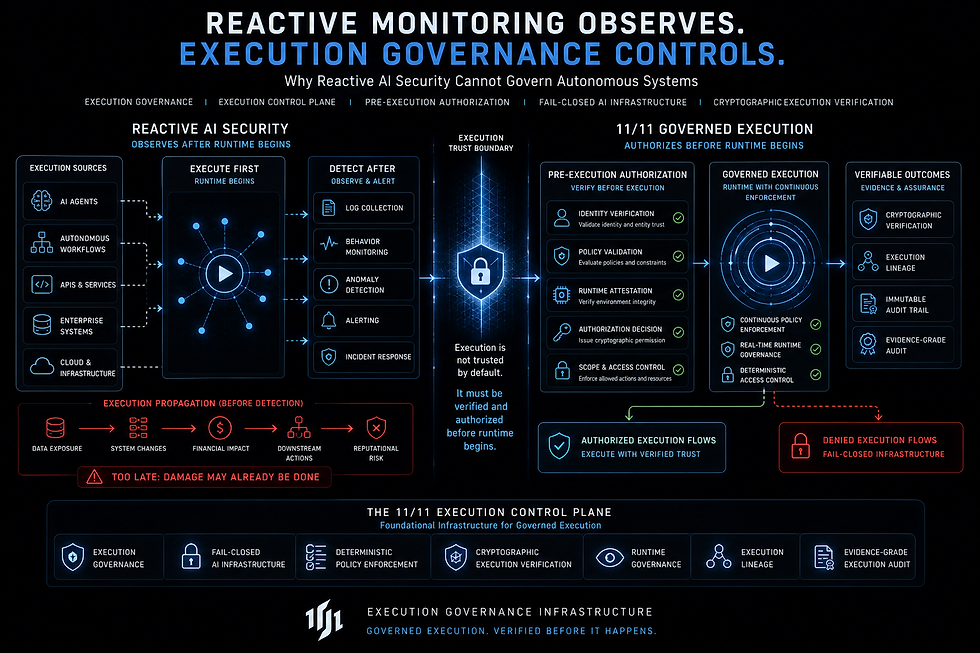
Modern systems assume computation is automatically valid once execution begins.
EA-11 challenges that assumption completely.
As autonomous infrastructure increasingly operates at machine speed, computation itself becomes part of the operational trust boundary.
Traditional systems typically separate:
computation
policy
runtime trust
execution governance
The system computes first.
Governance evaluates afterward.
That operational model becomes unstable in autonomous environments.
Machine-speed systems now coordinate:
AI inference
orchestration decisions
runtime execution
operational routing
distributed automation
sovereign infrastructure actions
At that scale, invalid computation becomes operational risk.
This is where EA-11 introduces a new infrastructure principle:
computation itself must become governable.
EA-11 (Execution Arithmetic) establishes a governed computation model where execution-valid computation depends on operational trust conditions before computation proceeds.
Computation is no longer treated as automatically admissible.
It becomes conditional.
Conditional on:
trust
policy
proof
runtime certainty
execution context
operational integrity
This creates a fundamentally different computational architecture.
Under EA-11:
invalid operational conditions invalidate computation
unverifiable runtime states invalidate computation
unsynchronized policy states invalidate computation
broken execution trust invalidates computation
No trusted execution state means no trusted computation.
This extends Execution Governance™ deeper into the computational layer itself.
Execution Governance™ governs:
whether execution is allowed.
EA-11 governs:
whether computation itself is operationally admissible.
That distinction is important.
Because future sovereign infrastructure will increasingly depend on autonomous systems making machine-speed decisions continuously.
Those decisions are computational events.
If computation itself cannot be governed, operational trust eventually degrades.
EA-11 introduces:
governed computation infrastructure.
A model where:
computation becomes policy-aware
runtime conditions affect admissibility
operational trust becomes computationally relevant
execution integrity affects computational validity
deterministic trust conditions govern execution arithmetic itself
This creates a deeper trust architecture beneath autonomous systems.
Not merely: “trusted execution.”
But:
trusted computation.
This becomes especially important for:
sovereign AI systems
autonomous infrastructure
runtime orchestration
operational decision systems
machine-speed governance environments
critical infrastructure AI
distributed execution systems
Because autonomous systems do not simply execute.
They compute continuously.
EA-11 establishes the principle that:
computation without operational trust is no longer inherently valid.
That is the infrastructure shift now emerging.
That is why EA-11 introduces governed computation infrastructure.
Public Infrastructure Endpoints
Public Runtime Infrastructure
Public Governance Console
Runtime Governance Demo
Public Governance Proof Viewer
Infrastructure Health Dashboard
Execution Lineage Explorer
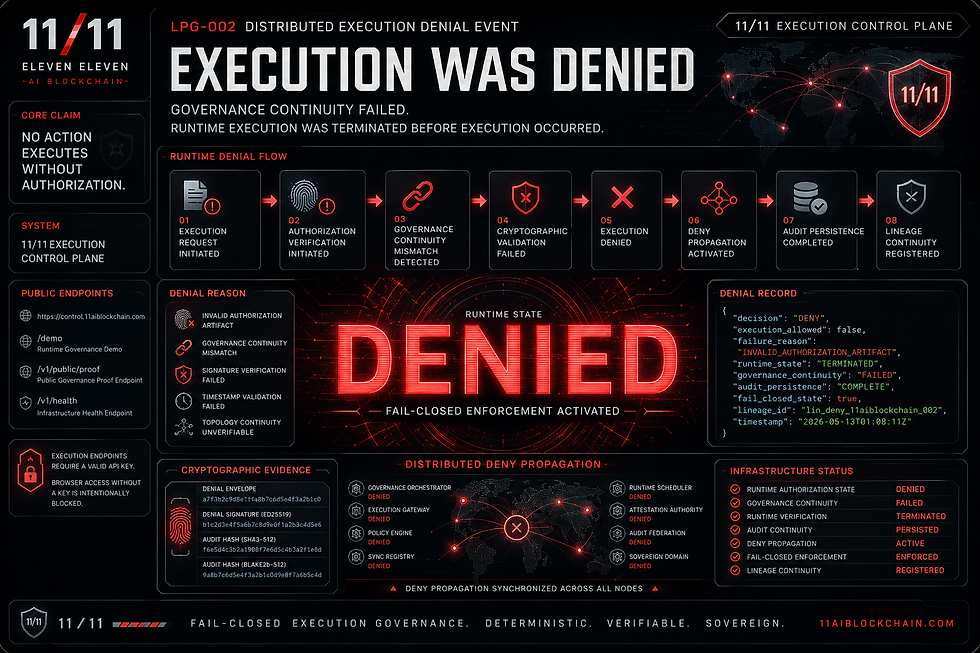
Execution endpoints intentionally require valid API authorization.
Browser access without a valid authorization key is fail-closed by design.
11/11 introduces Execution Governance™ infrastructure for governed autonomous execution and deterministic operational trust.
EA-11™Execution Arithmetic™ Governed Computation™ Patent Pending

Comments