
EG-015 Execution Lineage Architecture
- 11/11 AI

- May 11
- 2 min read
Updated: May 13

Execution without lineage creates unverifiable infrastructure.
As autonomous systems increasingly coordinate:
AI inference
enterprise workflows
financial systems
sovereign compute
infrastructure orchestration
distributed agents
regulated automation
the ability to prove execution history becomes foundational.
Execution itself must remain traceable.
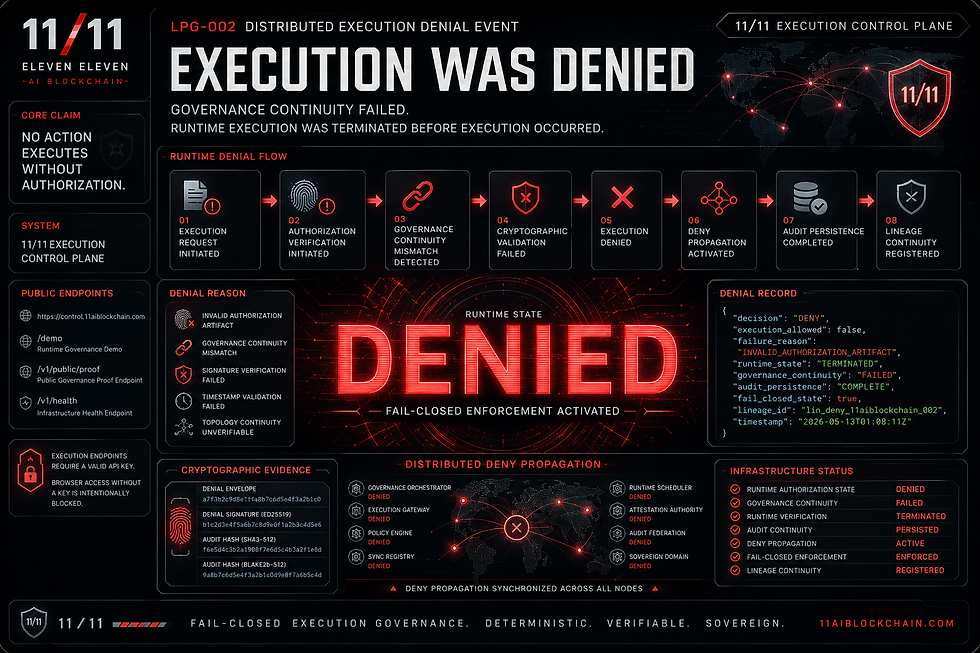
11/11 defines execution lineage architecture as immutable governance infrastructure that persistently links authorization, runtime actions, verification states, and audit continuity across the execution lifecycle.
Execution trust becomes historically provable.
Not temporarily assumed.
What Is Execution Lineage?
Execution lineage is the persistent governance chain connecting:
execution requests
authorization artifacts
policy decisions
runtime verification
execution actions
governance transitions
audit persistence
throughout the entire execution lifecycle.
Lineage establishes operational trust continuity.
Every governed execution event becomes cryptographically attributable.
Why Execution Lineage Matters
Traditional infrastructure often records:
logs
telemetry
events
monitoring data
But logs alone do not establish governed execution trust.
Execution lineage establishes:
execution ancestry
authorization continuity
governance persistence
immutable verification history
runtime trust traceability
This changes audit semantics.
Infrastructure no longer merely records events.
Infrastructure proves governed execution history.
EG-015 Execution Lineage Principles
1. Execution Must Remain Historically Traceable
Every governed execution event must remain linked to its authorization and governance origin.
Execution ancestry must remain provable.
2. Authorization and Runtime States Must Remain Linked
Execution lineage must preserve:
authorization artifacts
policy validation outcomes
runtime trust transitions
verification continuity
Trust fragmentation cannot occur.
3. Lineage Records Must Be Immutable
Execution lineage systems must resist:
tampering
deletion
silent modification
unverifiable mutation
Execution history must remain trustworthy.
4. Governance Persistence Must Continue Throughout Runtime
Lineage cannot stop after execution begins.
Governance continuity must persist through the full execution lifecycle.
5. Lineage Must Support Cryptographic Verification
Execution lineage must remain independently verifiable through:
cryptographic hashes
signed audit chains
deterministic verification
tamper-evident governance records
Execution trust must remain mathematically provable.
Autonomous Infrastructure Requires Persistent Trust
Autonomous systems increasingly execute at machine speed.
Reactive audit alone becomes insufficient.
Future infrastructure increasingly requires:
immutable execution lineage
persistent governance continuity
cryptographic audit persistence
operational execution ancestry
governed runtime traceability
deterministic trust verification
Execution history becomes infrastructure-critical.
Execution Lineage Changes Infrastructure Semantics
Historically:
audit systems recorded infrastructure activity.
Execution governance requires infrastructure to prove:
why execution occurred
who authorized execution
what policy permitted execution
how runtime trust persisted
whether governance continuity remained intact
Execution lineage transforms runtime history into governed trust infrastructure.
Lineage Becomes a Core Trust Primitive
As AI infrastructure scales:
execution lineage becomes foundational for:
enterprise trust systems
sovereign compute environments
regulated AI systems
autonomous runtime governance
operational trust assurance
infrastructure accountability
Execution governance requires persistent historical trust continuity.
11/11 Positioning
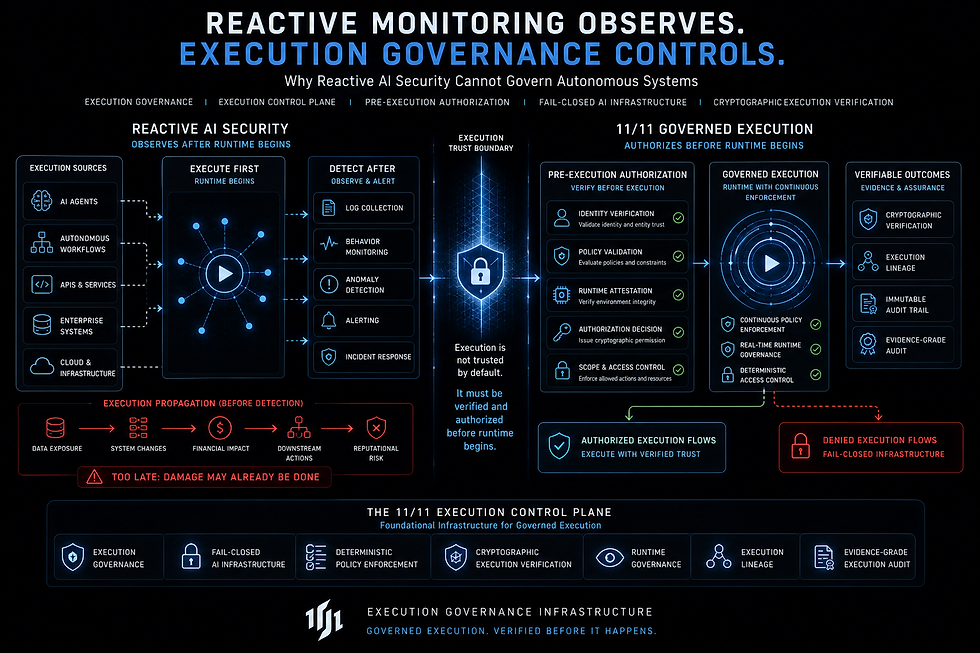
11/11 is positioned as the execution governance layer for AI infrastructure.
Its governance architecture establishes:
immutable execution lineage
authorization continuity
cryptographic audit persistence
governed runtime traceability
deterministic governance verification
operational trust continuity
before, during, and after execution occurs.
Execution itself becomes the trust boundary.
Official Proof Systems
Public Governance Console
Runtime Governance Demo
Public Governance Proof Viewer
Infrastructure Health Dashboard
Execution Lineage Explorer
Execution governance requires more than runtime enforcement.
Execution history itself must remain permanently provable.

Comments