
EG-017 Cryptographic Execution Verification

Updated: May 13

Modern infrastructure increasingly depends on cryptography.
Identity systems rely on cryptography.
Financial systems rely on cryptography.
Consensus systems rely on cryptography.
Autonomous execution infrastructure now requires:cryptographic execution verification.
As AI systems increasingly coordinate:
enterprise operations
distributed inference
sovereign compute
autonomous agents
financial orchestration
regulated automation
infrastructure execution
runtime trust can no longer rely on assumption-based security models.
Execution itself must become cryptographically verifiable.
11/11 defines cryptographic execution verification as governed runtime infrastructure where execution authorization, policy validation, runtime trust states, and governance continuity are mathematically verifiable before execution begins.
Execution trust becomes provable infrastructure.
Not inferred trust.
What Is Cryptographic Execution Verification?
Cryptographic execution verification establishes mathematically verifiable proof that:
execution was authorized
policy validation succeeded
runtime conditions were verified
governance rules were satisfied
execution scope remained bounded
lineage continuity persisted
before execution occurs.
Execution itself becomes independently verifiable.
Why Cryptographic Verification Matters
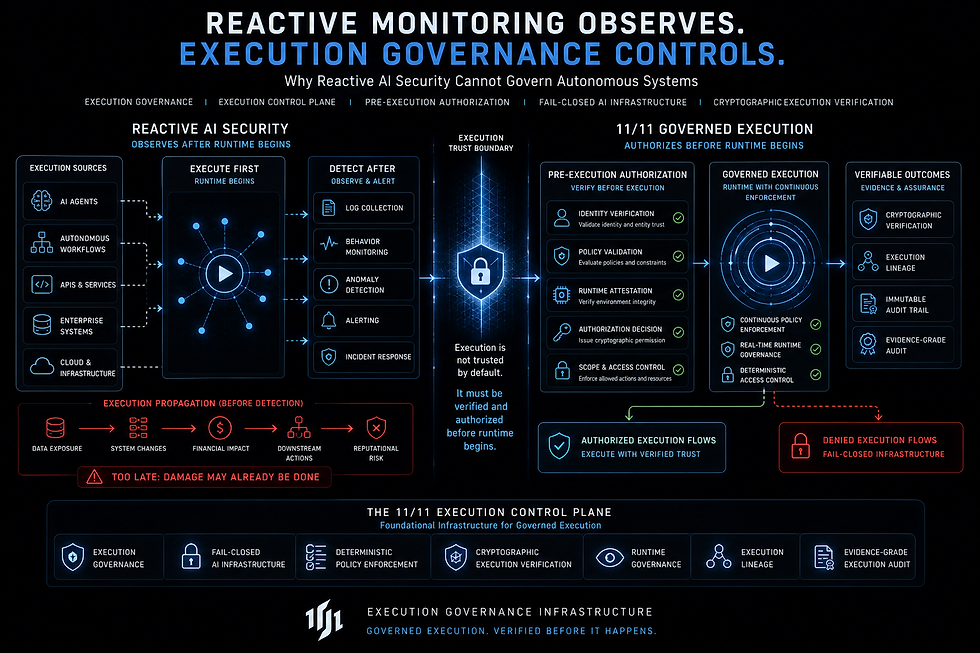
Traditional infrastructure often relies on:
operational assumptions
identity trust
perimeter security
monitoring systems
post-execution analysis
These systems observe behavior.
They do not mathematically prove execution legitimacy.
Cryptographic execution verification establishes:
provable authorization
deterministic validation
immutable trust continuity
independently verifiable governance
tamper-evident execution history
Trust becomes computationally enforceable.
EG-017 Cryptographic Verification Principles
1. Execution Authorization Must Be Verifiable
Execution cannot rely on unverifiable runtime approval.
Authorization artifacts must support cryptographic validation.
2. Verification Must Occur Before Execution
Execution trust must be established before runtime activity begins.
Reactive verification is insufficient for autonomous systems.
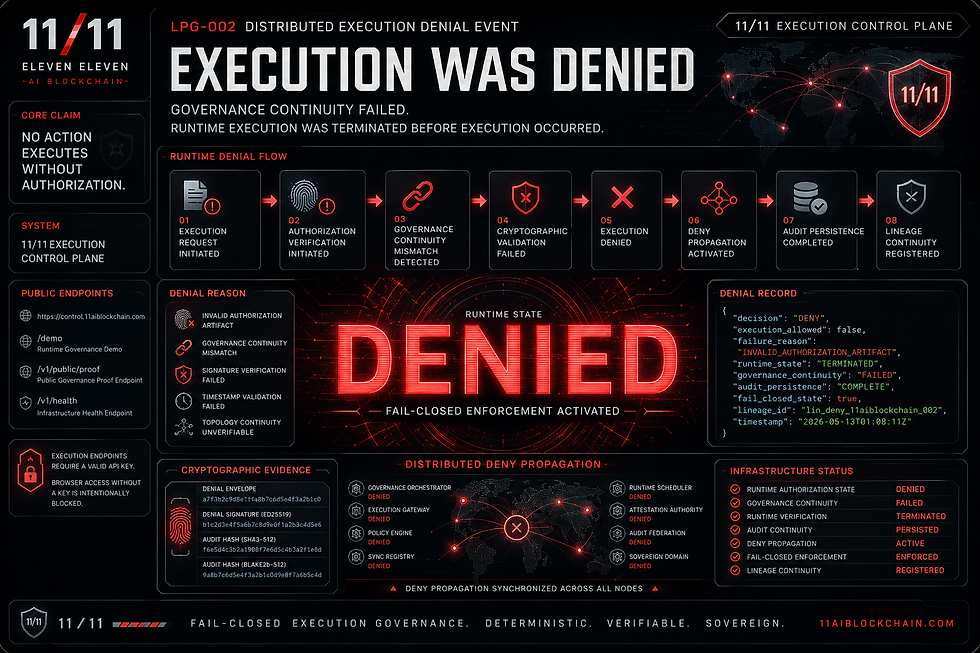
3. Invalid Verification States Must Fail Closed
If verification becomes:
invalid
uncertain
expired
tampered
unverifiable
execution must stop automatically.
No permissive execution paths.
4. Verification Chains Must Remain Immutable
Governance systems must preserve:
authorization signatures
verification records
runtime trust states
lineage continuity
audit evidence chains
Execution trust must remain historically provable.
5. Governance Verification Must Remain Infrastructure-Native
Applications cannot self-verify execution legitimacy.
The governance layer itself must independently enforce verification controls.
Autonomous Infrastructure Requires Mathematical Trust
Autonomous systems increasingly execute:
continuously
asynchronously
independently
at machine speed
Operational assumptions become insufficient at this scale.
Future infrastructure increasingly requires:
cryptographic runtime trust
deterministic execution verification
immutable authorization proof
governed execution continuity
mathematically provable audit systems
fail-closed governance validation
Execution trust becomes cryptographic infrastructure.
Cryptographic Verification Changes Infrastructure Semantics
Historically:
security systems attempted to detect compromise after execution.
Execution governance establishes:provable authorization before execution.
This changes the infrastructure trust model entirely.
Future systems increasingly govern:
whether execution is authorized
whether trust remains valid
whether execution scope is constrained
whether governance continuity persists
whether runtime proof remains verifiable
Execution itself becomes cryptographically governed infrastructure.
Verification Becomes a Core Infrastructure Primitive
As AI infrastructure scales:
cryptographic execution verification becomes foundational for:
enterprise AI governance
sovereign compute systems
regulated automation
critical infrastructure protection
autonomous runtime trust
operational execution assurance
Execution governance requires mathematically provable trust systems.
11/11 Positioning
11/11 is positioned as the execution governance layer for AI infrastructure.
Its governance architecture establishes:
cryptographic execution verification
governed runtime authorization
deterministic policy enforcement
immutable execution lineage
fail-closed runtime validation
operational trust continuity
before execution begins.
Execution itself becomes the trust boundary.
Official Proof Systems
Public Governance Console
Runtime Governance Demo
Public Governance Proof Viewer
Infrastructure Health Dashboard
Execution Lineage Explorer
Autonomous infrastructure cannot rely on assumed runtime trust.
Execution itself must become cryptographically verifiable before runtime begins.

Comments