
Execution Authority: The Missing Layer Of Artificial Intelligence

The AI Industry Has Solved Intelligence
Over the past decade, artificial intelligence has advanced at an unprecedented pace.
Models reason.
Agents plan.
Systems generate code.
Machines analyze data.
Autonomous workflows now perform tasks that once required entire teams of specialists.
This progress has fundamentally changed how organizations think about software.
Yet despite these advances, a foundational question remains largely unanswered.
Who gave the system authority to act?
As artificial intelligence evolves from information generation to operational execution, the answer to this question becomes more important than model capability itself.
Execution without authority is no longer a technical issue.
It is an infrastructure issue.
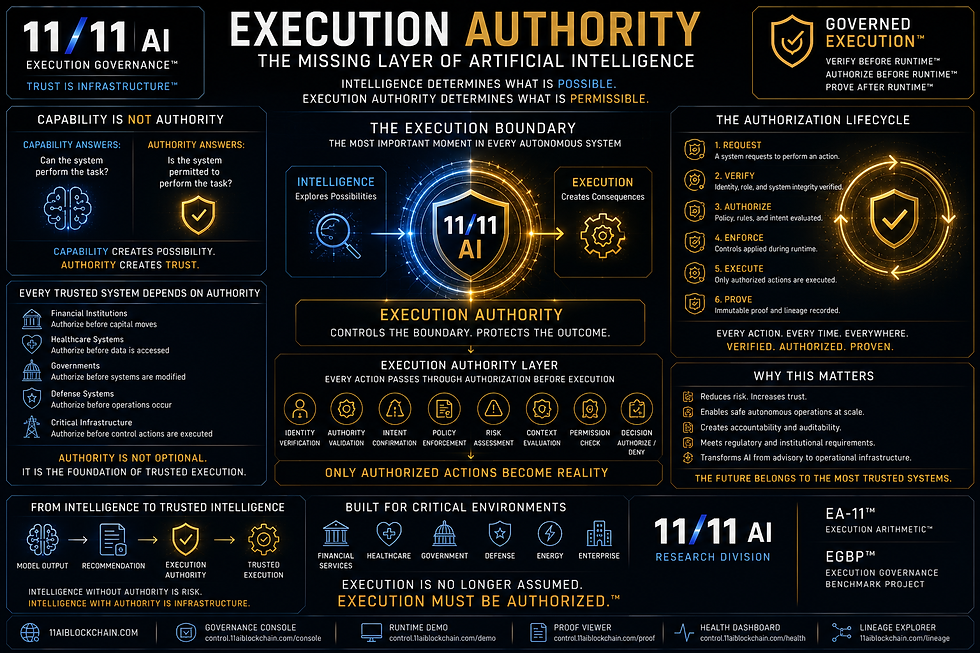
Capability Does Not Equal Authority
Modern AI systems are increasingly capable of interacting with operational environments.
They can:
Execute API calls.
Move financial assets.
Initiate workflows.
Control enterprise systems.
Coordinate autonomous agents.
Access confidential information.
Interact with critical infrastructure.
Each of these capabilities creates operational value.
Each also creates operational responsibility.
The existence of capability does not imply permission.
Capability answers:
Can the system perform the task?
Authority answers:
Is the system permitted to perform the task?
The distinction defines the boundary between intelligence and governance.
Every Trusted System Already Depends Upon Authority
Execution authority is not a new concept.
Financial institutions require authorization before capital moves.
Healthcare systems require authorization before records are accessed.
Governments require authorization before sensitive systems are modified.
Military systems require authorization before operational actions occur.
Industrial control systems require authorization before infrastructure changes are executed.
Artificial intelligence should operate under the same principle.
Authority is not an optional feature.
Authority is the foundation of trusted execution.
The Execution Boundary
Every autonomous system eventually reaches the same point.
A recommendation becomes an action.
A prediction becomes execution.
A model output becomes operational reality.
This transition represents the execution boundary.
It is the single most important moment within an autonomous system.
Before this point, intelligence explores possibilities.
After this point, consequences exist.
Execution Governance protects this boundary.
Execution Authority controls it.
Execution Authority As Infrastructure
Historically, authorization has been implemented as an application feature.
Execution Governance treats authorization differently.
It becomes shared infrastructure.
Every autonomous decision passes through a common authority layer before execution occurs.
This layer continuously evaluates:
Identity.
Authority.
Intent.
Policy.
Risk.
Operational conditions.
Environmental context.
Regulatory constraints.
Execution permissions.
Only after successful verification does execution proceed.
From Intelligence To Trusted Intelligence
Organizations increasingly recognize that intelligence alone is insufficient.
Operational trust requires verifiable authority.
Verifiable authority requires governance.
Governance requires runtime infrastructure.
Execution Governance provides that infrastructure.
Rather than simply evaluating outputs, it governs execution itself.
This transforms AI from an advisory technology into trusted operational infrastructure.
Why This Matters
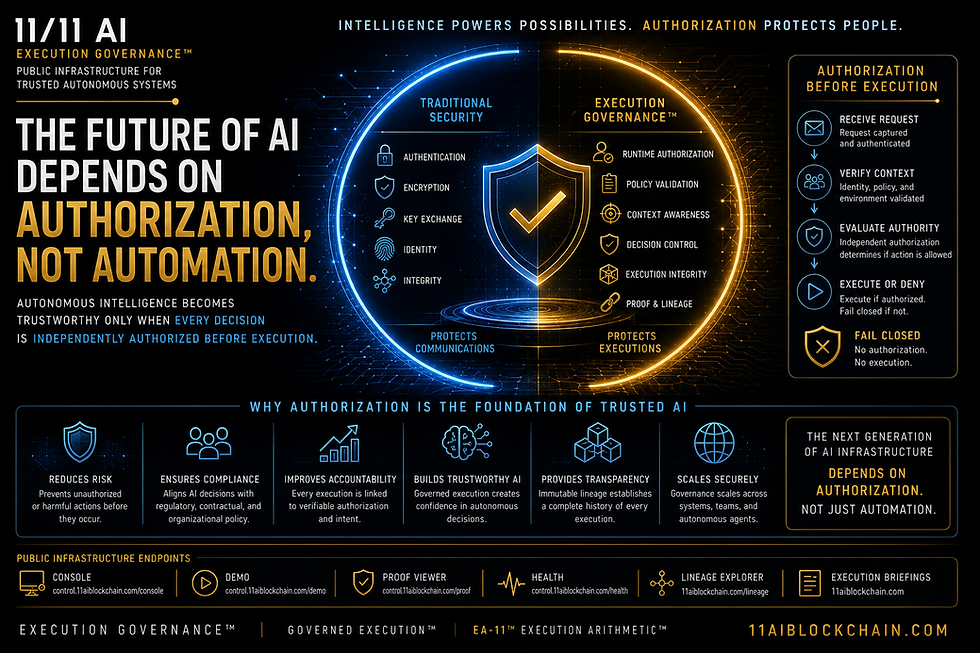
The autonomous economy will depend upon systems that can prove authority before execution.
Governments will require it.
Banks will require it.
Healthcare providers will require it.
Critical infrastructure operators will require it.
Defense organizations will require it.
The future will belong not only to intelligent systems.
It will belong to systems capable of demonstrating that every execution event occurred under authorized conditions.
Execution Authority enables that future.
Execution Governance enforces it.
Together they establish a new operational model built upon trust, accountability, and provable control.
Key Principle
Intelligence determines what is possible.
Execution Authority determines what is permissible.
Execution Governance ensures only authorized actions become reality.
"The future of AI will not be defined by who builds the smartest systems. It will be defined by who builds the most trusted systems."
Public Infrastructure Endpoints
Public Runtime Infrastructure
Public Governance Consolehttps://control.11aiblockchain.com/console
Runtime Governance Demohttps://control.11aiblockchain.com/demo
Public Governance Proof Viewerhttps://control.11aiblockchain.com/proof
Infrastructure Health Dashboardhttps://control.11aiblockchain.com/health
Execution Lineage Explorerhttps://www.11aiblockchain.com/lineage
Execution Governance™
Governed Execution™
EA-11™ Execution Arithmetic™
EGBP™ Execution Governance Benchmark Project
Patent Pending
11/11 AI Research Division
Trust Is Infrastructure™
Verify Before Runtime™Authorize Before Runtime™Prove After Runtime™
Execution Is No Longer Assumed.Execution Must Be Authorized™


Comments