
Execution Authorization as Critical Infrastructure


Execution Authorization as Critical Infrastructure
For decades, digital infrastructure has focused on enabling execution.
Networks move information.Operating systems execute instructions.Cloud platforms allocate compute.Artificial intelligence generates decisions.
Yet one foundational question remains largely unanswered:
Who authorizes execution?
As autonomous systems become increasingly capable of making decisions without direct human intervention, the importance of execution authorization grows alongside them. Most existing governance approaches focus on monitoring actions after they occur. Logs are collected. Events are reviewed. Compliance teams investigate outcomes.
The problem is that the execution has already happened.
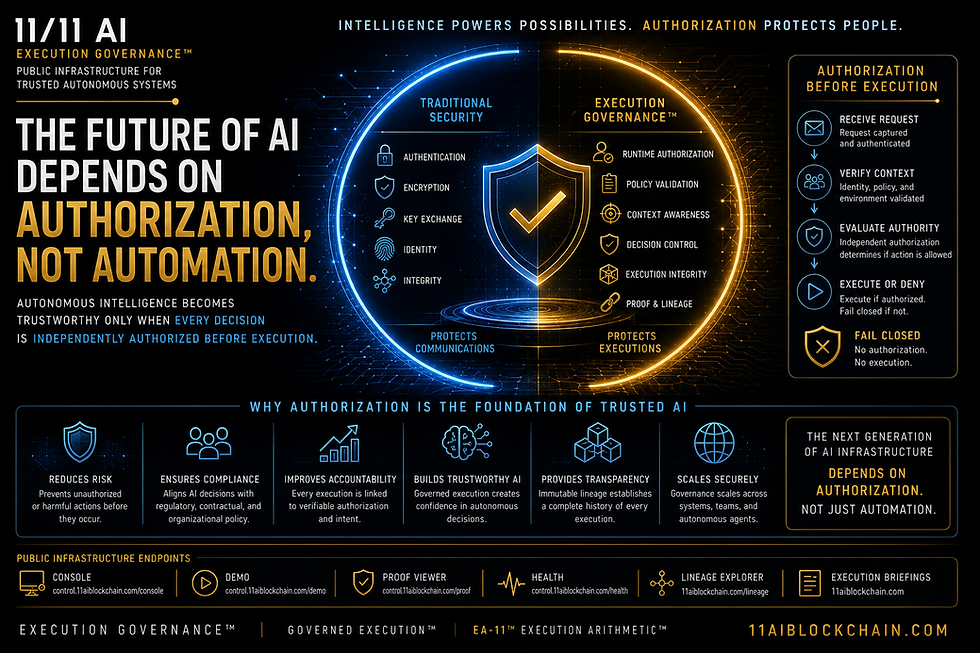
Execution Governance introduces a different model.
Rather than asking what occurred after an action was taken, Execution Governance asks whether the action should be permitted before execution begins.
This distinction is significant.
In regulated industries, critical infrastructure, defense systems, healthcare platforms, and financial networks, unauthorized execution may create consequences that cannot simply be reversed through later analysis.
Execution authorization establishes a pre-execution decision boundary.
Before execution is permitted, a system may evaluate:
•Trust requirements Policy requirements• Proof requirements• Confidence requirements• Execution context requirements
Only when execution conditions are satisfied does authorization occur.
This transforms governance from a forensic activity into an operational capability.
The concept is familiar in other domains.
Aircraft require authorization before takeoff.Financial markets implement pre-trade controls.Military systems enforce rules of engagement before action.Critical infrastructure validates safety conditions before activation.
Autonomous systems increasingly require the same discipline.
Execution Governance proposes that authorization itself should become a first-class infrastructure capability rather than an application-specific feature.
As AI systems continue to expand across government, enterprise, healthcare, defense, and financial environments, execution authorization may become as essential as authentication, networking, encryption, and observability.
The future of trusted autonomy may not be determined solely by what systems can do.
It may be determined by what systems are authorized to do.
Public Infrastructure Endpoints
Public Runtime Infrastructure
Public Governance Console
Runtime Governance Demo
Public Governance Proof Viewer
Infrastructure Health Dashboard
Execution Lineage Explorer
Execution endpoints intentionally require valid API authorization.
Browser access without a valid authorization key is fail-closed by design.
11/11 AI Research Division
Execution Governance™Governed Execution™


Comments