
Execution Lineage and the Future of Accountability

As autonomous systems become increasingly capable, accountability becomes increasingly difficult.
Traditional systems were designed around human decision-makers. An action occurred, a person approved it, and responsibility could be traced through a relatively straightforward chain of authority.
Autonomous systems introduce a different reality.
Decisions may be influenced by multiple models, datasets, policies, agents, workflows, confidence thresholds, and runtime conditions operating simultaneously across distributed environments.
When an outcome occurs, organizations must be able to answer a series of critical questions:
What decision was made?
Why was it made?
What policies influenced the decision?
What data was referenced?
What trust requirements were evaluated?
Who authorized execution?
What conditions existed at runtime?
Was the action compliant with applicable requirements?
Traditional logging systems often capture fragments of this information. Rarely do they provide a complete picture.
Execution Governance introduces the concept of Execution Lineage.
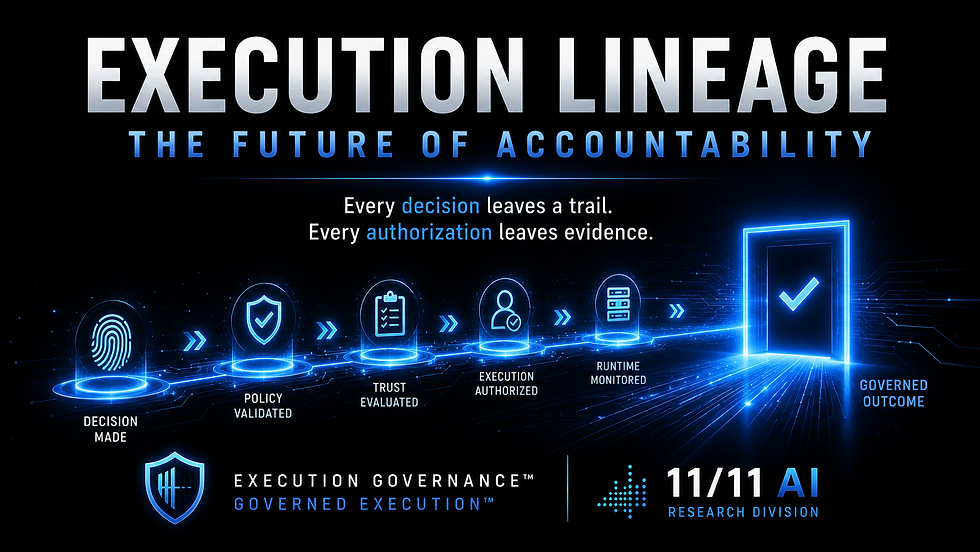
Execution Lineage extends beyond event logging by creating a verifiable chain of evidence connecting authorization, policy validation, trust evaluation, execution decisions, runtime activity, and resulting outcomes.
Instead of merely recording that an event occurred, Execution Lineage records the path that led to execution.
This distinction becomes increasingly important as AI systems expand into regulated and mission-critical environments.
Healthcare providers may need to demonstrate why a clinical recommendation was permitted.
Financial institutions may need to demonstrate why a transaction was authorized.
Critical infrastructure operators may need to demonstrate why an automated action was allowed to proceed.
Government agencies may need to demonstrate that execution complied with policy, law, and operational requirements.
In each case, accountability requires more than visibility.
It requires evidence.
Execution Lineage provides a framework for establishing that evidence through a governed chain of authorization and verification.
The objective is not simply to know what happened.
The objective is to understand why execution was permitted, under what conditions it occurred, and whether governance requirements were satisfied throughout the process.
As autonomous systems become foundational infrastructure, accountability must evolve alongside them.
The future will require more than logs.
It will require lineage.
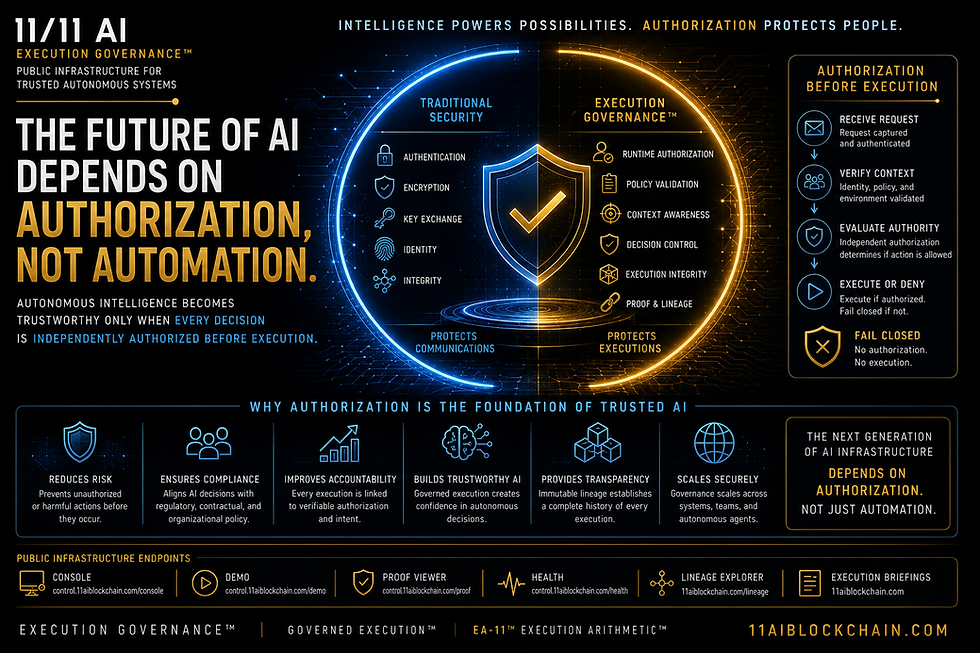
Public Infrastructure Endpoints
Public Runtime Infrastructure
Public Governance Console
Runtime Governance Demo
Public Governance Proof Viewer
Infrastructure Health Dashboard
Execution Lineage Explorer
Execution endpoints intentionally require valid API authorization.
Browser access without a valid authorization key is fail-closed by design.
Execution Governance™ provides a framework for creating that foundation.


Comments