
Infrastructure for Regulated AI

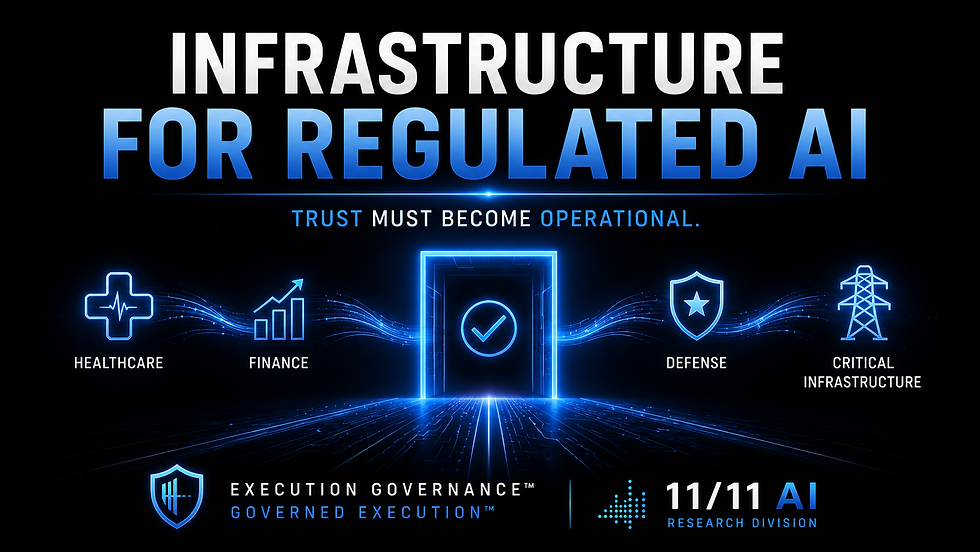
Artificial intelligence is rapidly moving from experimentation into regulated environments.
Healthcare systems influence clinical outcomes.
Financial systems participate in market operations.
Critical infrastructure systems support essential services.
Defense systems assist operational decision-making.
As AI becomes embedded within these environments, a fundamental requirement emerges:
Trust must become operational.
Organizations must be able to demonstrate not only what an AI system decided, but why execution was permitted.
This challenge extends beyond transparency.
It requires authorization.
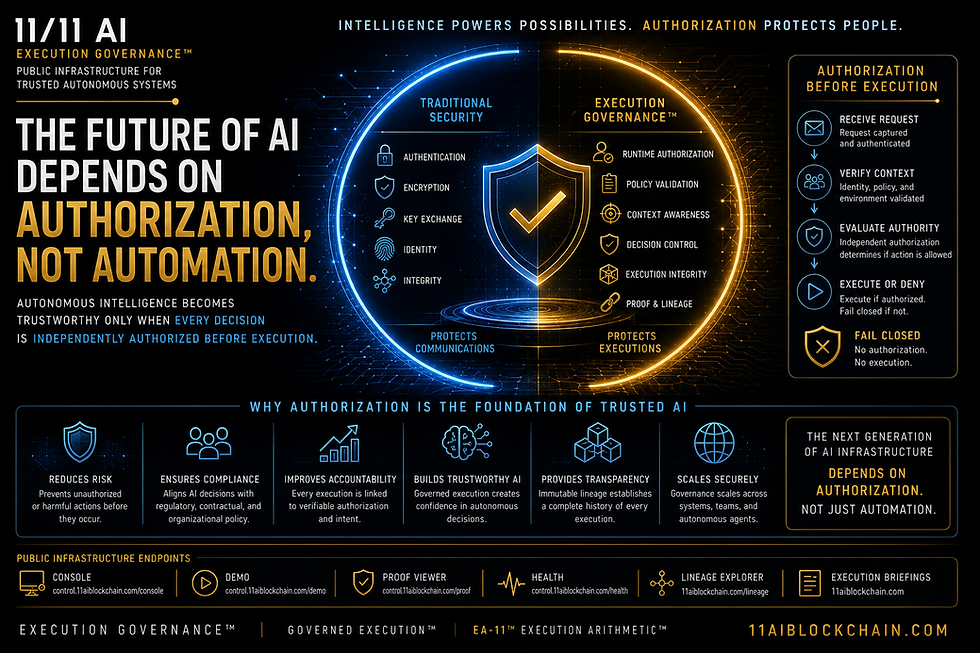
Execution Governance introduces an infrastructure model designed to establish trust before execution occurs.
Before an action is authorized, governance controls may evaluate:
Trust requirements
Policy requirements
Proof requirements
Confidence requirements
Execution context requirements
Only after those conditions are satisfied can execution proceed.
This creates a verifiable decision boundary between recommendation and action.
For regulated environments, that distinction is critical.
Compliance increasingly requires more than logs.
Risk management increasingly requires more than monitoring.
Autonomous systems require infrastructure capable of validating whether execution should occur before execution begins.
Execution Governance provides a framework for that capability.
As regulated AI expands across healthcare, finance, defense, and critical infrastructure, governance itself becomes infrastructure.
Not an application.
Not a dashboard.
An infrastructure layer.
Public Infrastructure Endpoints
Public Runtime Infrastructure
Public Governance Console
Runtime Governance Demo
Public Governance Proof Viewer
Infrastructure Health Dashboard
Execution Lineage Explorer
Execution endpoints intentionally require valid API authorization.
Browser access without a valid authorization key is fail-closed by design.
The future of trusted AI will depend not only on intelligence.
It will depend on authorization.


Comments