
Execution Provenance: Trust Must Travel With the Decision


Modern AI governance frameworks focus heavily on model behavior, audit logs, observability, and post-execution review. While these controls remain important, they leave a critical question unanswered:
Can trust be proven after an autonomous system has already acted?
As AI systems become increasingly autonomous, accountability can no longer depend solely on records generated after execution. Trust must accompany every decision from authorization through completion.
This requirement introduces a new infrastructure concept: Execution Provenance.
Execution provenance is the continuous preservation of authorization, policy compliance, trust conditions, and execution evidence throughout the lifecycle of an autonomous action.
Rather than asking what happened after execution, execution provenance asks:
Was the action authorized?
Were policy conditions satisfied?
Was execution permitted under approved governance controls?
Can the complete chain of authorization be proven?
These questions become increasingly important as autonomous systems move from recommendations to direct operational execution.
The Accountability Gap
Most governance architectures create evidence after decisions occur.
Examples include:
Audit logs
Monitoring systems
Security event records
Model observability platforms
Compliance reporting systems
These tools document outcomes.
They do not necessarily govern whether execution should have occurred in the first place.
An autonomous system can still perform an unauthorized action and generate a perfectly complete audit trail afterward.
The organization receives evidence.
The organization does not receive prevention.
This distinction represents the difference between observation and governance.
Execution Provenance as Infrastructure
Execution provenance establishes a verifiable chain connecting:
Identity
Authorization
Policy
Trust evaluation
Runtime enforcement
Execution outcome
Proof generation
Each execution event becomes linked to the conditions that permitted it.
This creates continuity between decision authority and operational action.
Instead of isolated logs, organizations gain a structured lineage demonstrating how and why execution occurred.
The result is a governance model where trust is carried forward rather than reconstructed afterward.
Why Autonomous Systems Require Provenance
Agentic AI systems increasingly perform actions that affect:
Financial transactions
Healthcare workflows
Critical infrastructure
Government operations
Defense systems
Enterprise automation
As authority shifts from humans to software agents, organizations must demonstrate not only what happened, but why execution was allowed.
Execution provenance provides the evidence chain required to support that demonstration.
Without provenance, accountability becomes fragmented.
With provenance, accountability becomes continuous.
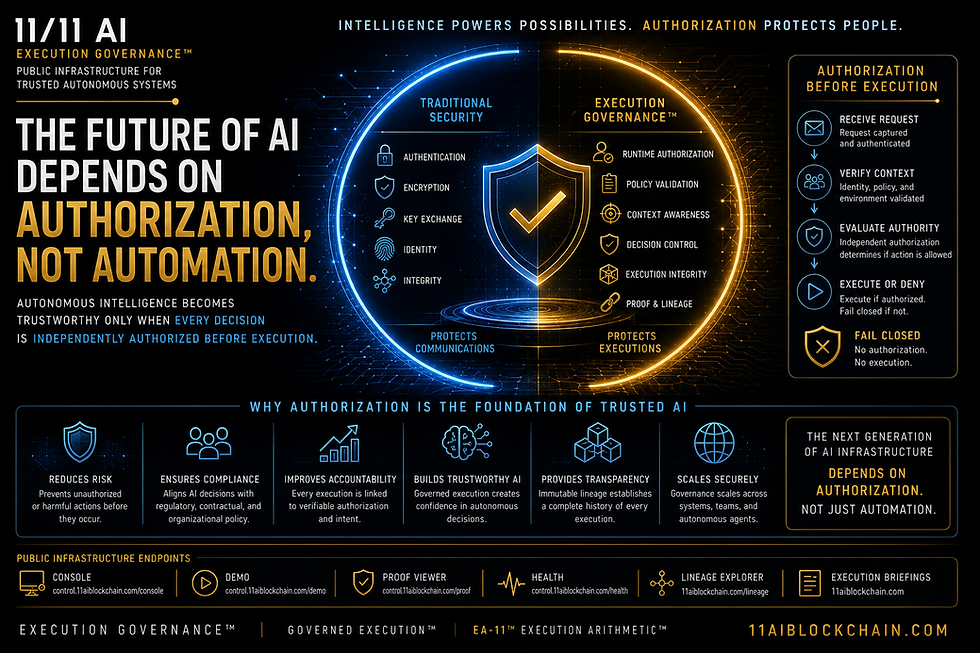
The Role of Execution Governance™
Execution Governance™ extends beyond auditing and monitoring.
It introduces controls that establish:
Verification Before Runtime
The system evaluates authorization, policy, trust, and execution conditions before action is permitted.
Enforcement During Runtime
Execution remains governed while operations are actively occurring.
Proof After Runtime
Cryptographic evidence demonstrates that execution occurred under approved governance conditions.
Together, these controls create a complete provenance chain from authorization through outcome.
Looking Ahead
The next generation of AI infrastructure will require more than transparency.
It will require provable accountability.
Organizations will increasingly need evidence that trust, policy, and authorization remained intact throughout autonomous execution.
Execution provenance represents a foundational step toward that future.
As autonomous systems continue to expand across regulated and mission-critical environments, accountability will no longer be measured solely by what can be audited afterward.
It will be measured by whether trust traveled with the decision itself.
Public Infrastructure Endpoints
Public Runtime Infrastructure
Public Governance Console
Runtime Governance Demo
Public Governance Proof Viewer
Infrastructure Health Dashboard
Execution Lineage Explorer
Execution endpoints intentionally require valid API authorization.
Browser access without a valid authorization key is fail-closed by design.
11/11 introduces Execution Governance™ infrastructure for governed autonomous execution and deterministic operational trust.
Execution Governance™ | Governed Execution™ | Patent Pending


Comments