
Execution Is Becoming the New Security Perimeter


Tomorrow's security boundary will not end at the network. It will begin before every autonomous decision.
Security Has Always Moved Forward
The history of cybersecurity is the history of changing security boundaries.
First came physical security.
Then network security.
Then firewalls.
Identity management.
Public-key cryptography.
Cloud security.
Zero Trust.
Each generation moved the perimeter closer to where risk actually existed.
Artificial intelligence changes that boundary once again.
The New Perimeter Is Execution
Modern AI systems are no longer passive software.
They plan.
Reason.
Call tools.
Coordinate with other agents.
Initiate workflows.
Interact with infrastructure.
Complete transactions.
As autonomous capability expands, execution itself becomes the operational boundary that determines organizational risk.
The question is no longer simply:
"Who connected?"
It becomes:
"What is this system permitted to do?"
Trust Must Exist Before Runtime
Traditional cybersecurity often validates access.
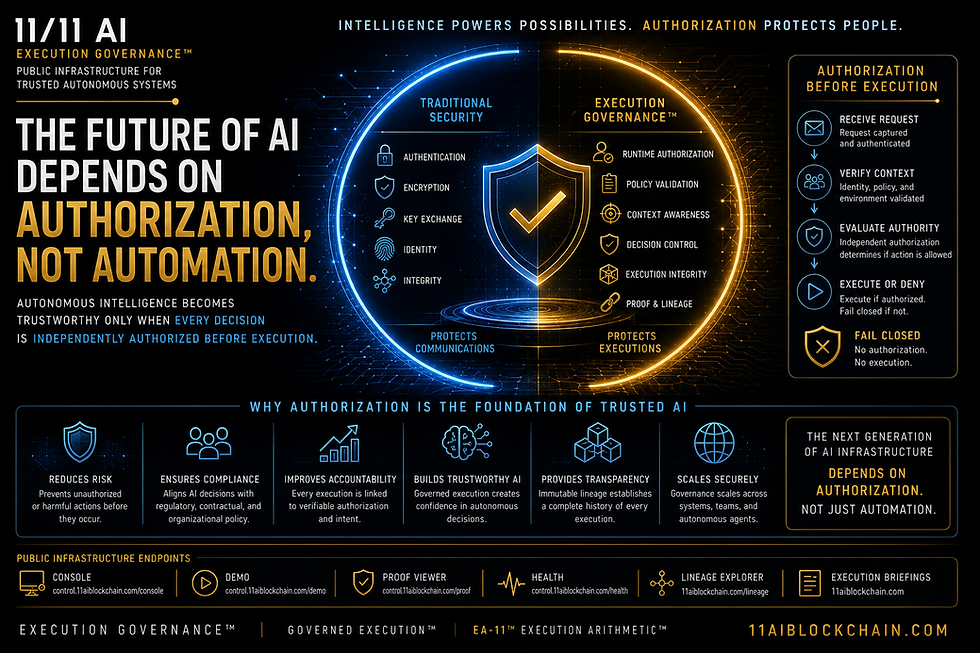
Execution Governance validates authority.
Before autonomous execution begins, governance independently evaluates whether an action satisfies organizational policy, operational constraints, and authorization requirements.
This transforms execution from an implicit assumption into an explicit security decision.
Every execution becomes intentional.
Every authorization becomes verifiable.
Every outcome becomes accountable.
Independent Governance
Execution Governance is intentionally separated from application logic.
Applications generate requests.
Governance evaluates authority.
Applications perform work.
Governance produces immutable proof.
This separation strengthens resilience while creating independent accountability across the execution lifecycle.
Why This Matters
Artificial intelligence is rapidly becoming operational infrastructure.
Infrastructure controls:
Financial systems.
Healthcare.
Manufacturing.
Transportation.
Energy.
Defense.
Government services.
These environments cannot depend solely upon application-level trust.
They require infrastructure-level governance.
A New Layer Of Digital Trust
Future autonomous infrastructure will increasingly consist of complementary trust layers.
Identity establishes who.
Cryptography protects communication.
Execution Governance determines whether autonomous actions may proceed.
Execution lineage preserves what occurred.
Together these capabilities establish confidence throughout the complete execution lifecycle.
Looking Ahead
The evolution of cybersecurity has always followed operational risk.
As AI becomes increasingly autonomous, execution becomes the next logical security perimeter.
Organizations that independently govern execution before runtime will be positioned to build more resilient, accountable, and trustworthy autonomous systems.
Execution Governance represents an architectural approach to that emerging infrastructure layer.
Networks connect systems. Cryptography protects communications. Execution Governance protects autonomous decisions.
AI shifts the security perimeter from networks toward execution.
Authorization becomes a security function.
Independent governance improves operational trust.
Future AI infrastructure requires verifiable execution authority.
Execution Governance™ • Governed Execution™ • EA-11™ Execution Arithmetic™
Patent Pending


Comments