
Execution Governance Will Become the Deterministic Trust Layer for AI Infrastructure


Infrastructure trust historically relied on:assumptions.
Systems assumed:
execution remained authorized
runtime conditions remained trusted
governance continuity persisted
policy enforcement remained intact
That model no longer scales for autonomous AI systems.
Modern infrastructure increasingly:
operates continuously
orchestrates dynamically
executes machine-speed workflows
coordinates distributed environments
adapts execution behavior during runtime
functions autonomously across operational domains
This creates a new infrastructure requirement:
deterministic runtime trust.
Execution governance becomes the deterministic trust layer for AI infrastructure.
SECTION 1 — WHY STATIC TRUST FAILS
Traditional trust models were built for:human-paced infrastructure.
Trust was established:once.
Authentication succeeded.Authorization succeeded.Execution began.
After runtime started, trust continuity was often assumed implicitly.
Autonomous AI systems fundamentally break this assumption.
Runtime conditions now evolve:continuously, dynamically, and autonomously.
Infrastructure must continuously validate:whether execution remains trusted.
SECTION 2 — WHAT A DETERMINISTIC TRUST LAYER ESTABLISHES
11/11 Runtime Governance Layer establishes:continuous deterministic trust enforcement.
Execution becomes continuously dependent on:
runtime policy validation
authorization continuity
governance state integrity
environment attestation
cryptographic verification
execution lineage continuity
Execution proceeds only while trust conditions remain valid.
This creates:deterministic runtime trust continuity.
SECTION 3 — TRUST MOVES INTO EXECUTION ITSELF
Historically, trust boundaries existed around:
networks
identities
perimeter controls
endpoint systems
AI infrastructure changes the location of trust.
Execution itself becomes:the runtime trust boundary.
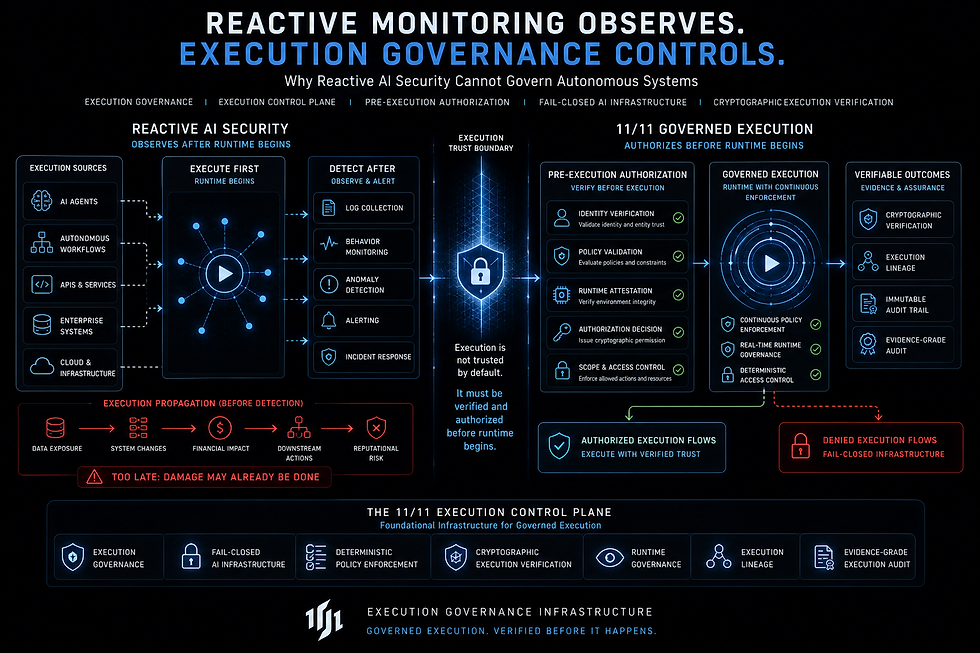
11/11 Execution Control Plane embeds governance directly into execution flow itself.
Execution becomes:actively governed infrastructure activity.
Trust becomes:runtime-native infrastructure logic.
SECTION 4 — FAIL-CLOSED DETERMINISTIC TRUST
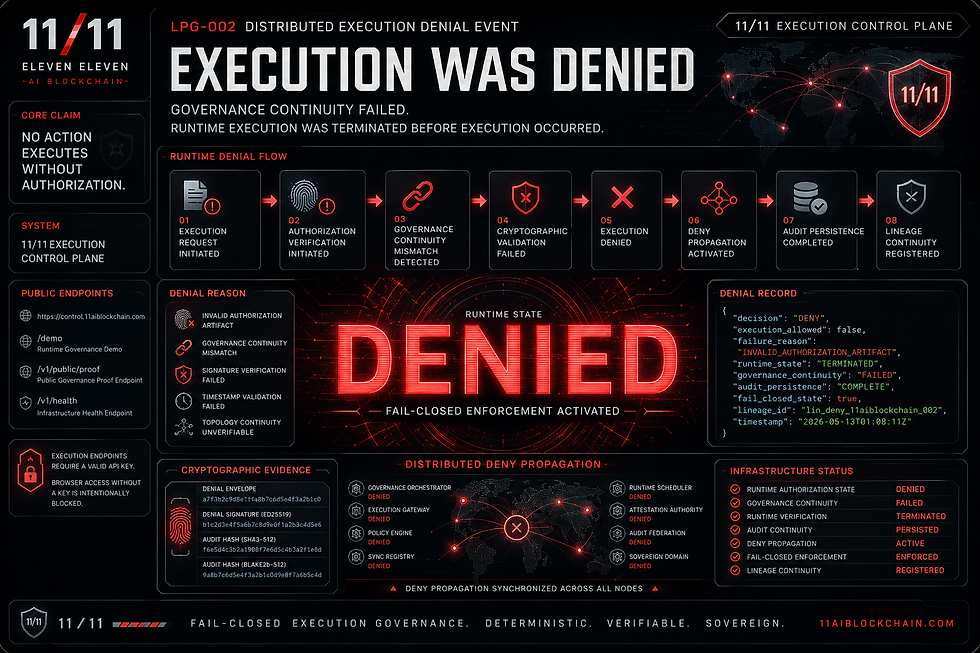
11/11 Runtime Trust Architecture establishes:fail-closed deterministic trust enforcement.
If authorization becomes invalid:execution stops.
If governance continuity fails:execution stops.
If runtime trust degrades:execution stops.
If cryptographic verification becomes invalid:execution stops.
Execution continuity becomes dependent on deterministic trust continuity.
SECTION 5 — WHY THIS BECOMES ESSENTIAL
AI systems increasingly operate across:
enterprise infrastructure
healthcare environments
financial systems
logistics coordination
industrial automation
autonomous agent ecosystems
regulated runtime operations
Organizations require:deterministic runtime trust.
Infrastructure must guarantee:
execution remains authorized
governance boundaries remain enforced
runtime trust remains intact
execution activity remains provable
operational continuity remains deterministic
Reactive trust assumptions become operationally insufficient.
SECTION 6 — FROM ASSUMED TRUST TO DETERMINISTIC TRUST
Traditional infrastructure optimized for:assumed trust models.
Execution governance establishes:deterministic trust infrastructure.
This creates a major architectural transition.
Instead of:authenticate → execute → monitor later
The future becomes:verify continuously → authorize → govern → enforce → prove
Execution itself becomes:continuously trusted infrastructure behavior.
SECTION 7 — THE NEXT TRUST INFRASTRUCTURE LAYER
11/11 Runtime Governance Layer establishes:execution governance as the deterministic trust layer for AI infrastructure.
This introduces:
governed execution continuity
deterministic runtime enforcement
fail-closed trust validation
cryptographic runtime verification
execution lineage continuity
evidence-grade governance proof
Execution itself becomes:continuously governed and trusted infrastructure activity.
SECTION 8 — THE FUTURE OF TRUSTED AI INFRASTRUCTURE
The future of AI infrastructure depends on:deterministic runtime trust.
Execution itself must become:
continuously validated
runtime governed
cryptographically verified
deterministically enforced
permanently auditable
before and during runtime execution.
Execution governance will become the deterministic trust layer for AI infrastructure.
11/11 is building the execution governance layer for AI infrastructure.

Comments