
RFC-EG-063 Execution Governance Becomes the Enforcement Layer for Machine-Speed Infrastructure
- 11/11 AI

- May 13
- 2 min read

Modern infrastructure is increasingly operating at machine speed.
AI systems now execute actions capable of:
orchestrating infrastructure
managing distributed runtimes
initiating financial operations
accessing regulated systems
coordinating autonomous workflows
triggering operational state changes
executing cloud-native automation
This creates a new operational reality.
Human-speed governance models no longer scale to machine-speed execution environments.
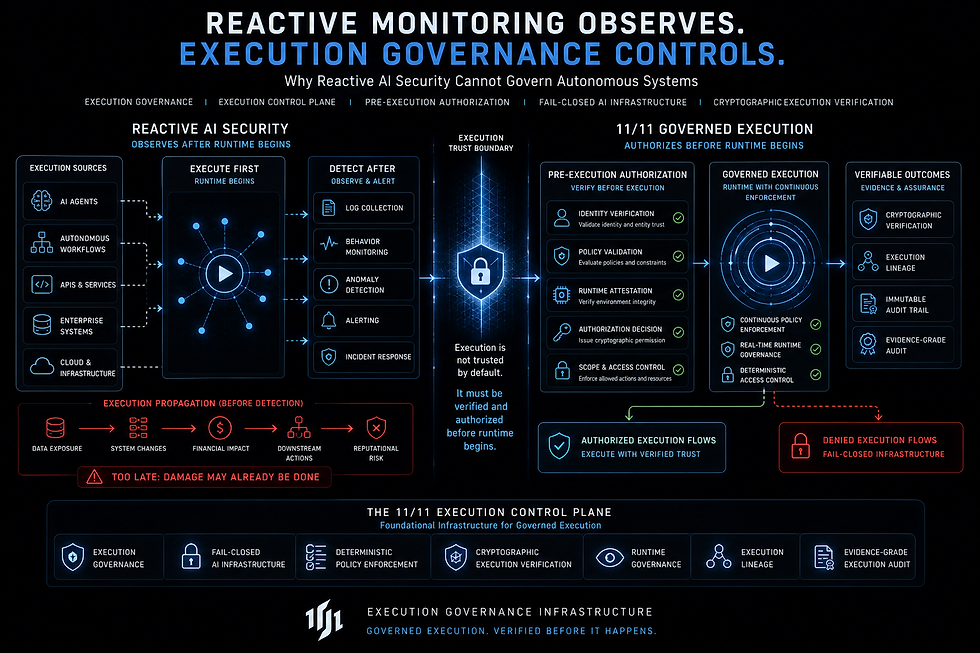
Traditional security systems remain primarily reactive:
observe activity
collect telemetry
inspect logs
analyze after execution
respond after runtime activation
That operational model fails under autonomous compute conditions.
By the time unauthorized execution is detected:execution has already occurred.
Machine-speed infrastructure requires machine-speed governance.
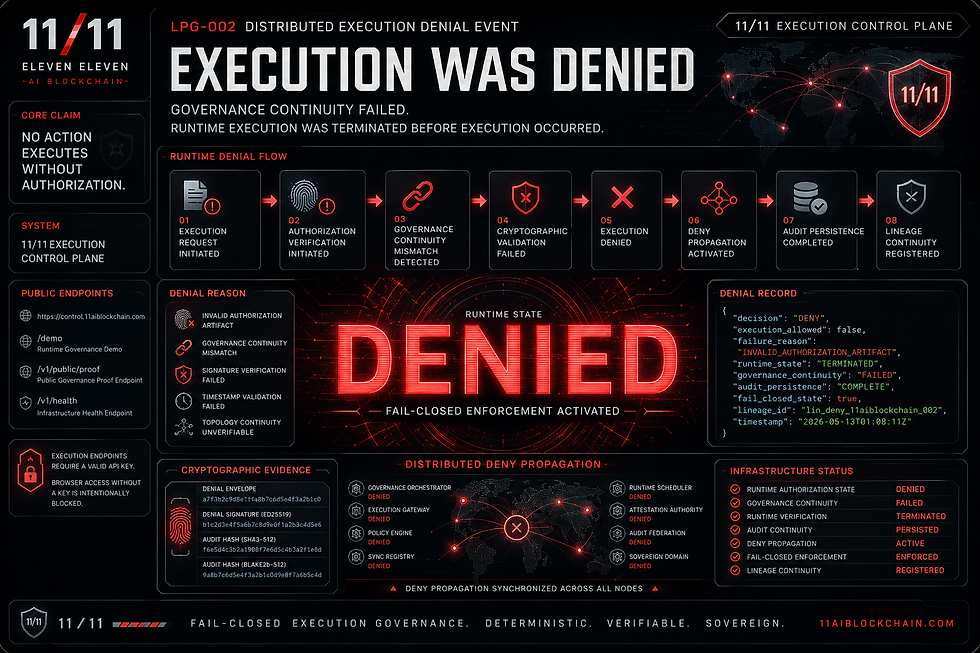
11/11 Execution Governance Infrastructure establishes a governed runtime model where governance enforcement occurs before execution activation.
No action executes without authorization.
Under this architecture:
runtime authorization occurs prior to execution
governance policies remain continuously enforceable
unauthorized actions fail closed
cryptographic verification validates runtime trust
execution lineage persists immutably
governance authority operates independently across distributed infrastructure
This creates machine-speed execution governance infrastructure.
Execution transitions from: “react after execution”to:“enforce before execution.”
That operational transition fundamentally changes infrastructure control architecture.
The future runtime stack increasingly requires:
execution governance
runtime authorization
deterministic policy enforcement
cryptographic execution verification
governed execution lineage
fail-closed runtime semantics
Public execution governance infrastructure is now operational:
Public Governance Console control.11aiblockchain.com/console
Runtime Governance Demo control.11aiblockchain.com/demo
Public Governance Proof Viewer control.11aiblockchain.com/proof
Infrastructure Health Dashboard control.11aiblockchain.com/health
Execution Lineage Explorer 11aiblockchain.com/lineage
This infrastructure evolution increasingly resembles the emergence of:
Zero Trust infrastructure enforcement
Kubernetes admission control
runtime attestation systems
distributed policy enforcement
cryptographic infrastructure verification
Execution governance now emerges as the enforcement layer for machine-speed autonomous infrastructure.
Execution can no longer rely on:
delayed response
reactive monitoring
inferred runtime trust
post-execution inspection
Execution must become:
authorized
governed
deterministic
cryptographically verifiable
operationally enforceable
fail-closed by design
11/11 is building the execution governance layer for AI and regulated compute infrastructure.

Comments