
Execution Governance Will Become Mandatory for Enterprise AI Infrastructure


Enterprise infrastructure is entering a new operational reality.
AI systems increasingly:
coordinate enterprise workflows
automate infrastructure decisions
orchestrate distributed runtime operations
access regulated systems
execute continuously across environments
operate with expanding operational authority
This changes enterprise trust requirements fundamentally.
Traditional enterprise security models were designed for:human-driven systems.
Autonomous AI infrastructure requires:continuous runtime governance.
Execution governance becomes mandatory enterprise infrastructure.
SECTION 1 — ENTERPRISE TRUST MODELS ARE CHANGING
Historically, enterprise systems established trust through:
identity systems
network controls
endpoint protections
access management
monitoring infrastructure
These models assumed:human-driven execution continuity.
AI systems fundamentally change runtime behavior.
Execution now occurs: continuously, autonomously, and dynamically across distributed environments.
Trust can no longer remain:static.
Trust must become:continuously governed.
SECTION 2 — WHAT ENTERPRISE EXECUTION GOVERNANCE REQUIRES
11/11 Runtime Governance Layer establishes:enterprise-grade governed execution continuity.
Execution becomes continuously dependent on:
runtime policy validation
authorization continuity
governance state integrity
environment attestation
cryptographic runtime verification
execution lineage continuity
Execution proceeds only while governance conditions remain valid.
This creates:deterministic enterprise runtime trust.
SECTION 3 — WHY OBSERVABILITY IS NOT ENOUGH
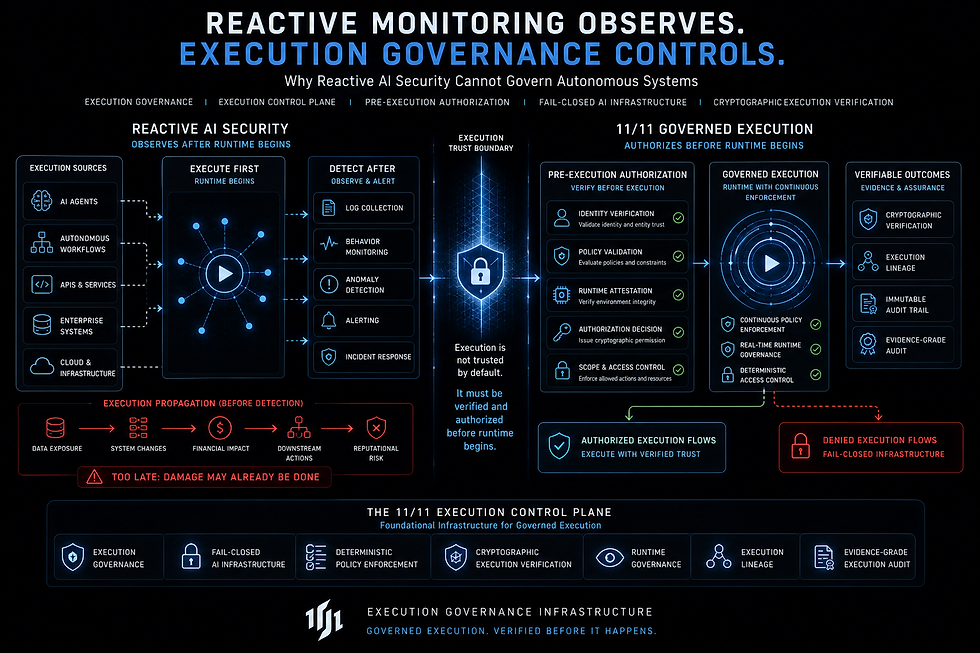
Most enterprise infrastructure today emphasizes:observability.
Monitoring systems explain:what happened.
Enterprise AI systems require something more advanced:runtime enforcement.
11/11 Execution Control Plane continuously governs:
execution scope
authorization validity
governance continuity
runtime integrity
trust enforcement
cryptographic validation
Execution itself becomes:actively governed enterprise infrastructure activity.
SECTION 4 — FAIL-CLOSED ENTERPRISE ENFORCEMENT
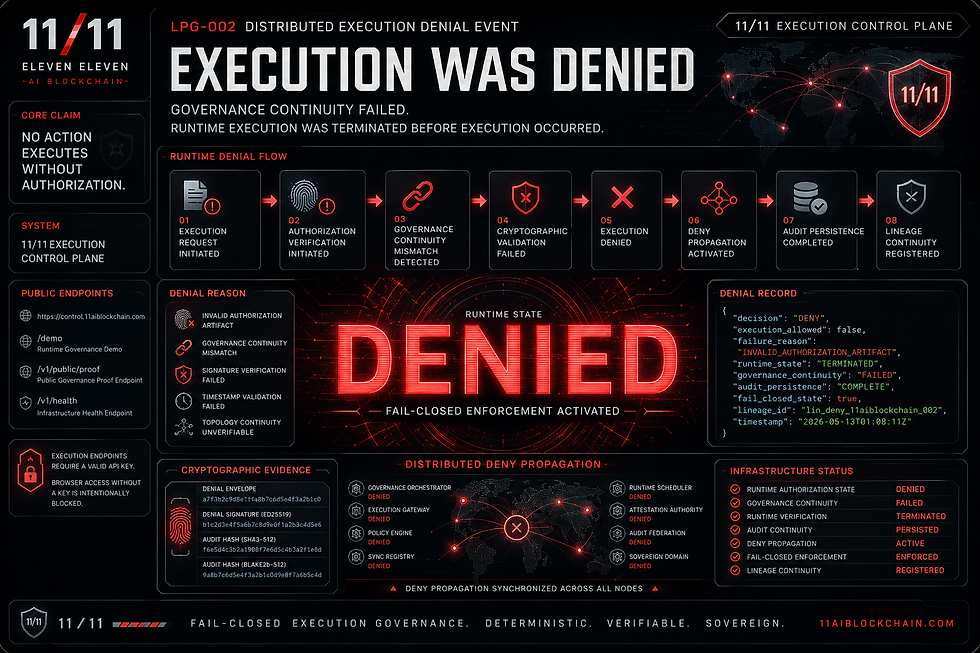
11/11 Runtime Trust Architecture establishes:fail-closed enterprise execution continuity.
If authorization becomes invalid:execution stops.
If governance continuity fails:execution stops.
If runtime integrity degrades:execution stops.
If cryptographic verification becomes invalid:execution stops.
Execution continuity becomes dependent on governance continuity.
SECTION 5 — WHY THIS BECOMES ESSENTIAL
Enterprise AI systems increasingly influence:
financial operations
healthcare workflows
logistics systems
customer infrastructure
operational automation
enterprise orchestration
regulated runtime environments
Organizations require:continuous runtime trust validation.
Infrastructure must guarantee:
execution remains authorized
governance boundaries remain enforced
runtime trust remains intact
execution activity remains provable
authorization continuity remains valid
Reactive security becomes operationally insufficient.
SECTION 6 — ENTERPRISE GOVERNANCE AS INFRASTRUCTURE
Execution governance is not simply:a compliance function.
It becomes:runtime infrastructure logic.
11/11 Runtime Governance Layer embeds governance directly into enterprise execution flow.
This transforms infrastructure from:reactive operational visibility
into:continuous runtime trust enforcement.
Execution becomes:continuously governed infrastructure behavior.
SECTION 7 — THE NEXT ENTERPRISE INFRASTRUCTURE STANDARD
Enterprise infrastructure historically standardized:
identity systems
networking controls
virtualization
orchestration
observability
audit systems
AI infrastructure introduces a new required enterprise layer:
execution governance.
This establishes:
deterministic runtime trust
governed execution continuity
fail-closed enforcement
cryptographic runtime validation
execution lineage continuity
evidence-grade governance proof
Execution governance becomes foundational enterprise infrastructure.
SECTION 8 — THE FUTURE OF ENTERPRISE AI SYSTEMS
11/11 Runtime Trust Architecture establishes:enterprise execution governance
as a foundational operational primitive.
This introduces:
governed runtime continuity
deterministic trust enforcement
cryptographic runtime verification
fail-closed execution control
execution lineage continuity
continuous governance validation
Execution itself becomes:continuously trusted enterprise infrastructure behavior.
CLOSING
Enterprise AI infrastructure can no longer rely on:static trust assumptions,
reactive monitoring,
or post-execution analysis.
The future requires:continuous execution governance.
Execution itself must become:
continuously validated
runtime governed
cryptographically verified
deterministically enforced
permanently auditable
before and during runtime execution.
Execution governance will become mandatory for enterprise AI infrastructure.
11/11 is building the execution governance layer for AI infrastructure.

Comments