
Execution Governance Is the Missing Control Plane for Autonomous AI


Artificial intelligence has become increasingly autonomous. What it still lacks is an independent authority that determines whether execution should occur.
Intelligence Has Outpaced Governance
Artificial intelligence has advanced from prediction engines into reasoning systems capable of planning, tool use, memory, and autonomous decision making.
The pace of innovation has been extraordinary.
Every month introduces larger models, more capable agents, and increasingly sophisticated autonomous workflows.
Yet one architectural component remains largely absent.
Independent execution governance.
Today's AI Stack
Modern AI infrastructure generally consists of:
Foundation Models.
Reasoning Engines.
Agent Frameworks.
Memory Systems.
Retrieval.
Tool Calling.
Inference Infrastructure.
Monitoring.
Observability.
These technologies improve intelligence.
None independently determines whether execution should occur.
Authorization frequently remains embedded inside application logic rather than existing as an independent infrastructure service.
The Missing Control Plane
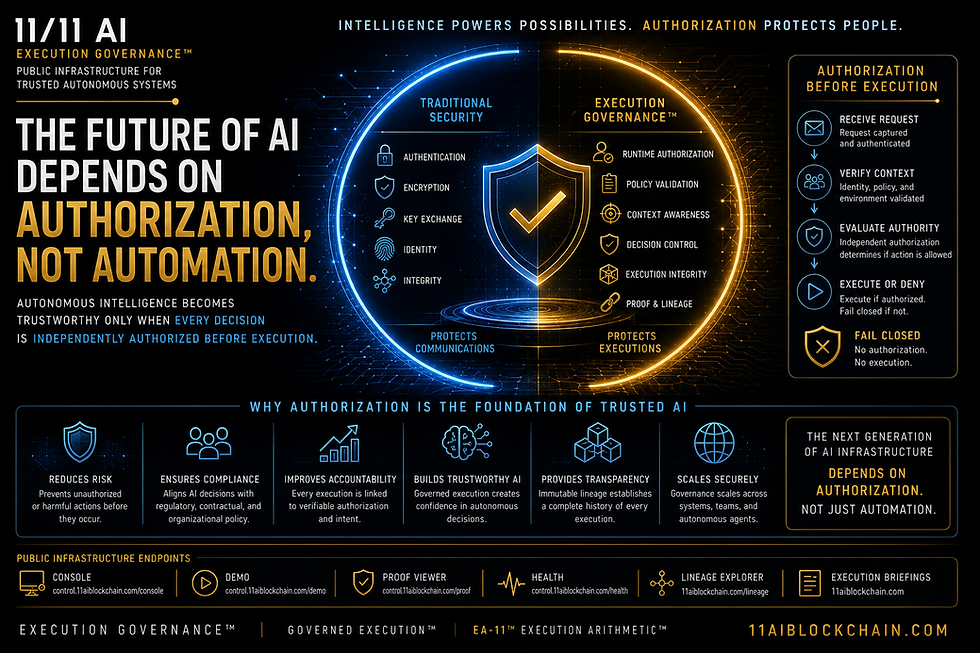
Execution Governance introduces a separate operational layer positioned before runtime.
Instead of allowing applications to determine their own authority, governance evaluates execution requests independently.
Every request may be examined against:
• Organizational policy
• Identity
• Context
• Runtime conditions
• Regulatory requirements
• Operational boundaries
• Authorization rules
Only after governance requirements have been satisfied does execution proceed.
Otherwise, execution terminates safely.
Fail Closed.
Separating Intelligence From Authority
Modern infrastructure separates many responsibilities.
Applications do not perform their own networking.
They do not operate their own certificate authorities.
They do not independently define operating system security.
Execution authority should follow the same principle.
Artificial intelligence generates possible actions.
Execution Governance determines whether those actions are authorized.
This architectural separation improves transparency, accountability, and operational trust.
Building Infrastructure Instead of Features
Execution Governance is not another AI application.
It is infrastructure.
Infrastructure survives model changes.
Infrastructure survives framework changes.
Infrastructure survives vendor changes.
As foundation models continue evolving, independent governance remains consistent across the entire execution environment.
Toward Governed Intelligence
Future autonomous systems will require:
Independent authorization.
Immutable execution records.
Cryptographic governance receipts.
Policy enforcement before runtime.
Execution lineage.
Deterministic governance outcomes.
These capabilities transform artificial intelligence from autonomous software into governed operational infrastructure.
Looking Forward
Artificial intelligence will continue becoming faster.
Models will continue becoming larger.
Agents will continue becoming more autonomous.
Trust, however, will increasingly depend upon something different.
Independent authorization.
Execution Governance establishes an architectural control plane designed to evaluate execution before autonomous actions occur.
The future of AI will depend not only upon what systems can do, but upon what they are permitted to do.
Intelligence generates possibilities. Execution Governance determines which possibilities become reality.
AI requires an independent execution control plane.
Authorization should exist outside application logic.
Governance before runtime improves trust and accountability.
Future autonomous infrastructure depends upon independent execution authority.
Execution Governance™ • Governed Execution™ • EA-11™ Execution Arithmetic™
Patent Pending


Comments