
Execution Governance Will Become the Trust Infrastructure for Autonomous AI Economies


AI systems are rapidly evolving beyond:isolated automation.
Infrastructure increasingly operates through:
autonomous orchestration
machine-generated execution
distributed AI coordination
continuous operational workflows
agent-to-agent interactions
infrastructure-native decision systems
This creates the foundation for:autonomous AI economies.
As AI systems begin coordinating: transactions, operations, services, and infrastructure activity autonomously, trust becomes the central operational requirement.
The future of autonomous AI economies depends on:execution governance.
SECTION 1 — AUTONOMOUS ECONOMIES REQUIRE TRUST INFRASTRUCTURE
Traditional economies depend heavily on:institutional trust systems.
Examples include:
banking infrastructure
legal enforcement
accounting systems
financial audit systems
regulatory oversight
operational governance frameworks
Autonomous AI economies require equivalent trust infrastructure for:runtime execution itself.
AI systems must continuously prove:
execution remains authorized
governance continuity remains valid
operational boundaries remain enforced
runtime trust remains intact
execution activity remains accountable
Execution governance becomes:the trust infrastructure layer for autonomous economies.
SECTION 2 — WHAT TRUST INFRASTRUCTURE MEANS
11/11 Runtime Governance Layer establishes:continuous runtime trust infrastructure.
Execution becomes continuously dependent on:
runtime policy validation
authorization continuity
governance state integrity
environment attestation
cryptographic verification
execution lineage continuity
Execution proceeds only while governance conditions remain valid.
This creates:deterministic economic runtime trust.
SECTION 3 — TRUST MOVES INTO MACHINE-SPEED OPERATIONS
Historically,trust systems evolved around:human-paced operations.
Autonomous AI systems fundamentally change operational velocity.
Infrastructure now executes:
continuously
autonomously
across distributed runtime environments
through machine-speed orchestration
with adaptive operational behavior
Trust can no longer depend on:manual review or delayed enforcement.
Trust must become:runtime-native and continuously enforceable.
SECTION 4 — FAIL-CLOSED ECONOMIC TRUST CONTINUITY
11/11 Runtime Trust Architecture establishes:fail-closed runtime trust continuity.
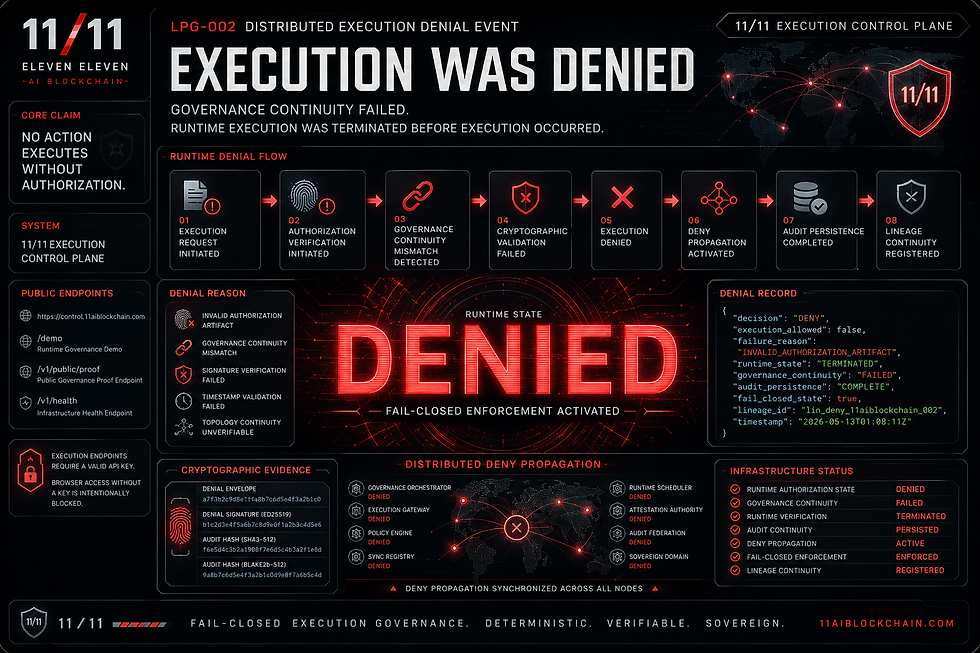
If authorization becomes invalid:execution stops.
If governance continuity fails:execution stops.
If runtime trust degrades:execution stops.
If cryptographic verification becomes invalid:execution stops.
Economic operational continuity becomes dependent on governance continuity.
SECTION 5 — WHY THIS BECOMES ESSENTIAL
Autonomous AI systems increasingly coordinate:
enterprise workflows
financial infrastructure
logistics orchestration
autonomous marketplaces
industrial operations
machine-to-machine interactions
regulated operational environments
Organizations require:continuous runtime trust enforcement.
Infrastructure must guarantee:
execution remains governed
operational trust remains intact
runtime boundaries remain enforced
execution activity remains provable
autonomous coordination remains accountable
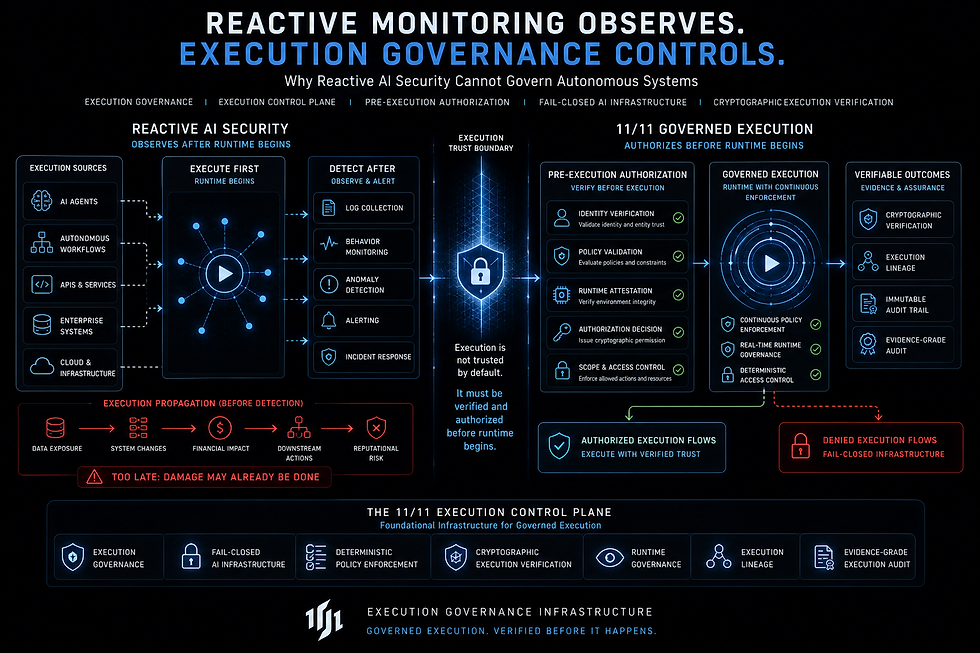
Reactive operational visibility becomes economically insufficient.
SECTION 6 — FROM OPERATIONAL AUTOMATION TO GOVERNED AUTONOMY
Traditional infrastructure optimized for:automation.
Autonomous AI economies require:governed autonomy.
This creates a major operational transition.
Instead of:execute → monitor → react later
The future becomes:verify → authorize → govern continuously → enforce → prove
Execution itself becomes:continuously governed economic infrastructure activity.
SECTION 7 — THE NEXT ECONOMIC INFRASTRUCTURE LAYER
11/11 Runtime Governance Layer establishes:execution governance as the trust infrastructure for autonomous AI economies.
This introduces:
deterministic runtime governance
governed execution continuity
fail-closed operational enforcement
cryptographic runtime validation
execution lineage continuity
evidence-grade governance proof
Execution itself becomes:continuously trusted economic infrastructure activity.
SECTION 8 — THE FUTURE OF AUTONOMOUS AI ECONOMIES
Autonomous AI economies require:continuous execution governance.
Execution itself must become:
continuously validated
runtime governed
cryptographically verified
deterministically enforced
permanently auditable
before and during runtime execution.
Execution governance will become the trust infrastructure for autonomous AI economies.
11/11 is building the execution governance layer for AI infrastructure.

Comments