
PILLAR PAGE 03 Execution Governance vs Observability


Introduction
Modern infrastructure increasingly depends on autonomous execution systems.
AI runtimes now:
orchestrate infrastructure
automate workflows
execute operational decisions
coordinate distributed systems
operate continuously at machine speed
Traditional observability systems were not designed to govern autonomous execution.
Most observability platforms primarily:
collect telemetry
monitor logs
analyze traces
detect anomalies
inspect behavior after execution occurs
Execution governance establishes a fundamentally different model:
authorize before execution.
No action executes without authorization.
What Observability Does
Observability systems provide visibility into runtime activity.
Typical observability functions include:
telemetry collection
log aggregation
distributed tracing
metrics analysis
anomaly detection
infrastructure monitoring
Observability answers:
what happened
where it happened
when it happened
how systems behaved
Observability is fundamentally:reactive.
What Execution Governance Does
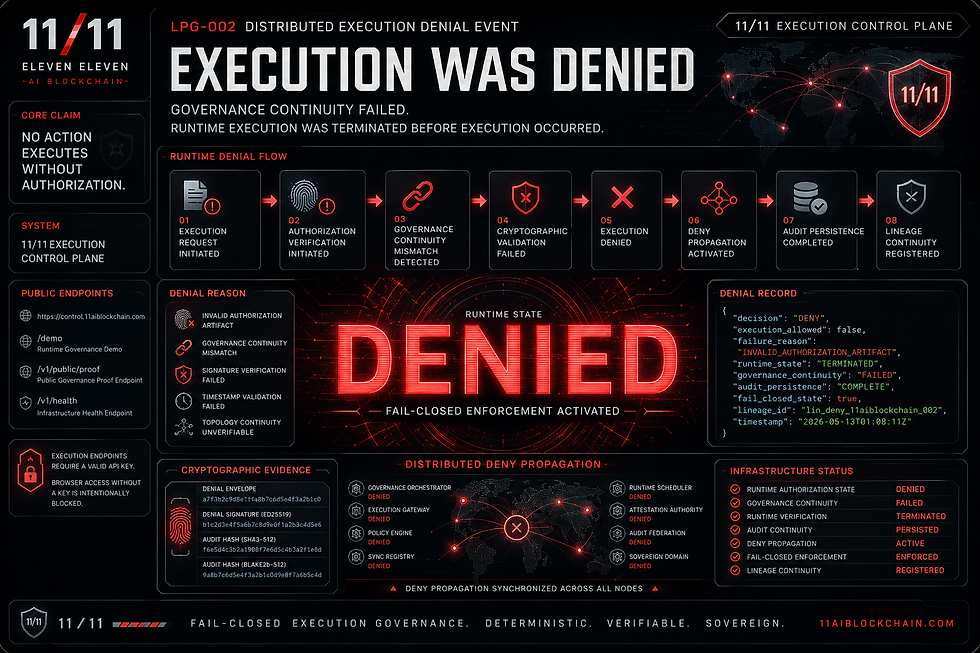
Execution governance establishes deterministic runtime control before execution activation occurs.
Execution governance determines:
whether execution is authorized
whether runtime conditions are trusted
whether policy permits execution
whether runtime integrity remains valid
whether execution should continue
Execution governance answers:
should execution occur
should runtime continue
should execution terminate
should actions fail closed
Execution governance is fundamentally:proactive.
The Core Difference
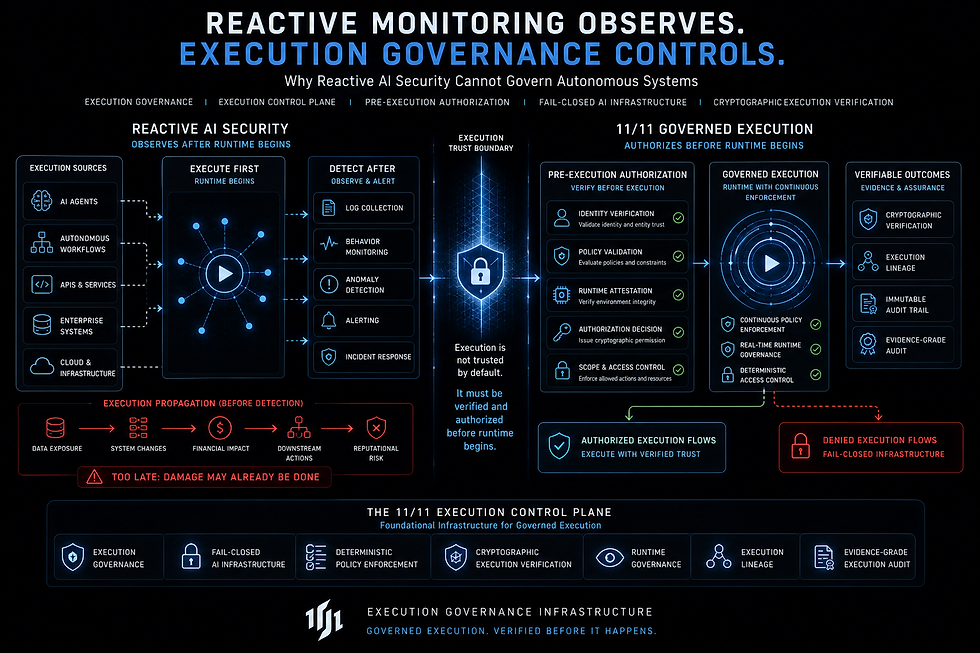
Observability:
observe after execution.
Execution Governance:
control before execution.
That distinction changes everything.
Why Observability Alone Fails
Observability systems may detect:
anomalous runtime behavior
unauthorized activity
policy violations
suspicious execution patterns
But detection occurs after runtime activation.
By the time alerts occur:execution has already happened.
For autonomous systems:that delay becomes operationally dangerous.
AI systems increasingly:
execute continuously
operate autonomously
coordinate machine-speed workflows
interact with critical infrastructure
Reactive security models no longer scale.
Execution Governance Establishes Deterministic Control
Execution governance establishes:
pre-execution authorization
fail-closed enforcement
continuous runtime verification
cryptographic runtime trust
immutable execution lineage
deterministic policy enforcement
Execution becomes:governed infrastructure.
Observability vs Execution Governance
Observability | Execution Governance |
Monitors systems | Controls systems |
Reactive | Proactive |
Detects after execution | Authorizes before execution |
Collects telemetry | Enforces policy |
Provides visibility | Establishes control |
Observes runtime | Governs runtime |
Alerts on violations | Blocks violations |
Detects anomalies | Fails closed |
Why Autonomous Systems Require Governance
Autonomous systems increasingly:
initiate actions independently
execute machine-speed decisions
orchestrate infrastructure
coordinate distributed runtimes
access regulated environments
Observability alone cannot govern these systems.
Execution governance becomes necessary infrastructure.
Execution Governance Architecture
Execution governance infrastructure typically includes:
Governance Control Plane
policy engine
authorization engine
risk evaluation
integrity services
lineage services
Runtime Enforcement Layer
runtime guards
integrity monitors
behavioral enforcement
anomaly detection
fail-closed controls
Execution Infrastructure
compute
containers
orchestration
services
distributed runtimes
Public Execution Governance Infrastructure
11/11 public execution governance infrastructure is operational:
Public Governance Console
Runtime Governance Demo
Public Governance Proof Viewer
Infrastructure Health Dashboard
Execution Lineage Explorer
The Future Of Infrastructure
Modern infrastructure increasingly requires:
deterministic authorization
governed execution
runtime enforcement
continuous verification
cryptographic runtime trust
fail-closed operational control
Observability remains important.
But observability alone is no longer sufficient.
Execution governance establishes:the operational control layer for autonomous systems.
Conclusion
Observability systems:watch infrastructure.
Execution governance:controls infrastructure.
Autonomous systems increasingly require:
authorization before execution
continuous runtime enforcement
immutable execution lineage
fail-closed operational semantics
Execution governance transforms runtime systems from:implicitly trusted environments
into:deterministically governed infrastructure.
11/11 is building the execution governance layer for AI and regulated compute infrastructure.

Comments