
RFC-EG-053 Execution Lineage Becomes Foundational Runtime Infrastructure

Modern infrastructure increasingly depends on autonomous execution systems operating across:
AI inference environments
distributed cloud runtimes
regulated healthcare systems
financial orchestration layers
autonomous defense infrastructure
machine-driven operational environments
As execution autonomy expands, a critical infrastructure problem emerges:
most systems cannot deterministically prove:
what executed
why execution was allowed
which policies authorized execution
what runtime conditions existed
which governance authority approved execution
whether execution lineage remained intact
This creates a growing operational trust gap across modern compute infrastructure.
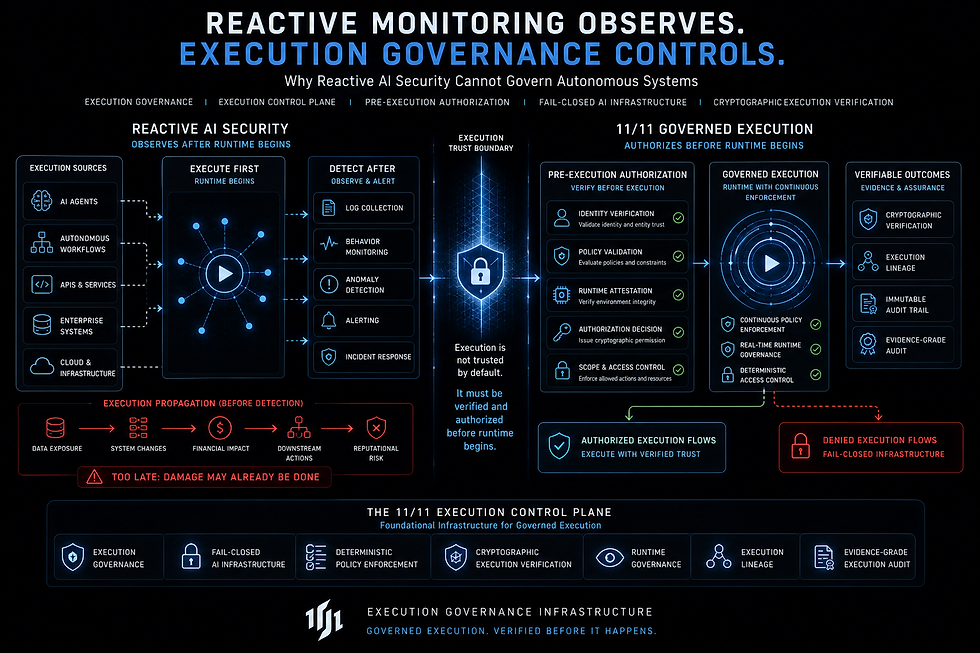
Traditional observability systems capture events after execution.
Execution governance requires proving trust before execution occurs.
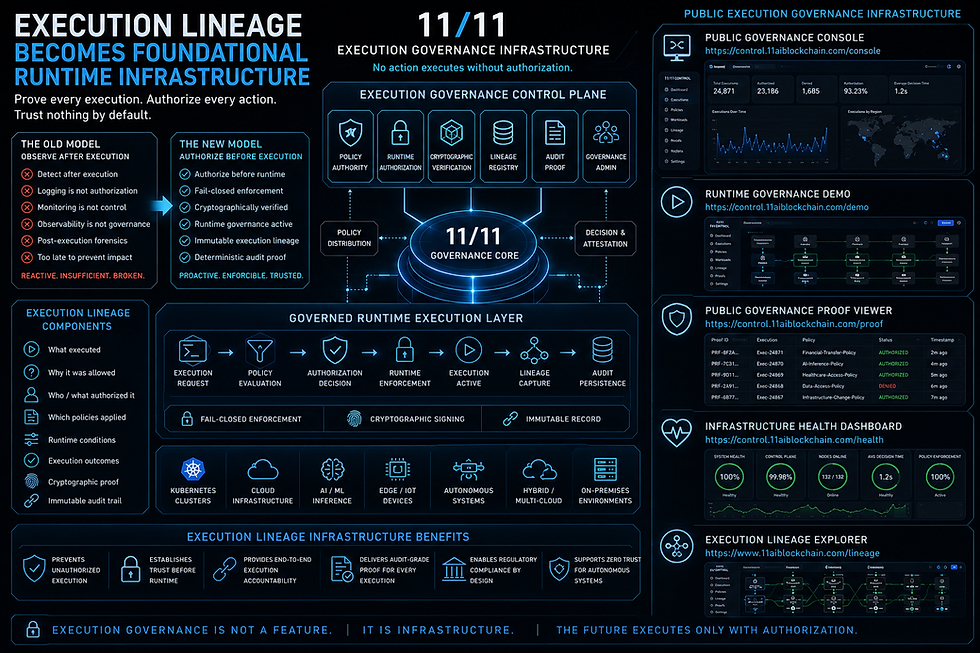
11/11 Execution Governance Infrastructure establishes a governed runtime model where execution lineage becomes a foundational infrastructure layer.
Under this architecture:
execution authorization occurs before runtime activation
governance policies are cryptographically enforced
runtime authorization artifacts persist across execution states
execution lineage remains permanently traceable
audit proof becomes deterministic and verifiable
distributed runtime trust becomes operationally enforceable
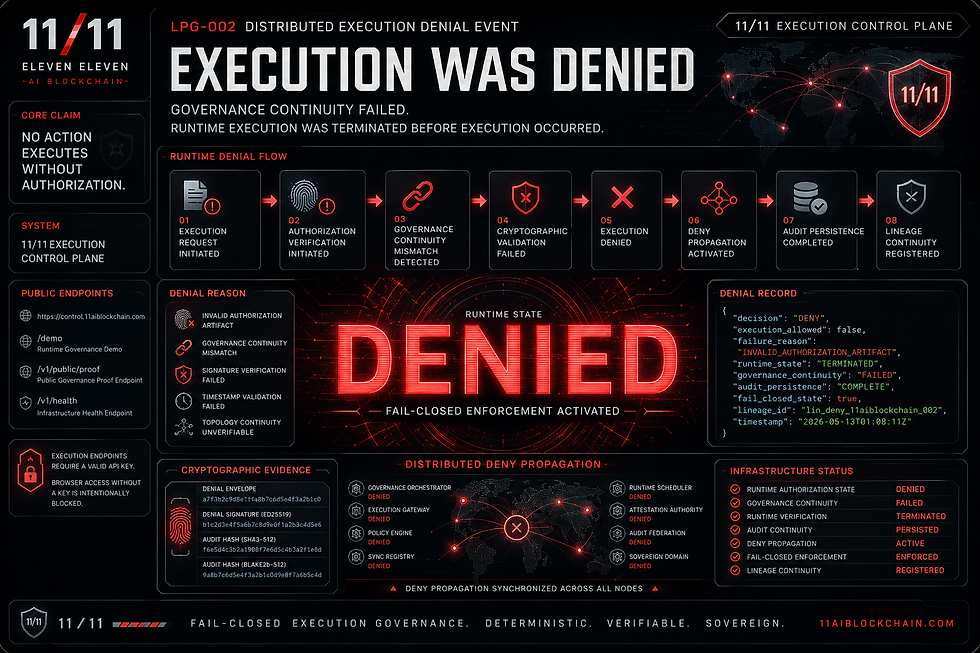
No action executes without authorization.
Execution lineage transforms runtime infrastructure from:“best-effort observability”to:“deterministic execution accountability.”
This creates a new operational foundation for AI and regulated compute systems.
Execution lineage infrastructure increasingly becomes mandatory for:
AI runtime governance
autonomous system accountability
regulated financial execution
healthcare compute authorization
distributed cloud orchestration
operational compliance enforcement
Public execution governance infrastructure is now operational:
Public Governance Consolecontrol.11aiblockchain.com/console
Runtime Governance Democontrol.11aiblockchain.com/demo
Public Governance Proof Viewercontrol.11aiblockchain.com/proof
Infrastructure Health Dashboardcontrol.11aiblockchain.com/health
Execution Lineage Explorer11aiblockchain.com/lineage
This infrastructure transition increasingly mirrors the evolution previously seen with:
TLS for communications trust
TPM for hardware trust
Zero Trust for identity enforcement
runtime attestation for infrastructure verification
Execution lineage now emerges as the operational trust layer for autonomous compute execution.
The future runtime stack increasingly requires:
governed execution
cryptographic authorization
deterministic runtime enforcement
immutable execution lineage
distributed governance authority
fail-closed operational control
Execution itself can no longer operate as an untrusted black box.
Execution must become:
authorized
verifiable
traceable
enforceable
provable
11/11 is building the execution governance layer for AI and regulated compute infrastructure.

Comments