
PILLAR PAGE 16 Execution Lineage Infrastructure for Governed AI Systems | 11/11 Execution Governance


Why Runtime History Must Become Verifiable
Traditional infrastructure logging systems were designed primarily for operational troubleshooting.
Modern autonomous systems require something much more advanced.
AI infrastructure increasingly requires:
provable runtime history
immutable execution traceability
deterministic audit continuity
governance reconstruction capability
cryptographic evidence persistence
This creates the need for execution lineage infrastructure.
Execution lineage transforms runtime behavior into continuously verifiable governance history.
What Is Execution Lineage?
Execution lineage is the immutable record of how execution occurred throughout a governed runtime environment.
Lineage systems persist:
execution requests
authorization decisions
policy evaluations
runtime transitions
dependency relationships
orchestration actions
cryptographic verification artifacts
Execution lineage allows infrastructure operators to reconstruct execution history with deterministic accuracy.
The Failure of Traditional Logging Systems
Traditional logs are insufficient for autonomous runtime governance.
Conventional logging systems often suffer from:
incomplete visibility
fragmented telemetry
mutable records
inconsistent timestamps
missing context
unverifiable event chains
disconnected execution history
These weaknesses become critical within AI-driven execution environments.
Autonomous systems may execute thousands of actions beyond direct human visibility.
Execution lineage infrastructure establishes continuously traceable runtime governance.
The Shift From Logging to Governance Evidence
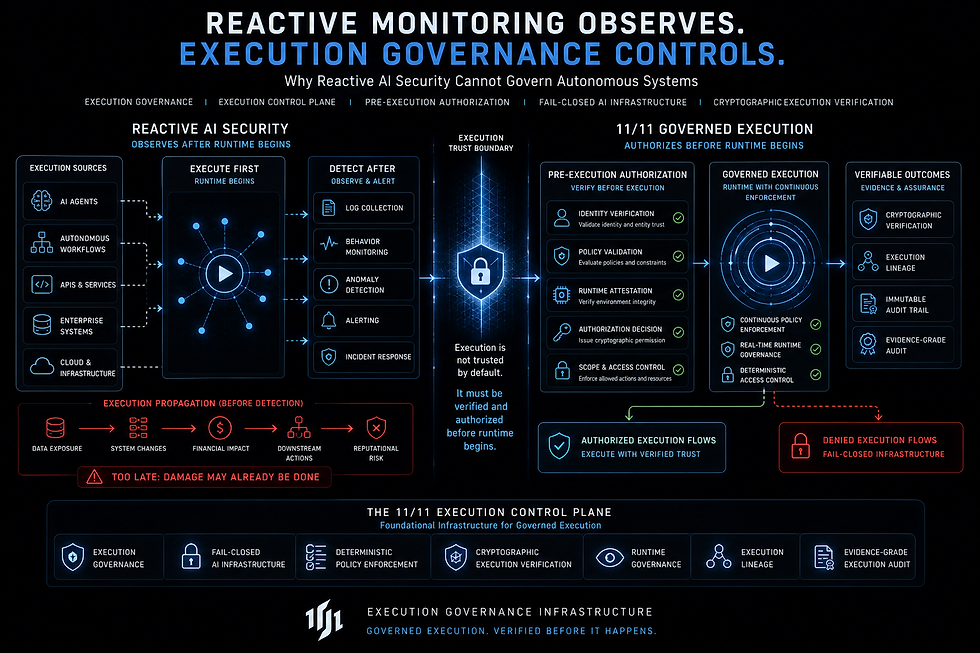
Execution lineage infrastructure differs fundamentally from standard observability systems.
Traditional observability focuses on:
telemetry
diagnostics
operational metrics
event monitoring
Execution lineage focuses on:
governance reconstruction
cryptographic proof
execution traceability
authorization continuity
deterministic audit integrity
runtime accountability
This creates evidence-grade governance infrastructure.
Related:
Cryptographic Runtime Verification
Runtime Integrity Systems
Governance Control Planes
Core Components of Execution Lineage Infrastructure
Event Capture Systems
Execution lineage begins with structured event capture.
Captured events may include:
execution initiation
authorization issuance
policy evaluations
runtime state transitions
orchestration actions
enforcement decisions
anomaly detection events
This creates structured governance visibility.
Lineage Graph Construction
Execution lineage systems build runtime relationship graphs.
These graphs map:
execution dependencies
authorization inheritance
runtime transitions
orchestration chains
workload relationships
trust propagation paths
Lineage graphs transform isolated runtime events into reconstructable governance flows.
Immutable Storage Infrastructure
Execution lineage requires tamper-evident persistence.
Immutable storage systems ensure:
records cannot be silently altered
governance history remains reconstructable
audit continuity persists
runtime evidence remains verifiable
execution history survives distributed environments
Immutable persistence is foundational to trustworthy governance infrastructure.
Cryptographic Proof Generation
Execution lineage systems increasingly generate cryptographic proof artifacts.
These artifacts verify:
execution authenticity
authorization continuity
audit integrity
policy enforcement history
lineage consistency
governance reconstruction validity
This creates provable runtime governance.
Deterministic Governance Reconstruction
Execution lineage systems must support deterministic reconstruction.
Deterministic reconstruction means:
identical lineage data produces identical governance conclusions
runtime history remains consistent
audit replay remains stable
governance evidence remains predictable
verification outcomes remain reproducible
This is essential for mission-critical infrastructure.
Continuous Lineage Persistence
Execution lineage operates continuously throughout runtime lifecycle operations.
Continuous lineage systems persist:
authorization updates
runtime transitions
policy modifications
enforcement events
workload state changes
orchestration behavior
trust boundary interactions
This creates continuously reconstructable governance infrastructure.
Execution Lineage in Autonomous AI Systems
Autonomous AI systems significantly increase governance complexity.
AI systems may independently:
chain execution decisions
invoke downstream services
coordinate infrastructure actions
orchestrate runtime workflows
modify execution pathways
interact across distributed environments
Execution lineage infrastructure ensures these behaviors remain reconstructable and verifiable.
Without lineage systems, autonomous execution becomes operationally opaque.
Distributed Execution Lineage
Modern infrastructure operates across distributed environments.
Execution lineage systems must therefore support:
multi-cloud orchestration
Kubernetes environments
sovereign runtime regions
edge deployments
hybrid infrastructure
federated governance systems
Distributed lineage infrastructure requires:
synchronized event coordination
globally consistent timestamps
distributed proof verification
lineage continuity preservation
cross-domain governance traceability
This creates globally reconstructable governance infrastructure.
Fail-Closed Governance and Lineage Integrity
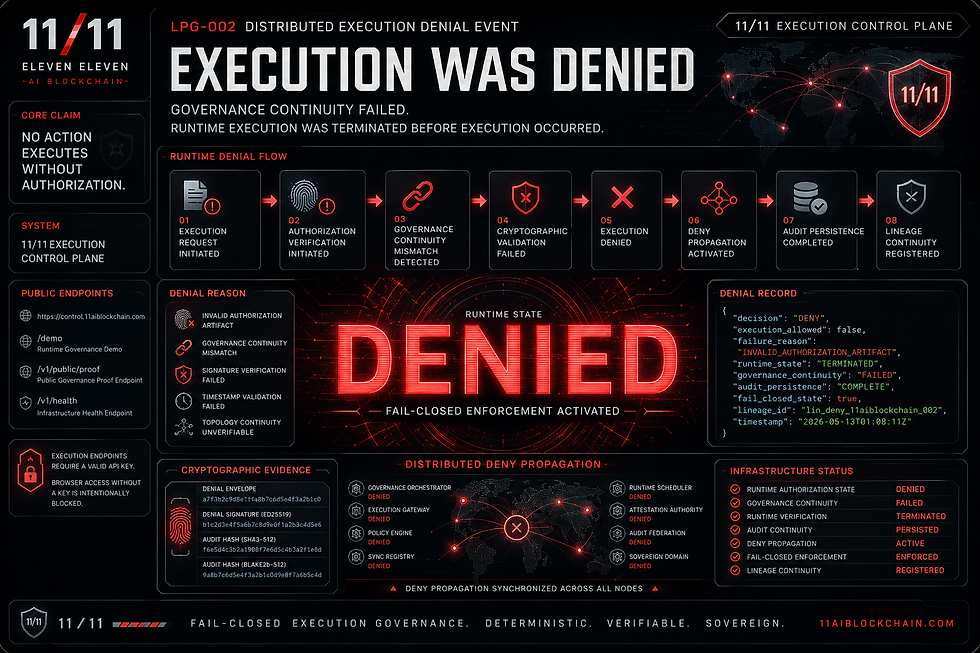
Fail-closed execution governance depends heavily on lineage integrity.
Governance systems may deny execution if:
lineage continuity breaks
authorization history becomes inconsistent
runtime transitions cannot be verified
audit evidence becomes corrupted
proof generation fails
Execution lineage therefore becomes operationally critical infrastructure.
Enterprise and Defense Governance
Execution lineage infrastructure is increasingly important for:
defense systems
sovereign AI infrastructure
healthcare governance
financial execution systems
industrial automation
critical infrastructure orchestration
These environments require evidence-grade operational accountability.
Execution lineage systems establish that accountability layer.
Public Governance Infrastructure
11/11 demonstrates execution lineage concepts through publicly accessible governance infrastructure.
Execution Lineage Explorer
Runtime Governance Demo
Governance Console
Governance Proof Viewer
Infrastructure Health Dashboard
The Future of Execution Lineage Infrastructure
As autonomous execution systems continue expanding, execution lineage infrastructure will become foundational operational architecture.
Future governed systems will increasingly require:
immutable runtime traceability
cryptographic audit continuity
deterministic governance reconstruction
distributed lineage synchronization
continuously verifiable execution history
evidence-grade runtime accountability
Execution lineage infrastructure is rapidly emerging as one of the foundational operational layers of governed AI infrastructure.

Comments