
PILLAR PAGE 04 Fail-Closed AI Infrastructure


Introduction
Modern AI systems increasingly operate autonomously across:
cloud infrastructure
distributed runtimes
operational systems
regulated environments
machine-speed execution workflows
Traditional infrastructure security architectures were not designed for autonomous execution systems.
Most existing systems still assume:
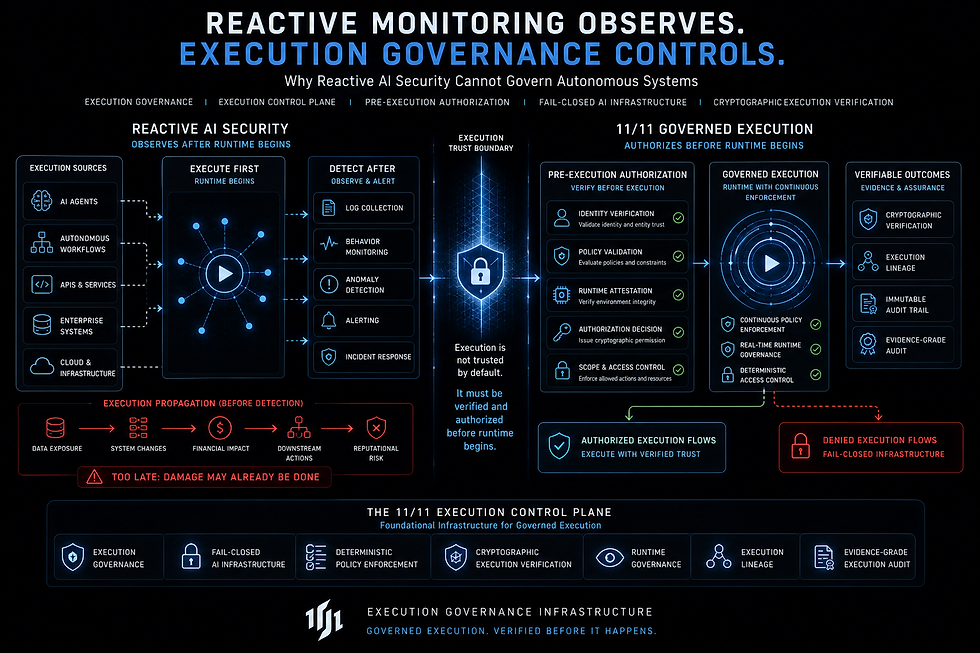
execution may proceed first
security response occurs later
runtime trust is implicitly assumed
violations can be handled after execution
That model no longer scales.
Autonomous systems increasingly require:
fail-closed infrastructure.
No action executes without authorization.
What Fail-Closed Means
Fail-closed infrastructure assumes:
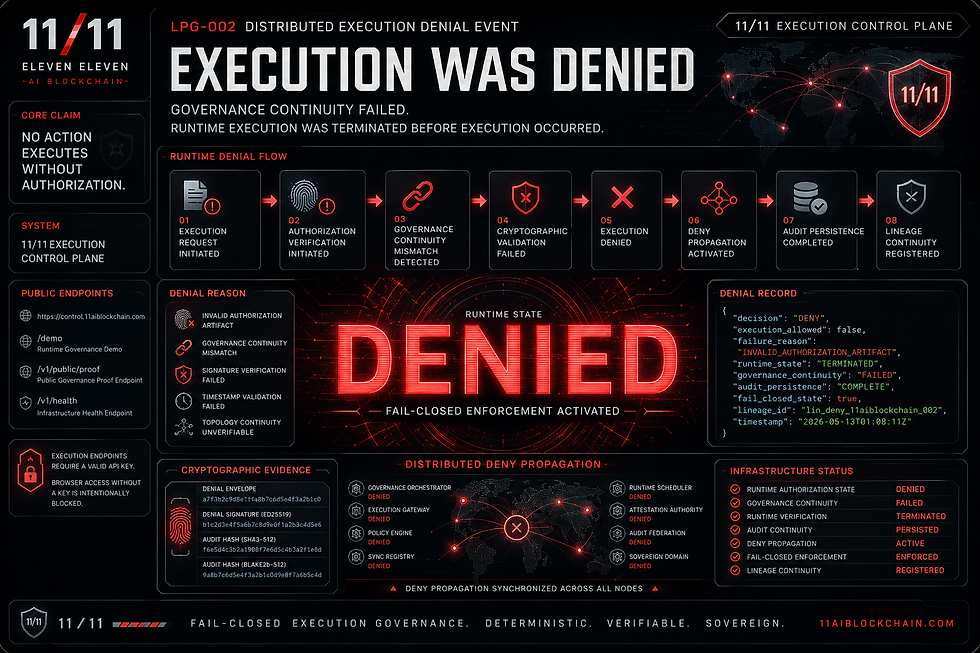
uncertainty defaults to deny
unauthorized execution never proceeds
policy violations terminate execution
invalid runtime conditions block activation
governance enforcement remains continuously active
If authorization fails:execution fails closed.
If integrity fails:execution fails closed.
If runtime trust cannot be verified:execution fails closed.
Why Fail-Open Infrastructure Fails
Traditional systems often operate:fail-open.
Meaning:
execution proceeds by default
violations are detected later
alerts occur after runtime activation
response follows operational impact
For autonomous systems:that creates dangerous operational exposure.
AI systems increasingly:
execute continuously
coordinate infrastructure
trigger operational workflows
interact with critical systems
operate at machine speed
Human-speed response models no longer scale.
Fail-Closed Infrastructure Establishes Deterministic Control
Execution governance changes the operational model entirely.
Instead of:“execute unless blocked”
the model becomes:“execute only if authorized.”
This establishes:
deterministic runtime control
governed execution
continuous enforcement
cryptographic verification
immutable execution lineage
operational accountability
Execution becomes:explicitly governed infrastructure.
Core Components Of Fail-Closed Infrastructure
1. Pre-Execution Authorization
Every execution request must be:
evaluated
validated
authorized
policy checked
environment verified
before runtime activation occurs.
2. Runtime Enforcement
Governance persists continuously during execution.
Runtime systems continuously verify:
integrity
state consistency
policy validity
behavioral compliance
environment trust
Violations fail closed.
3. Cryptographic Verification
Execution governance establishes:
signed authorization artifacts
immutable proof generation
execution verification
lineage persistence
deterministic evidence
Runtime trust becomes:cryptographically verifiable.
4. Immutable Execution Lineage
Every execution event becomes:
recorded
linked
traceable
immutable
verifiable
Execution lineage establishes:persistent operational accountability.
Fail-Closed Infrastructure vs Traditional Security
Traditional Security | Fail-Closed Infrastructure |
Observe after execution | Authorize before execution |
Reactive monitoring | Deterministic enforcement |
Detect violations later | Block violations immediately |
Fail-open assumptions | Fail-closed semantics |
Visibility-focused | Control-focused |
Best-effort security | Deterministic governance |
Why AI Infrastructure Requires Fail-Closed Enforcement
Autonomous systems increasingly:
initiate actions independently
execute machine-speed decisions
coordinate distributed infrastructure
access sensitive systems
operate continuously
Execution itself becomes:the operational trust boundary.
Fail-open systems become operationally unsafe.
Execution governance establishes:fail-closed runtime infrastructure.
Execution Governance Architecture
Execution governance infrastructure typically includes:
Governance Control Plane
policy engine
authorization engine
integrity services
lineage systems
risk evaluation
Runtime Enforcement Layer
runtime guards
integrity monitors
anomaly detection
fail-closed controls
enforcement engines
Execution Infrastructure
compute
containers
orchestration
runtime services
distributed systems
Public Execution Governance Infrastructure
11/11 public execution governance infrastructure is operational:
Public Governance Console
Runtime Governance Demo
Public Governance Proof Viewer
Infrastructure Health Dashboard
Execution Lineage Explorer
The Future Of Autonomous Infrastructure
Autonomous systems increasingly require:
deterministic authorization
fail-closed runtime enforcement
governed execution
runtime integrity verification
immutable execution lineage
continuous operational governance
Fail-closed infrastructure becomes:foundational operational infrastructure for autonomous systems.
Conclusion
AI systems increasingly require:fail-closed execution infrastructure.
Execution can no longer rely on:
inferred trust
reactive monitoring
delayed response
post-execution analysis
Execution must become:
authorized
governed
continuously enforced
cryptographically verifiable
fail-closed by design
11/11 is building the execution governance layer for AI and regulated compute infrastructure.

Comments