
The Fail-Closed Runtime Model


Denial as Foundational Runtime Infrastructure
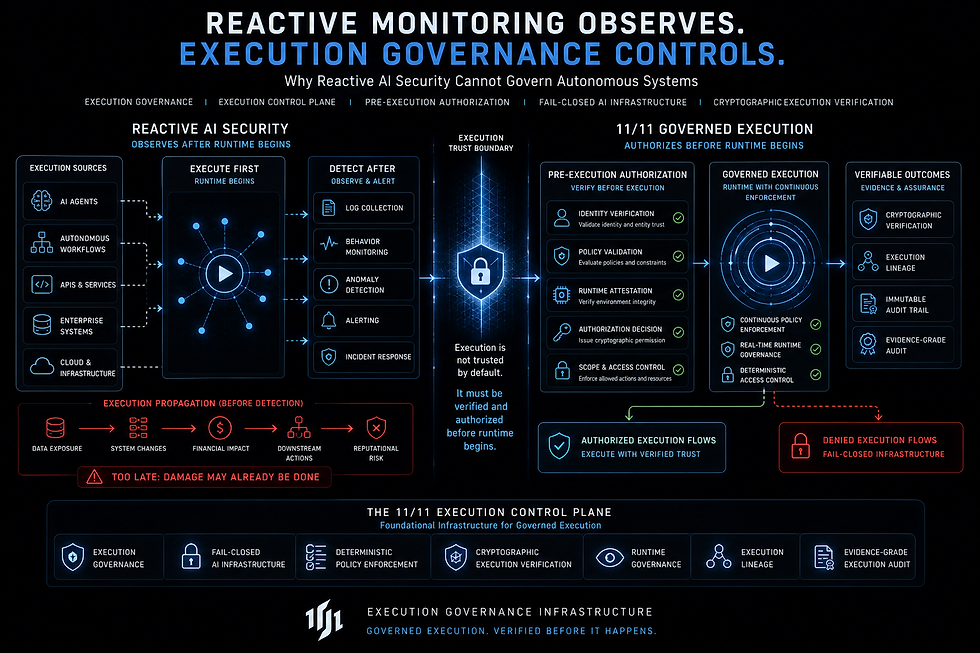
Modern infrastructure is entering an era where execution can no longer be trusted by default.
Historically, runtime systems often allowed execution automatically once a request reached the operational environment.
Security and governance systems usually acted afterward through:
monitoring
anomaly detection
incident response
post-execution audit
reactive containment
forensic review
That model becomes increasingly insufficient for autonomous systems and enterprise AI infrastructure.
As systems operate continuously at machine speed, the critical question becomes:
what happens when trust cannot be verified?
The fail-closed runtime model answers directly:
execution is denied.
What Fail-Closed Runtime Means
Fail-closed runtime infrastructure denies execution whenever governance validation fails.
Execution should not proceed when the system cannot verify:
authorization
runtime identity
policy compliance
environmental integrity
cryptographic validity
lineage continuity
governance state
Under this model, uncertainty does not produce permissive execution.
Uncertainty produces denial.
This creates:governed execution infrastructure.
Why Fail-Closed Matters
Open execution models assume runtime activity is permitted unless explicitly blocked.
This creates significant risk in autonomous environments.
If execution proceeds before validation, then:
unauthorized operations may occur
policy violations may propagate
runtime compromise may scale
autonomous systems may amplify failures
evidence may become incomplete
attribution may become fragmented
Fail-closed runtime infrastructure prevents this by denying execution until trust is established.
Failure to Verify Means Denial
Fail-closed runtime systems treat verification failure as an enforcement condition.
Execution denial may occur when there is:
no authorization artifact
invalid authorization signature
expired authorization window
policy mismatch
runtime identity inconsistency
environmental integrity failure
replay detection
revoked authorization
lineage discontinuity
governance state failure
Failure to verify is not a warning.
It is not deferred remediation.
It is not merely an alert.
It is execution denial.
Pre-Execution Authorization
Fail-closed runtime infrastructure depends upon pre-execution authorization.
Execution requests must first pass through:
policy authorities
authorization services
runtime verification systems
cryptographic trust layers
environmental validation systems
governance enforcement infrastructure
Execution becomes:
policy-aware
authorization-bound
cryptographically verifiable
operationally attributable
governance-controlled
Only after trust is established may execution proceed.
Authorization Artifacts
Authorization artifacts establish the runtime trust state required for fail-closed execution.
Artifacts may include:
execution scope
initiator identity
policy validation
environmental bindings
temporal validity
cryptographic signatures
governance metadata
operational attribution
If the artifact is missing, invalid, expired or mismatched, execution is denied.
Authorization therefore becomes infrastructure-native.
Runtime Verification
Fail-closed systems depend upon runtime verification.
Verification systems may validate:
authorization integrity
runtime identity
policy consistency
cryptographic signatures
environmental trust
governance metadata
execution lineage continuity
operational trust conditions
Execution should not proceed unless verification succeeds.
Runtime verification therefore becomes the gate between request and execution.
Execution Control Plane
The fail-closed runtime model is enforced by the execution control plane.
The execution control plane coordinates:
policy enforcement
authorization validation
runtime verification
execution gateway decisions
lineage tracking
immutable audit persistence
cryptographic trust validation
This establishes runtime governance as enforceable infrastructure.
Execution Gateways
Execution gateways enforce the final runtime decision.
They may:
allow execution when trust is verified
deny execution when validation fails
record governance outcomes
route verification decisions
preserve audit evidence
maintain lineage continuity
The gateway becomes the operational boundary between requested execution and governed execution.
Execution Lineage
Fail-closed runtime systems also depend upon execution lineage.
Lineage systems track:
authorization origin
execution inheritance
runtime trust relationships
governance continuity
policy authority relationships
distributed execution chains
If lineage continuity cannot be established, execution may be denied.
Lineage therefore becomes an enforcement input, not merely an audit output.
Immutable Audit
Fail-closed governance requires immutable audit infrastructure.
Audit systems persist:
authorization decisions
denial events
verification states
execution outcomes
cryptographic evidence
lineage relationships
Denial events are not failures of the system.
They are proof that governance is functioning.
Autonomous Systems Require Fail-Closed Runtime
Autonomous infrastructure can:
execute continuously
coordinate recursively
propagate decisions automatically
influence distributed systems
operate without direct human oversight
Reactive detection cannot safely govern this runtime velocity.
Autonomous systems require denial-by-default infrastructure when trust cannot be verified.
Fail-closed runtime becomes essential.
Infrastructure Is Evolving
Historically, infrastructure normalized:
encrypted transport
identity verification
Zero Trust networking
hardware trust anchors
Fail-closed runtime governance now emerges as the next foundational infrastructure requirement.
Execution itself must become governed before runtime activity occurs.
Infrastructure therefore shifts from:
trusted execution
to:
verified-or-denied execution.
Conclusion
The Fail-Closed Runtime Model establishes denial as foundational infrastructure for governed execution.
Under this model:
execution requires authorization
verification becomes mandatory
infrastructure denies untrusted activity
governance becomes runtime-enforced
audit becomes evidence-grade
lineage becomes operationally necessary
cryptographic trust becomes infrastructure-native
Execution can no longer proceed merely because it was requested.
Execution must first be verified.
If trust cannot be established, execution is denied.
That is the foundation of fail-closed AI infrastructure.
“Failure to verify is not a warning. It is an execution denial condition.”


Comments