
Governance Verification as a Runtime Requirement
- 11/11 AI

- May 25
- 3 min read

Artificial intelligence infrastructure is entering a new operational phase.
The market is shifting away from environments where governance exists primarily as:
policy interpretation
procedural oversight
post-event auditing
observational telemetry
retrospective compliance analysis
Autonomous infrastructure fundamentally changes these assumptions.
As machine-speed systems increasingly coordinate:
operational workflows
infrastructure orchestration
autonomous decision pathways
policy-bound execution
distributed runtime actions
cross-domain infrastructure operations
governance must evolve from:advisory oversight
to:runtime enforcement validation.
This transition is establishing governance verification as a runtime operational requirement.
Traditional infrastructure verification models primarily validate:
system availability
network integrity
identity assertions
infrastructure health
operational resiliency
Execution Governance™ introduces an additional requirement:verification of authorized execution itself.
This distinction is becoming operationally critical.
In autonomous infrastructure environments, the central governance question increasingly becomes:
“Was the execution authorized before runtime action occurred?”
Execution governance infrastructure operationalizes this through deterministic runtime verification.
Under governed execution architecture:
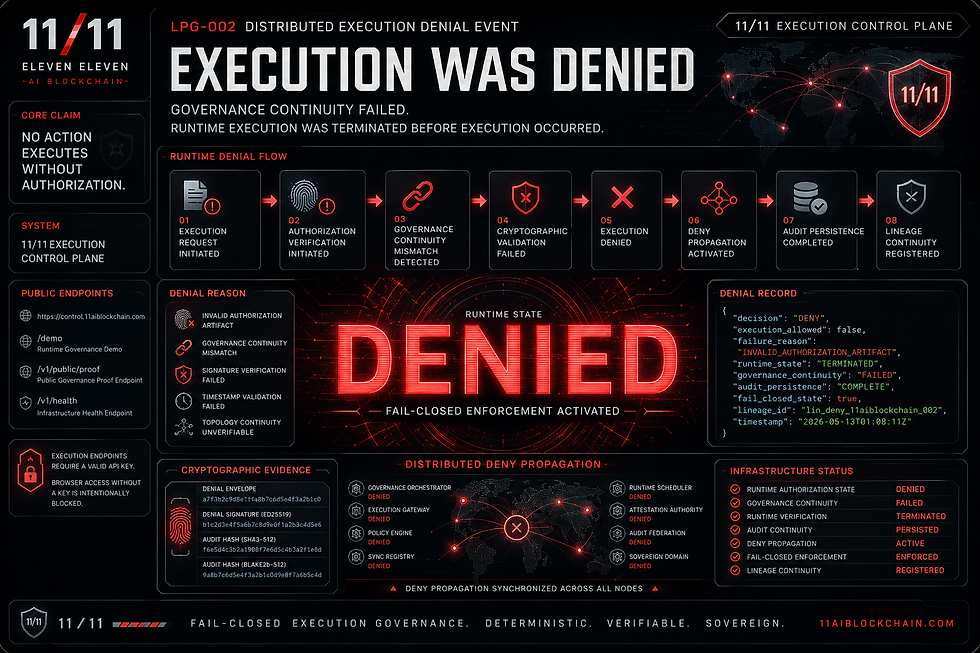
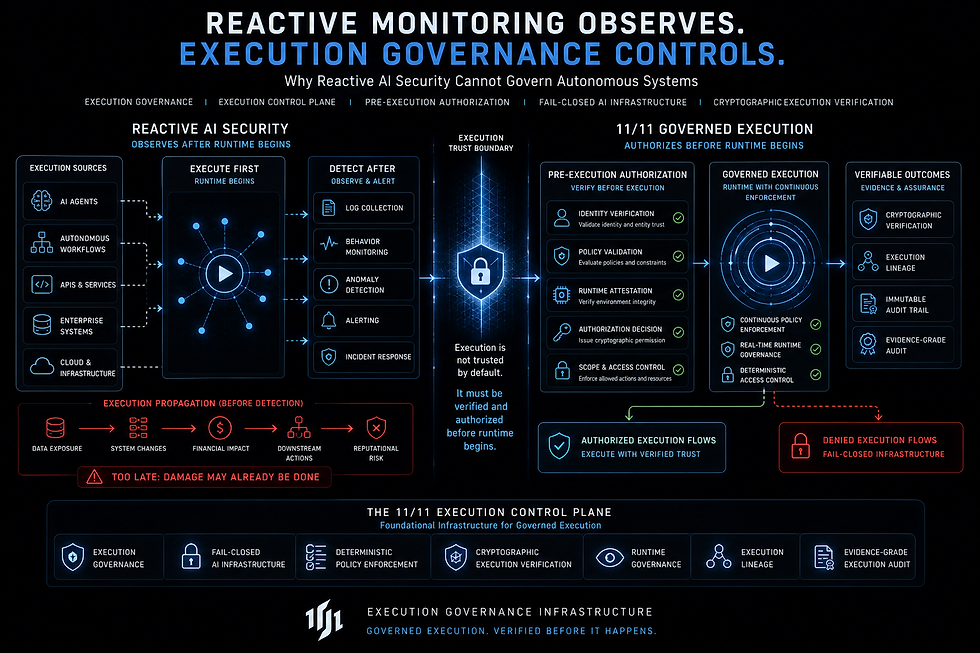
execution authorization is validated before action
runtime policy enforcement becomes deterministic
execution lineage is persistently recorded
governance attestation becomes externally verifiable
unauthorized runtime paths fail closed
authorization artifacts remain bound to execution events
This transforms governance from:a reporting function
into:a runtime infrastructure dependency.
The implications are substantial.
Autonomous systems increasingly operate across:
defense infrastructure
financial orchestration systems
healthcare automation
industrial control environments
sovereign compute ecosystems
national-scale infrastructure networks
Within these environments, infrastructure operators cannot depend solely upon:implicit trust assumptions.
Operational governance must become:verifiable at runtime.
Governance verification enables this transition.
Execution Governance Compatible (EGC) infrastructure therefore establishes operational mechanisms capable of validating:
authorization integrity
execution provenance
deterministic policy enforcement
runtime trust-boundary continuity
governance attestation legitimacy
fail-closed operational behavior
Importantly, this verification model remains implementation-neutral.
Infrastructure providers may implement differing:
runtime architectures
orchestration systems
execution environments
governance engines
policy frameworks
While still supporting interoperable governance verification semantics.
This interoperability is becoming increasingly important as autonomous systems scale across:
federal contractor ecosystems
coalition infrastructure environments
hybrid sovereign clouds
distributed operational systems
cross-domain compute environments
Without interoperable verification models, governance assurance becomes fragmented.
Execution governance infrastructure resolves this through:standardized runtime verification semantics.
This mirrors previous infrastructure normalization trends observed across:
Zero Trust Architecture
Kubernetes conformance ecosystems
identity federation systems
cryptographic attestation frameworks
secure orchestration environments
infrastructure verification layers
The convergence is accelerating.
Future procurement standards will increasingly evaluate whether infrastructure systems can:
prove authorized execution
validate runtime governance enforcement
preserve execution lineage continuity
maintain trust-boundary integrity
verify governance attestation evidence
support deterministic runtime enforcement
fail closed during authorization failure
This transforms governance verification into:procurement-critical infrastructure.
Not optional telemetry.
Not advisory policy analysis.
Operational runtime governance.
As autonomous infrastructure becomes embedded within:
national infrastructure systems
defense operational environments
industrial automation layers
financial execution systems
healthcare coordination platforms
sovereign AI ecosystems
Governance verification may become as foundational as:
encryption
identity validation
audit logging
infrastructure monitoring
cryptographic signing
runtime isolation
Execution Governance™ therefore represents the evolution from:observable infrastructure
to:verifiably governed execution systems.
Governance verification is becoming the operational mechanism through which autonomous infrastructure proves:
authorization legitimacy
runtime integrity
deterministic governance continuity
execution accountability
operational trust assurance
The organizations establishing runtime governance verification infrastructure today are likely defining:the future operational baseline for autonomous systems governance.
Internal Links
Execution Governance™
Governed Execution™
Public Runtime Infrastructure:
Execution Lineage Explorer:
No action executes without authorization.
RFC-EG Reinforcement:
RFC-EG-011, RFC-EG-017, RFC-EG-021, RFC-EG-026, RFC-EG-031, RFC-EG-036
Ecosystem Expansion:
Runtime Verification Layer
Governance Attestation Layer
Execution Lineage Layer
Deterministic Enforcement Layer
EGC Conformance Ecosystem
11/11 introduces Execution Governance™ infrastructure for governed autonomous execution and deterministic operational trust.
Execution Governance™ Governed Execution™ Patent Pending

Comments