
Governed Execution for Autonomous Systems


Runtime Governance for the Autonomous Era
Autonomous systems fundamentally change infrastructure requirements.
Historically, most software environments operated with significant human oversight.
Execution decisions remained constrained by:
manual review
operational supervision
human authorization
isolated workflows
slower execution cycles
limited runtime autonomy
That operational model is rapidly disappearing.
AI systems increasingly coordinate:
infrastructure operations
enterprise automation
financial execution
distributed orchestration
machine-level workflows
healthcare operations
critical infrastructure systems
As runtime autonomy expands, execution itself becomes the trust boundary.
This fundamentally changes infrastructure assumptions.
Autonomous systems now require:governed execution.
Why Autonomous Systems Change Everything
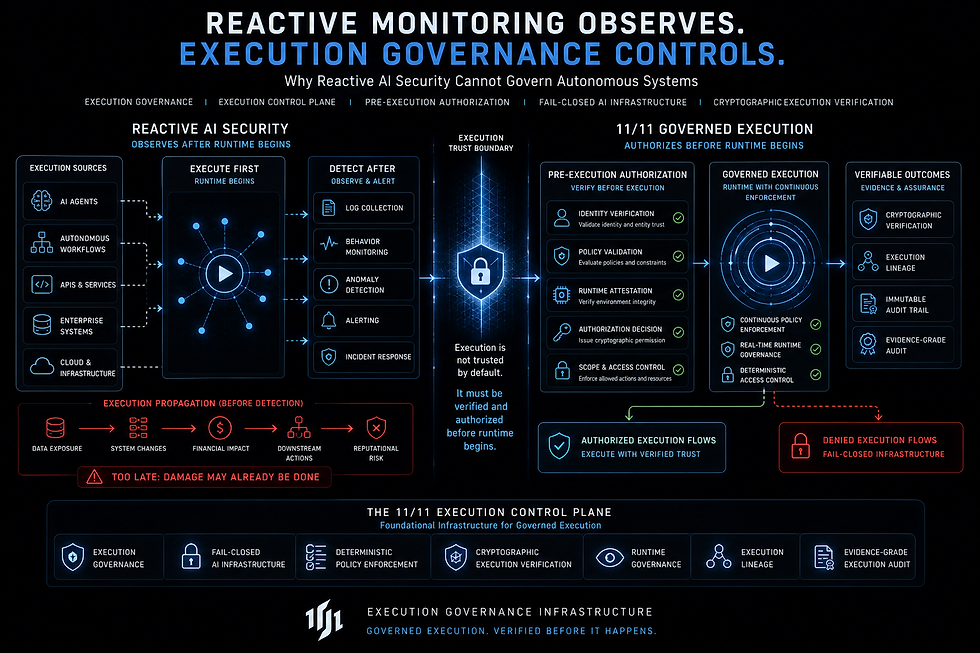
Traditional infrastructure models largely assumed:
execution could be trusted by default.
If execution was requested, runtime systems generally permitted execution automatically.
Verification often happened later through:
monitoring
logging
anomaly detection
post-execution review
reactive security controls
This becomes structurally insufficient for autonomous systems.
Autonomous infrastructure can execute:
continuously
independently
recursively
at machine speed
across distributed environments
without direct human oversight
Reactive governance cannot sufficiently secure environments operating at autonomous runtime velocity.
Execution must therefore become governed before runtime activity begins.
What Governed Execution Means
Governed execution establishes mandatory runtime governance before execution occurs.
Execution becomes conditional upon:
authorization validation
policy enforcement
runtime verification
environmental trust
cryptographic integrity
governance approval
operational attribution
Execution therefore no longer proceeds automatically.
Trust must first be established.
This creates:governed runtime infrastructure.
Autonomous Systems Require Runtime Trust
Autonomous systems require runtime trust architecture.
Infrastructure must continuously verify:
execution authorization
runtime identity
policy compliance
environmental integrity
execution lineage
cryptographic validity
operational governance state
Without runtime trust enforcement, autonomous systems create escalating operational risk.
As autonomy scales, runtime governance becomes foundational infrastructure.
The Failure of Open Execution
Open execution environments assume runtime activity is permitted unless explicitly blocked.
This creates dangerous conditions for autonomous infrastructure.
In open execution systems:
unauthorized execution may propagate rapidly
policy violations may cascade
machine coordination may amplify compromise
runtime drift may spread operationally
attribution may become unclear
post-execution detection may occur too late
Autonomous systems therefore cannot safely rely upon open execution assumptions.
They require fail-closed governance models.
Fail-Closed Autonomous Infrastructure
Governed autonomous systems require fail-closed infrastructure enforcement.
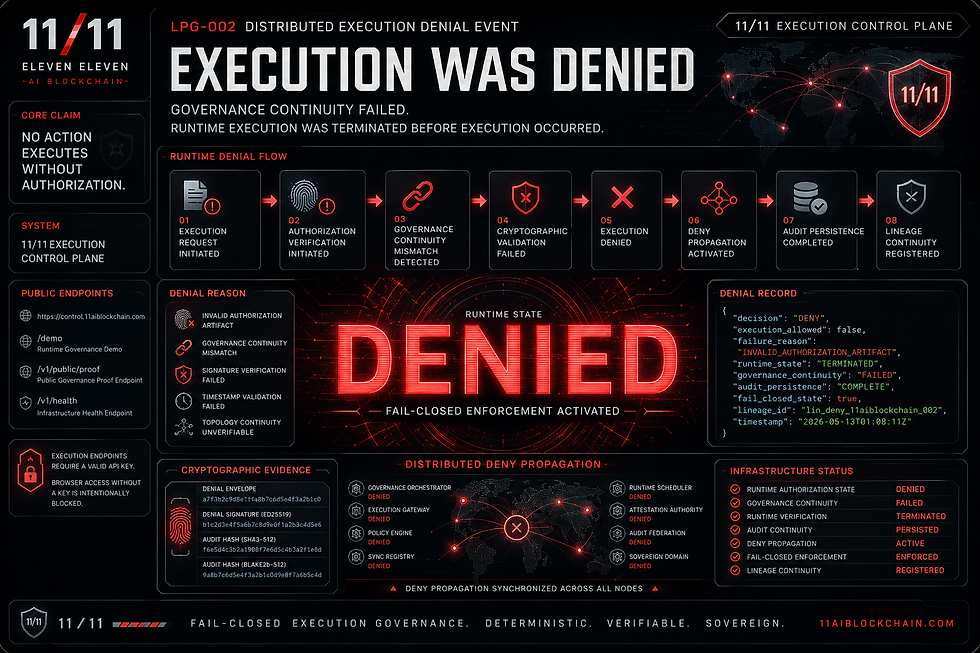
Execution must be denied whenever governance validation fails.
Denial conditions may include:
missing authorization
invalid signatures
policy mismatch
runtime identity failure
environmental integrity issues
replay detection
revoked authorization
lineage inconsistency
Failure to verify therefore results in denial.
Not warning.Not deferred remediation.Not reactive observation.
Denial.
This transforms governance into an enforceable infrastructure capability.
Authorization Artifacts
Authorization artifacts establish runtime trust for autonomous systems.
Artifacts may include:
execution scope
initiator identity
runtime environment binding
authorization validity
cryptographic signatures
governance metadata
temporal constraints
operational attribution
Execution should not occur without valid authorization artifacts.
Authorization therefore becomes infrastructure-native.
Runtime Verification
Governed autonomous systems require continuous runtime verification.
Verification systems may validate:
authorization integrity
runtime identity
cryptographic signatures
policy consistency
environmental bindings
execution lineage
operational trust conditions
governance ancestry
This creates:
evidence-grade verification
immutable execution audit
runtime accountability
forensic traceability
operational attribution
Execution therefore becomes:cryptographically governed.
Governance Mesh Architecture
As autonomous systems scale, governance must operate across distributed runtime environments.
Governance mesh architectures establish coordinated runtime enforcement across:
multi-agent systems
distributed runtimes
enterprise orchestration environments
machine-level infrastructure
multi-cloud execution systems
autonomous workflow environments
This creates governance continuity across autonomous runtime infrastructure.
Execution Lineage
Autonomous systems also require execution lineage infrastructure.
Execution lineage establishes traceable ancestry across runtime operations.
Lineage systems track:
authorization origin
execution inheritance
policy authority relationships
governance dependencies
distributed execution chains
runtime verification states
Execution therefore becomes:
attributable
traceable
auditable
verifiable
evidence-capable
This becomes essential for autonomous operational accountability.
The Infrastructure Transition
Historically, infrastructure normalized:
encrypted transport
identity verification
Zero Trust networking
hardware trust anchors
Governed execution now emerges as the next foundational infrastructure layer.
Execution itself must become governed before runtime activity occurs.
Infrastructure therefore shifts from:
trusted execution
to:
authorized execution.
Autonomous Infrastructure Requires Governance
Autonomous systems cannot safely operate without:
runtime verification
authorization enforcement
deterministic policy control
fail-closed execution
cryptographic governance
immutable audit
execution lineage
operational trust enforcement
Governance therefore becomes:core infrastructure architecture for autonomous systems.
Conclusion
Governed execution establishes the runtime trust model required for autonomous infrastructure environments.
Under this model:
execution requires authorization
runtime governance becomes foundational
infrastructure fails closed
verification becomes continuous
cryptographic trust becomes operationally necessary
execution becomes attributable
lineage becomes infrastructure-native
Autonomous systems can no longer safely operate under open execution assumptions.
Execution must first become governed.
Governed execution is becoming foundational infrastructure for the autonomous era.
“Autonomous systems cannot safely operate under open execution assumptions.”

Comments