
Why Global Financial Infrastructure Requires Execution Governance

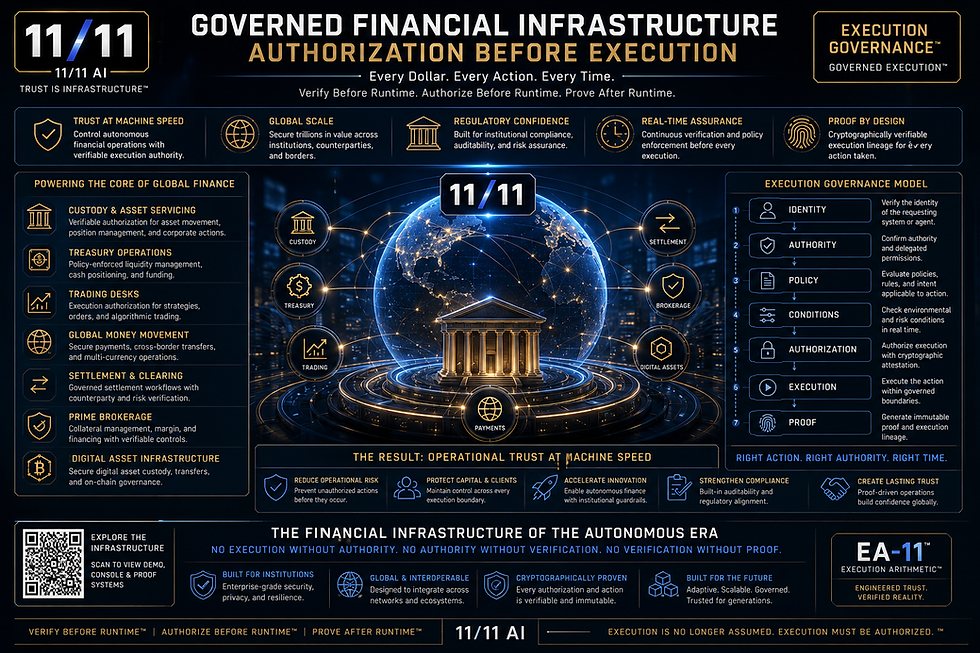
Modern financial infrastructure is built on trust.
Not trust in people.
Trust in systems.
Every day, global financial institutions move trillions of dollars through interconnected networks spanning:
Custody Platforms
Treasury Operations
Settlement Systems
Prime Brokerage
Capital Markets
Securities Processing
Cross-Border Payments
Liquidity Management
Trade Execution
Digital Asset Infrastructure
These systems have evolved over decades to achieve extraordinary levels of reliability.
Yet a new challenge is emerging.
Artificial intelligence is rapidly becoming embedded within financial operations.
AI systems are increasingly being used to:
Evaluate transactions
Route payments
Analyze market conditions
Manage liquidity
Execute trading strategies
Monitor compliance
Authorize operational workflows
Support treasury decisions
Coordinate settlement operations
The industry has largely focused on model performance.
However, the larger question is becoming operational authority.
As AI gains access to financial systems, who authorizes execution?
This is not a theoretical concern.
A single unauthorized action within institutional infrastructure can affect:
Millions of accounts
Billions in settlement value
Global counterparties
Treasury balances
Market positions
Regulatory obligations
The challenge is not whether AI can make decisions.
The challenge is determining whether AI should be permitted to execute those decisions.
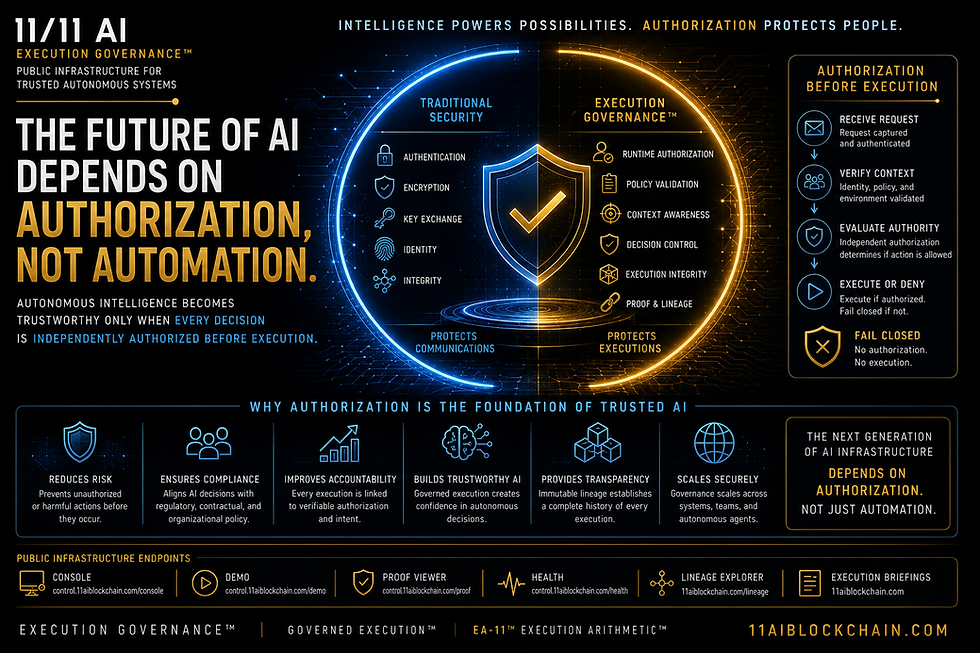
Current financial controls focus primarily on:
Identity
Authentication
Role-based access
Segregation of duties
Approval workflows
Post-event auditing
These controls were designed for human operators.
Agentic systems introduce a fundamentally different execution model.
A system may generate thousands of decisions per second.
A system may coordinate actions across multiple platforms.
A system may dynamically interact with tools, APIs, and counterparties.
Traditional approval structures do not scale to autonomous execution.
This creates an authorization gap.
Execution Governance closes that gap.
Execution Governance introduces a dedicated authorization layer between decision generation and execution.
Before any action occurs, the system must establish:
Who initiated the action.
What authority exists.
Which policies apply.
Which controls are required.
Whether environmental conditions are satisfied.
Whether execution is permitted.
Only then can execution proceed.
This architecture transforms financial governance from reactive oversight into proactive control.
The model becomes:
Verify Before Runtime.
Authorize Before Runtime.
Execute Under Policy.
Generate Proof After Runtime.
This creates a financial execution fabric capable of supporting autonomous operations while maintaining institutional control.
For global custody organizations, Execution Governance provides verifiable authorization lineage for asset movement.
For treasury organizations, it provides policy-enforced liquidity controls.
For trading operations, it provides execution authorization boundaries.
For payment networks, it provides transaction-level governance validation.
For digital asset infrastructure, it provides cryptographically verifiable execution authority.
The result is not merely better compliance.
The result is operational trust at machine speed.
The next generation of financial infrastructure will not be defined solely by artificial intelligence.
It will be defined by controlled artificial intelligence.
Financial institutions already understand this principle.
Every dollar movement requires authorization.
Every settlement requires validation.
Every trade requires authority.
The same principle must now extend to autonomous systems.
As financial organizations adopt AI, the infrastructure challenge becomes clear:
How do we prove that a system was authorized to act?
Execution Governance provides that answer.
Not after execution.
Before execution.
Because in financial infrastructure, trust is not created by observation.
Trust is created by authorization.
And authorization is becoming the foundation of machine-scale finance.
The future of custody, treasury, trading, and global money movement will depend upon a simple principle:
No execution without authority.
No authority without verification.
No verification without proof.
That is the foundation of Governed Financial Infrastructure.
Public Infrastructure Endpoints
Public Runtime Infrastructure
Public Governance Consolehttps://control.11aiblockchain.com/console
Runtime Governance Demohttps://control.11aiblockchain.com/demo
Public Governance Proof Viewerhttps://control.11aiblockchain.com/proof
Infrastructure Health Dashboardhttps://control.11aiblockchain.com/health
Execution Lineage Explorerhttps://www.11aiblockchain.com/lineage
Execution Governance™
Governed Execution™
EA-11™ Execution Arithmetic™
Patent Pending
Public Infrastructure Endpoints
11/11 AI Research Division
Trust Is Infrastructure™
Verify Before Runtime™Authorize Before Runtime™Prove After Runtime™
Execution Is No Longer Assumed.Execution Must Be Authorized™


Comments