
Immutable Execution Audit as Infrastructure


Establishing Evidence-Grade Runtime Accountability
Modern infrastructure increasingly depends upon operational trust.
Historically, audit systems primarily focused on:
log collection
event retention
compliance reporting
incident reconstruction
operational visibility
post-execution analysis
These systems improved observability.
However, observability alone does not establish trustworthy execution infrastructure.
As autonomous systems scale, infrastructure now requires:
immutable runtime evidence
verifiable operational attribution
lineage continuity
cryptographic audit integrity
governance persistence
execution accountability
This establishes:immutable execution audit infrastructure.
What Immutable Execution Audit Means
Immutable execution audit establishes tamper-evident runtime evidence across execution systems.
Audit infrastructure preserves:
authorization decisions
verification states
execution outcomes
runtime identity continuity
policy enforcement events
denial conditions
lineage relationships
cryptographic evidence
Execution therefore becomes:
traceable
attributable
verifiable
auditable
evidence-capable
Audit evolves from:record keeping
to:
runtime trust infrastructure.
Why Traditional Audit Is Insufficient
Traditional audit systems often depend upon mutable operational logs.
This creates structural weaknesses.
Mutable audit systems may suffer from:
incomplete attribution
fragmented evidence
trust discontinuity
unverifiable execution history
operational tampering
post-event reconstruction failure
Autonomous systems operating continuously at machine speed cannot safely depend upon mutable audit assumptions.
Infrastructure therefore requires immutable execution evidence.
Autonomous Systems Require Immutable Audit
Autonomous infrastructure increasingly coordinates:
enterprise orchestration
distributed runtime execution
machine-level automation
financial infrastructure
healthcare operations
autonomous agents
critical operational systems
These systems operate:
continuously
recursively
autonomously
globally
at machine speed
Without immutable audit infrastructure:
attribution weakens
evidence continuity breaks
governance drift expands
runtime accountability collapses
forensic reconstruction becomes unreliable
Immutable audit therefore becomes foundational runtime infrastructure.
Immutable Audit and Governed Execution
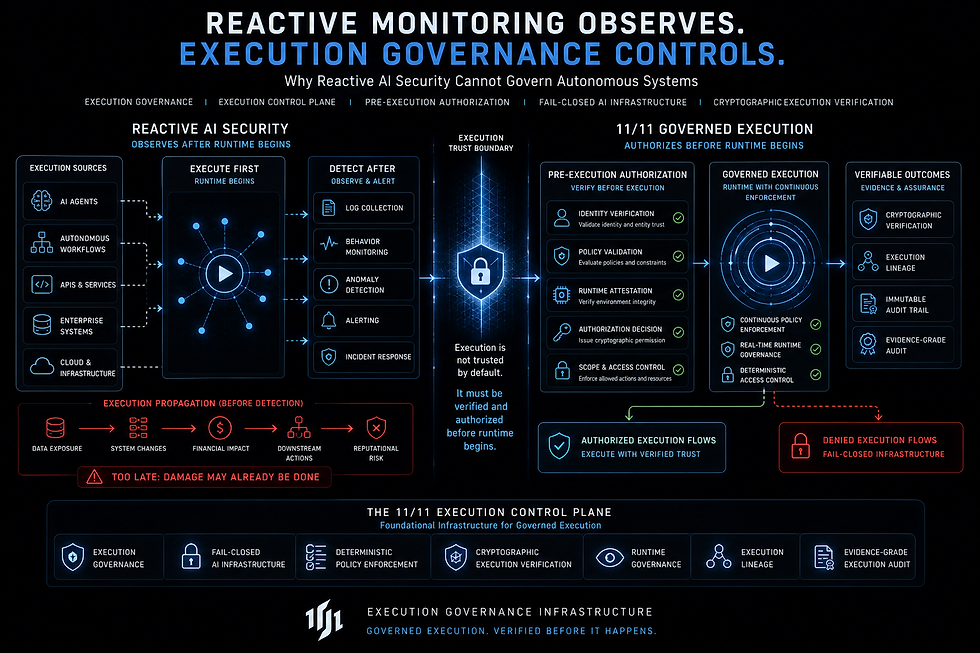
Governed execution depends upon immutable audit continuity.
Execution governance requires infrastructure capable of proving:
authorization validity
runtime trust continuity
policy enforcement
execution lineage
governance continuity
operational attribution
Execution therefore cannot simply be monitored.
Execution must become provable.
Immutable audit establishes that proof layer.
Runtime Verification and Audit Integrity
Immutable audit systems continuously preserve runtime trust conditions.
Audit infrastructure may record:
authorization artifacts
runtime verification states
cryptographic signatures
environmental trust conditions
lineage continuity
governance metadata
operational attribution
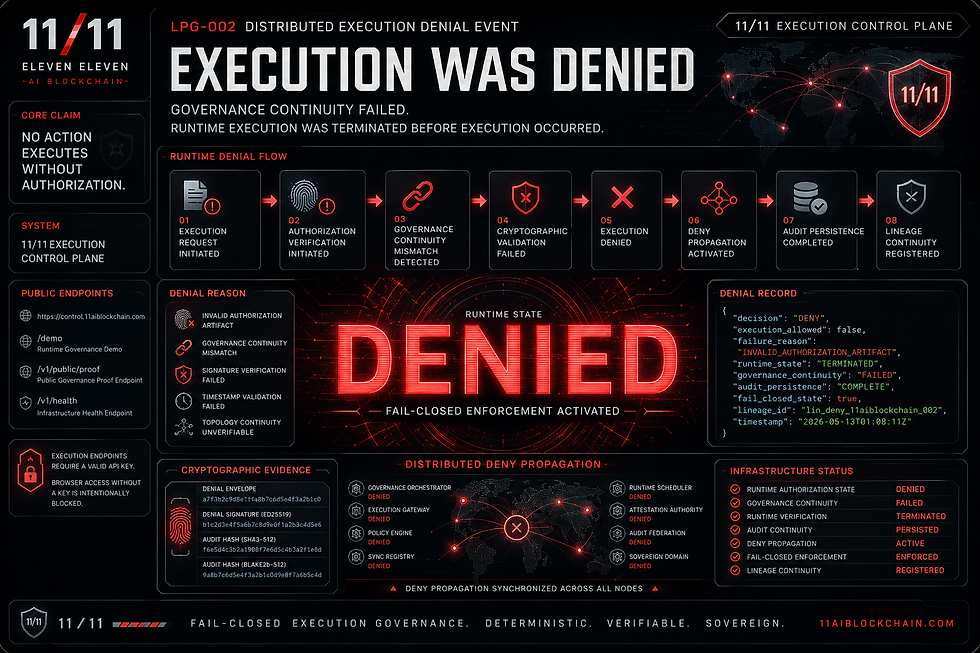
denial outcomes
This transforms audit into:continuous runtime evidence infrastructure.
Pre-Execution Authorization Persistence
Immutable audit infrastructure also preserves pre-execution authorization continuity.
Audit systems may persist:
policy evaluations
authorization decisions
trust validation states
execution gateway decisions
environmental validation
runtime identity continuity
Execution therefore becomes permanently attributable to governance decisions.
Authorization Artifacts and Immutable Evidence
Authorization artifacts establish foundational runtime evidence relationships.
Artifacts may include:
execution scope
temporal validity
policy validation
runtime identity bindings
cryptographic signatures
governance metadata
operational attribution
environmental conditions
Immutable audit infrastructure preserves these relationships across execution lifecycles.
Artifacts therefore become:persistent runtime trust evidence.
Execution Lineage and Audit Continuity
Immutable audit systems also depend upon execution lineage continuity.
Lineage systems preserve:
authorization origin
governance ancestry
runtime trust relationships
distributed execution inheritance
policy authority continuity
operational attribution chains
Execution therefore becomes:
traceable
attributable
verifiable
auditable
evidence-capable
Lineage continuity strengthens immutable audit integrity.
Fail-Closed Audit Integrity
Immutable audit infrastructure also supports fail-closed governance.
Execution may be denied whenever audit integrity conditions fail.
Denial conditions may include:
missing audit continuity
invalid evidence chains
lineage discontinuity
unverifiable authorization history
runtime attribution failure
governance evidence inconsistency
Failure to establish audit continuity therefore becomes a runtime governance condition.
Cryptographic Audit Verification
Immutable execution audit increasingly depends upon cryptographic verification systems.
Verification may include:
cryptographic evidence chains
authorization signatures
runtime integrity
lineage continuity
distributed trust validation
immutable persistence validation
operational attribution
governance ancestry
This creates:
evidence-grade verification
immutable runtime accountability
forensic traceability
operational trust continuity
governance persistence
Execution therefore becomes:cryptographically auditable infrastructure.
Governance Mesh Audit Continuity
Distributed governance environments require immutable audit continuity across governance meshes.
Audit infrastructure increasingly operates across:
distributed runtimes
multi-cloud environments
autonomous orchestration systems
machine-level execution systems
enterprise governance meshes
distributed AI coordination layers
Audit therefore becomes:distributed runtime evidence infrastructure.
Infrastructure Is Evolving
Historically, infrastructure normalized:
encrypted transport
identity verification
Zero Trust networking
hardware trust anchors
Immutable execution audit now emerges as the next foundational infrastructure layer.
Execution itself must become permanently attributable and verifiable.
Infrastructure therefore shifts from:
observable execution
to:
evidence-grade execution.
Conclusion
Immutable execution audit establishes the evidence layer required for governed execution infrastructure.
Under this model:
execution becomes permanently attributable
audit becomes immutable
runtime governance becomes provable
verification becomes evidence-grade
lineage becomes operationally necessary
cryptographic trust becomes infrastructure-native
execution becomes continuously auditable
Execution can no longer remain operationally opaque.
Infrastructure must now produce immutable runtime evidence.
Immutable execution audit is becoming foundational infrastructure for the autonomous era.
“Execution without immutable audit cannot produce trustworthy infrastructure.”

Comments