
Why Infrastructure Trust Must Shift From Detection to Authorization


The Runtime Trust Model Is Changing
Modern infrastructure is entering a new operational trust era.
Historically, most runtime systems operated under implicit execution assumptions.
Execution generally proceeded automatically once requests reached runtime environments.
Security systems largely focused on:
monitoring
anomaly detection
incident response
post-execution audit
reactive containment
forensic reconstruction
This operational model emerged during an era where systems were:
slower
less autonomous
human-supervised
operationally constrained
more centralized
That environment no longer exists.
AI systems increasingly coordinate:
enterprise infrastructure
financial operations
distributed orchestration
autonomous workflows
machine-level execution
healthcare systems
critical infrastructure environments
As runtime autonomy expands, execution itself becomes the trust boundary.
Infrastructure trust therefore must evolve.
The Failure of Detection-Based Trust
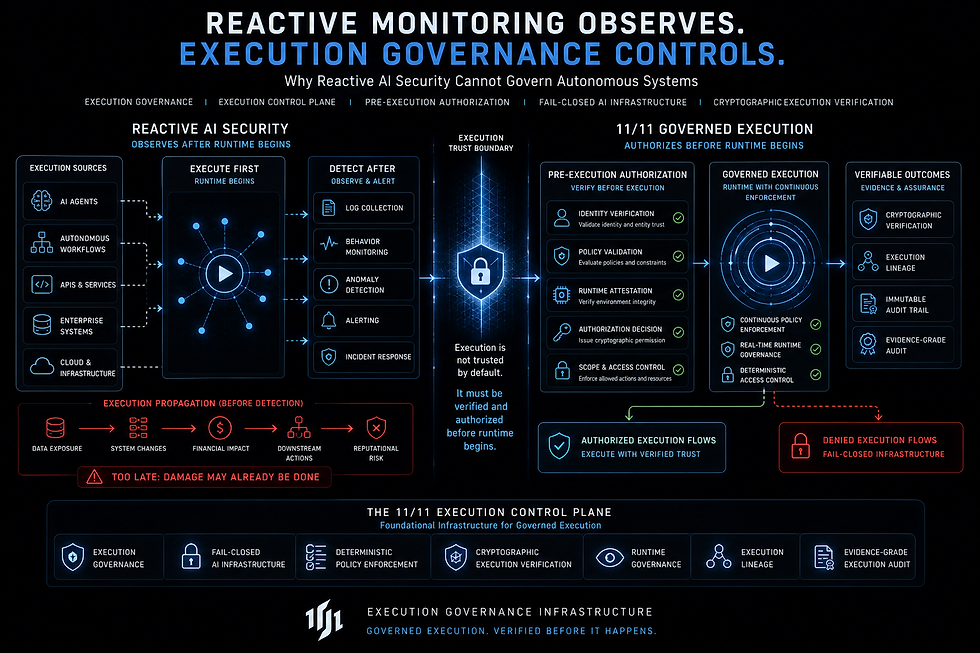
Traditional security systems fundamentally depend upon detecting compromise after execution already occurred.
This creates a structural limitation.
By the time reactive systems identify:
unauthorized execution
policy violations
runtime compromise
operational drift
autonomous propagation
execution already happened.
For autonomous infrastructure operating continuously at machine speed, this delay becomes operationally dangerous.
Detection after execution can no longer sufficiently establish runtime trust.
Visibility Does Not Equal Trust
Modern infrastructure often confuses visibility with governance.
Organizations may possess:
telemetry systems
centralized logging
SIEM dashboards
runtime monitoring
anomaly detection
observability tooling
These systems improve visibility.
However, visibility alone does not establish runtime trust.
Monitoring what happened does not prevent unauthorized execution from occurring.
Infrastructure therefore requires something more foundational:
authorization before execution.
What Authorization-Based Trust Means
Authorization-based trust establishes runtime governance before execution activity begins.
Execution becomes conditional upon:
authorization validation
runtime verification
policy enforcement
environmental trust validation
cryptographic integrity
governance continuity
operational attribution
Execution therefore no longer proceeds automatically.
Trust must first be established.
This creates:governed execution infrastructure.
Runtime Verification
Authorization-based trust depends upon runtime verification systems.
Verification engines may validate:
authorization integrity
runtime identity
policy consistency
cryptographic signatures
environmental trust
governance metadata
execution lineage continuity
operational trust conditions
Execution should not proceed unless verification succeeds.
This transforms trust into:runtime-enforced infrastructure.
Pre-Execution Authorization
Infrastructure trust increasingly requires pre-execution authorization.
Execution requests must first pass through:
policy authorities
authorization services
runtime verification engines
cryptographic trust layers
governance enforcement infrastructure
environmental validation systems
Execution therefore becomes:
policy-aware
authorization-bound
cryptographically verifiable
operationally attributable
governance-controlled
Infrastructure therefore shifts from:
trusted execution
to:
authorized execution.
Authorization Artifacts
Authorization artifacts establish runtime trust continuity.
Artifacts may include:
execution scope
initiator identity
policy validation
environmental bindings
temporal validity
cryptographic signatures
governance metadata
operational attribution
Execution should not occur without valid authorization artifacts.
Authorization therefore becomes infrastructure-native.
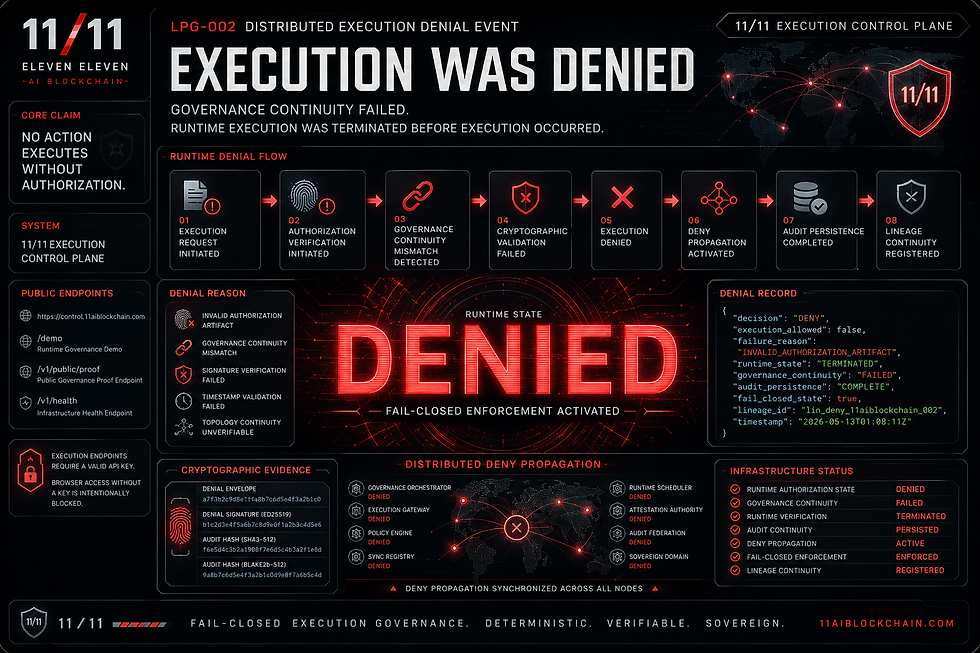
Fail-Closed Governance
Authorization-based infrastructure requires fail-closed enforcement.
Execution must be denied whenever trust validation fails.
Denial conditions may include:
missing authorization
invalid signatures
policy mismatch
replay detection
runtime identity inconsistency
environmental integrity failure
revoked authorization
lineage discontinuity
Failure to verify therefore results in denial.
Not observation.Not delayed remediation.Not reactive monitoring.
Denial.
This transforms governance into operational runtime infrastructure.
Autonomous Infrastructure Requires Authorization
Autonomous systems dramatically increase the need for authorization-based trust.
Autonomous infrastructure can:
execute continuously
coordinate recursively
scale globally
propagate decisions automatically
influence distributed systems
operate without direct human oversight
Reactive detection models cannot safely govern autonomous execution at scale.
Autonomous systems therefore require:
governed execution
runtime verification
authorization enforcement
fail-closed infrastructure
execution lineage
immutable audit
governance continuity
cryptographic trust validation
Authorization therefore becomes foundational infrastructure.
Execution Lineage
Authorization-based infrastructure also depends upon execution lineage systems.
Lineage establishes traceable runtime ancestry across execution operations.
Lineage systems track:
authorization origin
execution inheritance
governance continuity
runtime trust relationships
distributed execution chains
policy authority relationships
Execution therefore becomes:
traceable
attributable
verifiable
auditable
evidence-capable
Execution lineage becomes foundational for autonomous accountability.
Cryptographic Verification
Authorization-based infrastructure increasingly depends upon cryptographic verification systems.
Verification may include:
authorization signatures
runtime integrity
governance ancestry
distributed trust validation
immutable evidence persistence
policy consistency
operational attribution
execution lineage continuity
This creates:
evidence-grade verification
immutable execution audit
operational trust continuity
forensic traceability
runtime accountability
Execution therefore becomes:cryptographically governed.
Infrastructure Trust Is Evolving
Historically, infrastructure normalized:
encrypted transport
identity verification
Zero Trust networking
hardware trust anchors
Infrastructure trust now evolves toward:
governed execution
runtime authorization
continuous verification
fail-closed governance
immutable audit
execution lineage
cryptographic trust validation
Execution itself must become authorized before runtime activity occurs.
Conclusion
Infrastructure trust is shifting from reactive detection toward pre-execution authorization and governed execution.
Under this model:
execution requires authorization
runtime governance becomes foundational
infrastructure fails closed
verification becomes continuous
execution becomes attributable
lineage becomes operationally necessary
cryptographic trust becomes infrastructure-native
Execution can no longer remain implicitly trusted.
Trust must first be authorized before execution begins.
Authorization-based infrastructure trust is becoming foundational for the autonomous era.
“Detection after execution is no longer sufficient for autonomous infrastructure.”

Comments